

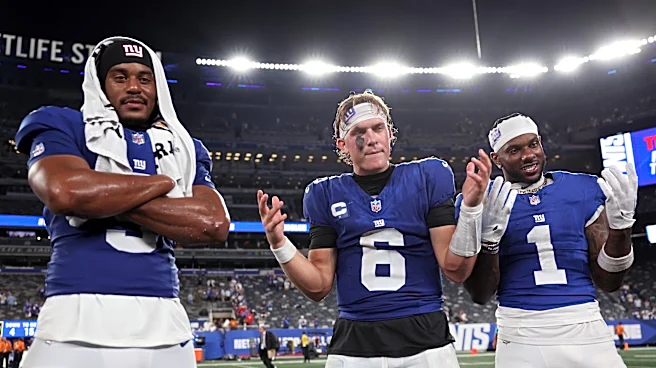
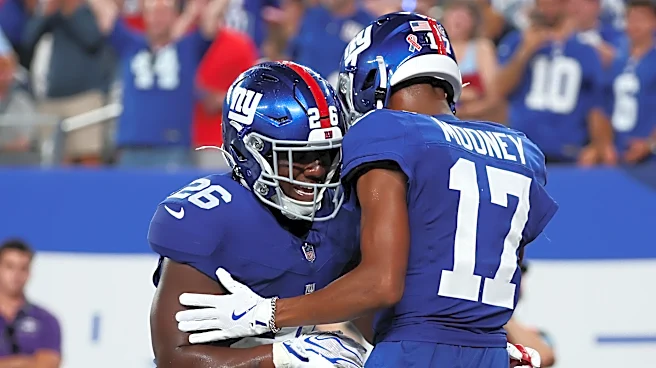
The New York Giants are off to a 1-0 start on the 2026 season after a statement win at home on Sunday Night Football.
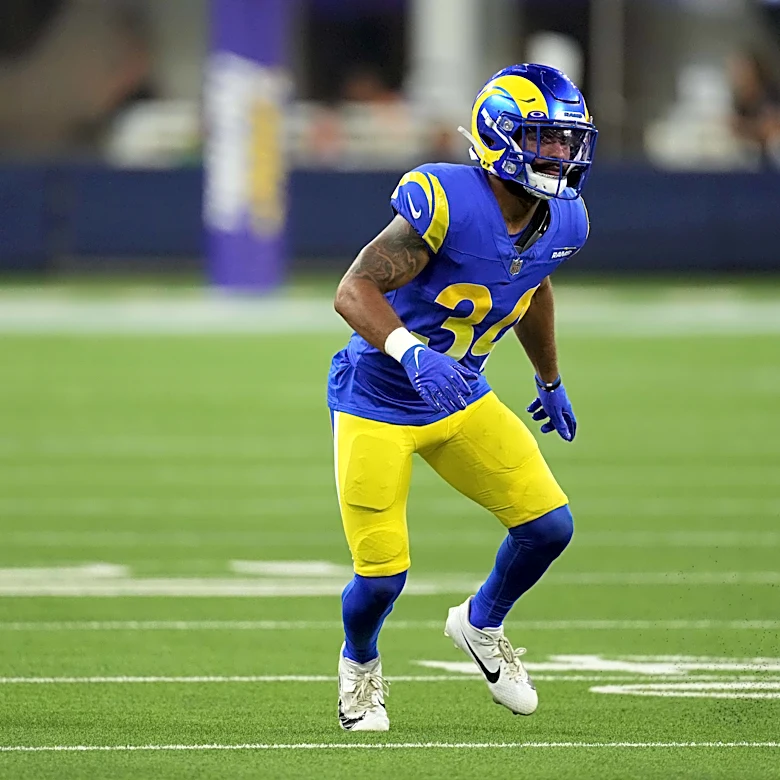
Now the Giants will have to travel across the country to take on the Los Angeles Rams on Monday Night Football.
Where the Giants were 3-point underdogs at home against the Dallas Cowboys to open the season, Las Vegas sees a significantly higher hill to climb for the Giants against the Rams. Despite coming out flat and taking an embarrassing loss in Australia to the San Francisco 49ers,
and losing Myles Garrett to a knee injury, the Rams are still 7.5-point favorites over the Giants as of this writing.
The Giants’ offense was the big surprise of the night against the Cowboys. It was punishing and methodical, allowing the Giants to utterly dominate the time of possession and allowed just two Dallas possessions in the entire second half. However, as many folks in the national media are quick to point out, Dallas’ defense was terrible in 2025.
Can the Giants do it against a good defense?
Let’s see what the Giants’ offense is up against in a Los Angeles Rams defense that has to be eager to make up for their week 1 performance
Tighten up ball security
The Giants’ win over the Cowboys was fantastic. They fielded a punishing run game that was married with a surgical passing attack. Even when the Giants weren’t able to be successful running the ball on early downs, their passing attack was there to pick up the slack and keep offense on the field.
That said, the Giants’ methodical offense masked a pretty significant wart: They got lucky with turnovers.
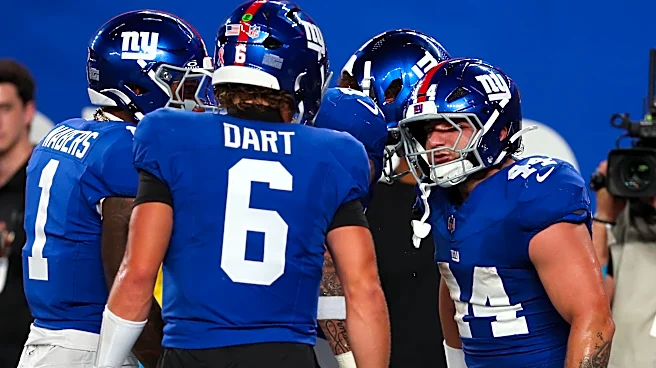
Isaiah Likely, Cam Skattebo, Jaxson Dart, and Tyrone Tracy all lost their handle on the ball. The Giants were, frankly, lucky that they were able to recover the ball on three of those fumbles. It was unfortunate that Tracy’s fumble was the one the Giants lost, as he was the least deserving of criticism — he had the ball high and tight with two arms on the ball. It was a great play by Quinnen Williams to punch it out, but it also ended Tracy’s night.
In the other cases, the players in question have aspects of their game that need attention.
To start, Jaxson Dart needs to be more aware of slot blitzes from his right. Twice he has been caught unaware and hit hard by a blitzing defensive back who walks up to the line late. And while the sack in the preseason could fall on Tracy’s shoulders for a missed blitz pickup, the sack-fumble caused by Caleb Downs’ blitz falls squarely on Dart. Even though the Rams didn’t send these types of blitzes frequently last year, the Giants should expect to see them until Dart proves he can make the defense pay for sending pressure. We could see more passes to the offensive right, throwing into the void created by sending the rusher. We could also see the Giants emphasizing hot routes when they alert to a potential blitz.
The fumbles by Likely and Skattebo could both be chalked up to the players trying to do too much.
In Likely’s case, he took a hand off the ball to stiff-arm a Dallas defender while a second defender came up to punch the ball out from behind. Likely caught the ball on a quick stick route over the middle, and he was attempting to pick up yards after the catch.
Similarly, Skattebo was carrying the ball on a toss play, and picking his way through traffic. Unlike Tracy, Skattebo only had one hand on the ball and was carrying it rather low and away from his body. That made it much more likely that he would lose control as he was bouncing off of hits. The lesson for both Skattebo and Likely is to avoid compromising ball security to pick up extra yardage.
The team won’t be nearly so lucky next time.
Another Fangio-adjacent defense
It was a pleasant surprise that the Giants were able to do pretty much whatever they wanted agaisnt the Cowboys’ defense.
Offseason excitement for Caleb Downs and Christian Parker aside, some of the Giants’ worst performances came against Vic Fangio-style defenses last year. Most notably, of course, was the Week 8 game against the Philadelphia Eagles and Fangio himself. As we covered last week, Parker is a Fangio disciple and was expected to bring elements of the Eagles’ defense to the Cowboys. And the scheme was similar, but people perhaps overestimated how quickly it would be up and running.
That isn’t the case with Chris Shula and the Rams.
Shula is, broadly speaking, a “Fangio-Adjacent” defensive mind. His scheme is an off-shoot of the “Fangio” system that’s taken over the NFL as a way to limit the league’s explosive passing attacks. The general shape of the defense is familiar at this point: A front that’s based in 3-4 principles but frequently uses a 4-2-5 nickel set. The secondary is based on two-deep principles, but consistently rotates coverages to muddy reads, disrupt offenses’ timing, and to change box math in the run game.
However, Shula also coached under Wade Phillips and incorporates some of Phillips’ defensive principles into his scheme.
For instance, where “Fangio” defenses typically begin in a Cover 4 or Quarters look and rotate to a Cover 3, Cover 6, or Cover 8 look, Shula instead likes to open in a Cover-3 look and rotate to a split-field look (such as Cover 2 or Cover 4). Shula has also mastered using stunts to isolate his rushers and create free runs into the backfield, as well as to improve box math in his favor when playing nickel sets.
One of the biggest questions hanging over the game is whether future Hall Of Fame defensive tackle Aaron Donald will play. The Rams are being coy about Donald’s status, but the Giants are expecting the perennial All-Pro to be there. While Donald hasn’t played football in two years, he remains one of the freakiest athletes to ever play the game. The Giants should plan on having to counter his explosiveness and agility, and do so in the context of the Rams’ other talented defensive linemen.
Even with Myles Garrett out with a knee injury, the Rams also boast Byron Young on the edge, as well as defensive tackles Braden Fiske, Kobe Turner, and Poona Ford. Young, Fiske, and Turner are all athletic linemen who are downright dangerous in the gap-exchange games that Shula loves to employ.
On the outside, we should probably expect that when the Rams rotate out of Cover-3, they’ll be going into more 2-Man or Man-Match Quarters (similar to what Dennard Wilson employs for the Giants), as opposed to Cover-2 or Cover-4 looks. The additions of Trend McDuffie and Jaylen Watson gives the Rams more press-man ability on the outside, and the Giants’ receivers will need to be ready for it.
Remaining methodical
The Giants didn’t exactly run up the score against the Cowboys, though there was a time (not all that long ago) when cracking 20 points would have been considered a great day. The Giants’ offense was more akin to a freight train than the Top Fuel dragster fielded by the Chicago Bears.
But here’s the thing about trains: They’re still the most efficient way to move people and cargo over land. And the Giants’ offense was efficient or, to quote Jaxson Dart, methodical.
We saw elements of each of Matt Nagy, Brian Callahan, and Greg Roman’s contributions ot the offense, and they meshed together surprisingly well. But so have the Rams. They’ll have some tape from which to work when preparing for the Giants and the question now becomes whether the Giants can maintain that style of offense as defenses become better able to prepare for it.
The good news is that it’s very unlikely that we’ve seen all the wrinkles in the Giants’ scheme. They made use of surprisingly innovative play design against the Cowboys.
For instance, they used 20-personnel (two backs, no tight ends, three receivers) on their second play of the day, but aligned fullback Patrick Ricard and wide receivers Malachi Fields and Braxton Berrios to simulate 22-personnel. Later in the game, the Giants motioned from a condensed set to a true spread alignment, only to find Isaiah Likely for a quick pop pass over the middle for a touchdown. The unconventional personnel groupings and alignments helped to create indecision on the Dallas defense and space for the Giants’ players to work.
Can the Giants find explosives?
Being methodical is fantastic. Being able to efficiently move the ball down the field and execute your offense even when the defense knows what’s coming is a hallmark of good football team. It’s a trait shared by the likes of the Rams, San Francisco 49ers, and Seattle Seahawks.
However, an offense still needs to give the defense a reason to defend the whole field.
We’ve seen the Giants play methodical offense only to lose traction once opposing defenses realized that they didn’t have to respect the vertical routes. The resurgence of the running game depends on defenses playing out of two-deep shells and sacrificing the run to prevent explosive passes.
This doesn’t mean that the Giants need to be a “bombs away” spread-n-shred offense. However, the Giants will need to unleash the explosive elements of their offense to keep defenses honest. Teams will be better able to stop them as they get more tape, and defenses that are more experienced won’t be thrown off as easily as the Cowboys by the Giants’ play design.
Describing the Giants’ offense as “efficient” does tend to miss the mark. After all, efficiency is generally defined as the greatest return for the least amount of input. In other words, a single gain of 15 yards is more efficient than three 5-yard plays. There’s obviously a balance between controlling the clock and trying to efficiently generate points, and leaning too hard into either isn’t sustainable. However, having a strong expelosive element to the offense does tend to correlate with winning.
Can the Giants generate those explosive plays against the Rams? We’ll find out on Monday night. However, they might need to do so if the defense can’t contain the Rams’ offense.