
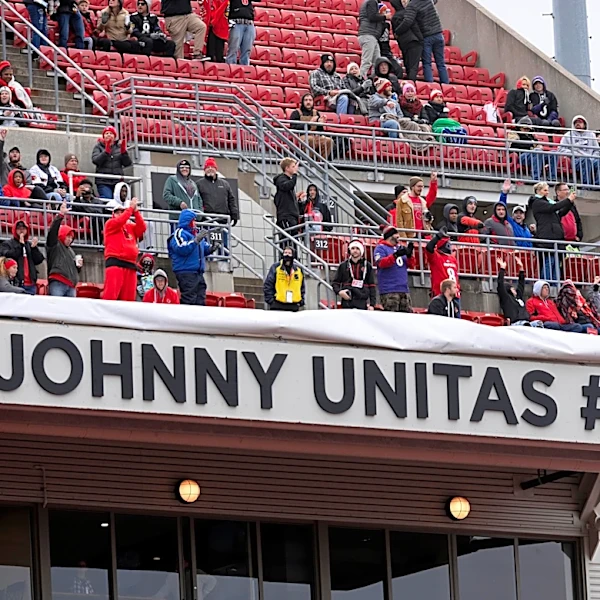



There’s an article going around that says roughly 10,000 tickets remain for Nebraska’s home games against Indiana and Ohio State. Those aren’t cupcakes. Those are the two programs that played for the Big Ten championship last season. And we’re a few short weeks from kickoff of the 2026 season.
Predictably, the reaction has been a chorus of people who want the sellout streak to finally die.
I want to take that argument seriously, because I don’t understand it. And I’d like someone to explain it to me.
First, let’s stop pretending anyone is being fooled.
I’m not going to defend the streak by claiming every seat is filled. It isn’t, and hasn’t been for a while. The Omaha World-Herald started getting scan data years ago, and it told the story plainly. In 2022 — the back end of the Scott Frost era — you had 70 tickets sold in one bulk buy on a Thursday. Same pattern for Minnesota. Same for Illinois. Three bulk buys in a single season. A donor bought 21,000 tickets at ten dollars a pop for the Wisconsin game, 85% off face value, and dumped them into resale.
That’s real, it’s documented, and anybody arguing the streak is a pure organic sellout hasn’t been paying attention.
Dave Feit has probably tracked this closer than anyone, and the critiques he’s collected are fair on their face: the streak “limps on,” the tickets are devalued, it’s a Weekend at Bernie’s façade, it’s not an attendance streak, it’s a tickets-sold streak, believing in it is like believing in Santa Claus.
Fine. Granted. Now what?
Here’s my actual question: what does killing it accomplish?
The most common version of the anti-streak argument goes like this — the streak should end, and then they’ll start paying attention. I see it on message boards, on social media, in the comments under my own videos: stop going to games and that will change something.
Change what, exactly?
Because Nebraska’s problem for the last twenty years has not been ticket revenue. It hasn’t been leaving the Big 12 for the Big Ten. It hasn’t been losing the Texas recruiting pipeline. It has been personnel decisions. Coaching hires. Staff hires. The wrong guy at the wrong time, over and over. If Bill Moos hadn’t hired Scott Frost, we’d have burned Lincoln down — and then Frost cost us five years anyway.
An empty stadium doesn’t fix a bad hire. It just means we made a bad hire and we lost our leverage.
The streak is a sales tool. That was my take in 2022 and it still is.
It might be the single best sales tool the athletic department has left. When the number flashes on the broadcast graphic during a national telecast, that’s free branding you cannot buy. It is the thing that says this place is different to a recruit who has never been to Lincoln. There have been a lot worse marketing strategies in college athletics.
And consider what the money actually does. When 21,000 tickets get bought by a donor, that donor isn’t lighting the money on fire. That money goes into the athletic department, and right now the athletic department needs every dollar it can find — because we are behind in revenue sharing, and that gap is the scariest thing about Nebraska’s near future.
The Ohio State comparison nobody wants to hear.
Everyone measures Nebraska against Ohio State. Ohio State’s institutional budget is a different universe — a huge chunk of it driven by their medical system and medical college. They graduate a multiple of what we do. More graduates means more alumni. More alumni means more donors. More donors means more money flowing to athletics.
Nebraska is a small state at the low end of that curve. We have to work substantially harder to generate the same dollar that other programs get handed. That’s the structural reality, and it doesn’t change based on whether the streak is at 400-something or zero.
And then there’s the part that really bothers me.
If the streak ends this year, I promise you what happens next: it becomes a club to beat Troy Dannen with. It becomes the headline number in every “fire the AD” thread.
By the same people who spent five minutes telling you they don’t give a damn about the sellout streak.
You can’t have it both ways. Either it’s a meaningless vanity stat and its death means nothing, or it matters — in which case keeping it alive matters too.
For what it’s worth, I think Dannen is doing a fairly good job at everything except football. Hoiberg has basketball moving. Softball, baseball, volleyball — we’re doing well across a bunch of sports. Football is the outlier, and 7-6 isn’t the standard. We’re not at the bottom, but we’re nowhere near where we should be, and year four for Matt Rhule needs to show something.
Meanwhile, the department has turned Memorial Stadium from a building that gets used six days a year into a venue that hosts concerts and events and pushes that revenue back out to athletes. That’s exactly the kind of adaptation Nebraska needs.
The standard we’re holding this to is absurd.
In the concert industry, if you sell 90% of your tickets, that’s a sellout. Nobody argues about it. We’ve been dramatically pickier about our own streak than the entire live entertainment business is about theirs.
Nebraska is going to have to start actually selling tickets, and that’s new. The season ticket waiting list used to be long. Apparently it isn’t anymore. There are $50-for-two promos on Bowling Green. That’s a sale. That’s what selling looks like.
Here’s where I land.
This streak has been alive my entire adult life. It started November 3, 1962, during the Cuban Missile Crisis. It survived two coaches while we were great and seven while we weren’t. It is the one continuous thread connecting the best of what this program was to whatever it is now, and it exists because Nebraska fans keep showing up for a product that has, frankly, been a pretty crap ride for two decades.
That’s not a lie. That’s a testament.
The way to fix this isn’t to kill the streak. The way to fix this is to stop being bad at football.
So if you’re on the other side of this — if you want it gone — I’m asking honestly: tell me what changes the day after. I want to hear it.
Go Big Red.