
There have been some big days in the history of the Nets.
On June 27, 2001, the New Jersey Nets sent Eddie Griffin, the seventh overall pick in that night’s Draft to the Houston Rockets for a package of
Richard Jefferson, Jason Collins and Brandon Armstrong. The same day, the two principals, Rod Thorn and Jerry Colangelo shook hands on a trade of Stephon Marbury for Jason Kidd, a deal finalized three weeks later. It was an unmitigated success.
Twelve years to the day after those deals, on June 27, 2013, the Brooklyn Nets sent a package to the Boston Celtics that included Gerald Wallace, Keith Bogans, Kris Humphries, MarShon Brooks and Kris Joseph plus three unprotected first-round draft picks — 2014, 2016, and 2018 — and a swap of firsts in 2017. In return, Paul Pierce, Kevin Garnett and Jason Terry — all 35+ — became Brooklyn Nets. It was an unmitigated disaster.
We don’t yet know how the events of June 25, 2024 will work out, but it’s likely going to be just as crucial. The Brooklyn Nets made two franchise-altering trades with the New York Knicks and Houston Rockets that night which for all intents and purposes were one big trade. They were negotiated simultaneously, revealed in tweets by Adrian Wojnarowski and Shams Charania 14 minutes apart and were hedges against each other.
Most of all, they signaled the Nets were going into a deep rebuild which much of the fan base had wanted, a clean break for mediocrity in return of long-term hope. They were hedges against one another. It also signaled that the post-Big Three hope that Mikal Bridges and to a lesser degree, Cam Johnson, would be the lynchpins of a future success had been abandoned.
The team had officially given up on a strategy to build around the two young players who had been the centerpiece of the Kevin Durant traded 16 months earlier. What had changed? The front office had not succeeded in finding a bigger piece, like a Donovan Mitchell, to form a nucleus for the future. Not to mention that Bridges quite obviously was unhappy in Brooklyn and longed for a reunion with his three Villanova cronies across the river.
Moreover, the Knicks offer was, as one insider has told ND, simply too good for the Nets to refuse. While the Knicks had sent a version of the Bridges trade package to Brooklyn at the 2024 deadline, the final form was a better deal. Also important, the offer reportedly softened Joe Tsai’s reluctance to go against the prevailing wisdom in New York: that you can’t do a deep rebuild in the Big Apple. That wisdom was simple: there’s just too much competition for the city’s entertainment dollar to walk things back. That is, if you lose fans’ interest, it will take you a while to get it back.
The Nets had seen that happen after the collapse of the Pierce-Garnett-DWill-Lopez-Johnson core in 2014-15. Even the feel-good aura of 2018-19, when the Nets shocked everyone and earned the sixth seed, didn’t help. Brooklyn finished dead last in attendance that season. They filled less than 85% of Barclays. They’re filling 98.8% of Barclays. So much for that prevailing wisdom.
So, now 18 months after the trade, where are we? Bottom line: it’s still too early to tell, but milestones are approaching that will likely tell the tale.
—————————————————————-
First a review of that night’s events, with what’s happened so far. Where there’s been some subsequent tangible developments, we note them in parenthesis. Asterisks designate players no longer with the team. A “+” sign indicates the player is no longer in the league
Brooklyn Nets received:
From New York Knicks:
- Bojan Bogdanovic*+
- Mamadi Diakite *+ (Zaire Williams, Mavericks second round pick in 2030)
- Shake Milton* (Maxwell Lewis*+)
- unprotected 1st-round pick in 2025 (Ben Saraf)
- unprotected 1st-round pick in 2027
- unprotected 1st-round pick in 2029
- unprotected 1st-round pick in 2031
- unprotected pick swap in 2028
- top-four protected 2025 1st-round pick via Bucks (Nolan Traore)
- 2nd round pick in 2025 (two future picks: a 2026 2nd round pick that’s the least favorable between Los Angeles Clippers and the most favorable of Miami Heat, Indiana Pacers and Boston Celtics along with a 2030 Celtics 2nd round pick)
- a $21.9 million trade exception (that went unused.)
From Houston Rockets
- unprotected 1st round pick in 2025 (Egor Demin)
- unprotected 1st round pick in 2026
NOTES: On July 19, two weeks after Nets-Knicks deal was finalized. Nets traded Momadi Diakite ($1.4 million guaranteed), the final piece of of the Nets-Knicks trade, and the draft rights to Serbian wing, Nemanja Dangubić. to Memphis Grizzlies for Ziaire Williams and the Dallas Mavericks second round pick in 2030.
The Nets acquired Maxwell Lewis in a December 29 deal that sent Dorian Finney-Smith and Shake Milton to the Los Angeles Lakers for him, three second round picks and D’Angelo Russell.
The Nets 2025 second rounder (No. 36), re-acquired from the Knicks, was traded to the Phoenix Suns on June 26, 2025, hours before the second round of the 2025 Draft was set to begin. Nets received two future picks in return: a 2026 2nd round pick that’s the least favorable between Los Angeles Clippers and the most favorable of Miami Heat, Indiana Pacers and Boston Celtics along with a 2030 Celtics 2nd round pick.
(The Nets also used a pick swap from the 2021 Nets trade for James Harden to acquire Danny Wolf.)
Brooklyn Nets sent out:
To the New York Knicks
- Mikal Bridges
- Keita Bates-Diop*+
- 2026 2nd-round pick
- Draft rights to Juan Pablo Vaulet, Argentine wing.
To the Houston Rockets
- Phoenix Suns’ 1st round pick in 2025 (Khaman Maluach)
- the Phoenix Suns’ 2027 1st round pick
- Swap rights to the two most favorable of the Dallas Mavericks, Phoenix Suns and Houston Rockets 1st round picks in 2029. Brooklyn retains the least favorable of Dallas, Houston and Phoenix’s first round draft picks in 2029.
NOTES: The 2026 2nd rounder will likely not transfer to the Knicks.
Grading each element of the trades is the traditional way to measure things, but the two trades were so complicated and so intertwined with other elements of team-building that grades wouldn’t be that illuminating. (Shortly afterwards, various writers did lay out their thoughts, giving the Nets high grades — almost all A’s — for the Knicks trades and little lower grades for the Houston deal.)
Milestones:
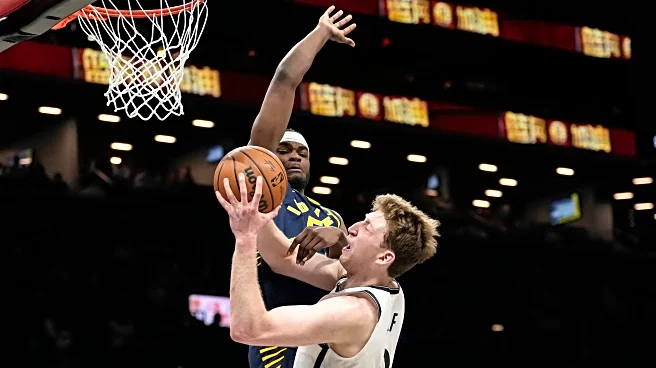
The bottom line is that we still have a long way — perhaps years — before the final grades can be be recorded but there are milestones that can be used to gauge how things are going. Two have already passed: the 2025 Draft where three of the five first rounders the Nets selected were the result of the two trades: the eighth (Demin), 19th (Traore) and 26th (Saraf) picks. All three 19-year-olds have shown some indications they can be good NBA players with the highest picked of three, Demin, looking the most solid. The other two, both among the 10 youngest players in the NBA, have shown flashes particularly in the G League.
The Suns pick of Khaman Maluach at No. 10, who many expected the Nets to take, has so far gone the other way. He was seen as a raw talent and he is perhaps more raw than the Phoenix braintrust thought when they took. Demin, taken two picks earlier, is certainly more advanced. The two are within six months in age.
Also, the Knicks, buoyed by Bridges, got further than any New York team had in a generation, making it to the Eastern Conference Finals. It’s a pro sports truism that if a trade results in a championship, that trumps everything. The Knicks came close.
Bigger milestones approach. The big one or at least the one most visible on the horizon is how well the Nets do in this May’s lottery. Even after their three-game winning streak. Brooklyn currently has the sixth best chance at the overall No. 1 pick — a nine percent shot — and a 27.6% chance of picking in the top three where most draftniks think you can’t go wrong. A.J. Dybantsa, the BYU wing, Darryn Peterson, the Kansas shooting guard, and Cam Boozer, the Duke big, have all been given the “franchise changer” label.
Getting one of those three would likely tip the trade scales in favor of the Nets. On the other hand, one NBA decision-maker told NetsDaily that “if the Nets don’t secure a top five pick in the lottery, (the rebuild) may take 10 years.”
The reasoning: while the Nets have a very good young coach, likely a core of good young players, some great draft assets, and the lure of New York, nothing attracts a superstar like a superstar. Still, while Brooklyn is currently sixth, two of the teams above them, the New Orleans Pelicans and Los Angeles Clippers, have no incentive to tank. Their firsts are already headed elsewhere. So that’s a positive. (Note the Nets will also have a second rounder in 2026 from the June 25 trade.)
In 2027, the Nets may have to swap first rounders with the Rockets another big milestone. Unprotected there, too. For many fans, that is the biggest milestone going forward. The Nets will have to be contenders by then, the narrative goes, or they will have to once again give up with of their own picks. Of course, trying to determine how things will go for either team two years in advance is hardly a science. Also, the Nets have the rights to the Knicks unprotected pick in 2027. As we noted, the two trades were perceived as hedges against one another.
Moreover, the 2027 NBA Draft is seen as very weak. Back in the summer, Jonathan Givony, the dean of draftniks, described how NBA executives feel about it back. “The most forward-thinking of those executives are already ringing alarm bells in their front offices for the 2027 NBA draft, which appears to be an especially weak group of rising high school seniors and international players born in 2007 and 2008.“ He is not alone.
There are other, perhaps under appreciated consequences from the two trades that fit the franchise’s long-term planning.
- The Nets vast cache of draft assets is now unbalanced … in a good way. Of the 32 picks they have going forward, 15 are bunched together between 2028 and 2032. Also, Brooklyn doesn’t owe any firsts after 2029.
- Assuming their five picks in 2025 work out, they’ll have an advantage the next few years in balancing rookie deals with the those required by stars and superstars. Next year, for example, the Nets will have seven players on rookie deals. Noah Clownely will be on the final year of his four-year deal, the Flatbush Five will be on their second year and whoever they take in the lottery will be in first year. Assuming nothing changes, those seven players will make around $40 million or a quarter of next year’s salary cap. So half the roster for a quarter of the cap. As one insider has told ND, having controllable first rounders offers GMs a lot of flexibility in filling out rosters … and avoiding aprons.
Of course a number of things could go wrong. Anyone who experienced the Big Three collapse knows that. If for some (now unlikely reason,) most of the Flatbush Five are busts, that would be a negative. If the Nets don’t secure a top pick in May or the pick doesn’t work out, that could make the Houston pick swap a disaster. If there’s a big gap between the Rockets and Nets in the 2026-27 season, fans will recall how the last big trade swap, from the Celtics trade, resulted in the Nets having to surrender the rights to Jayson Tatum. And if Mikal Bridges helps ignite a Knicks dynasty, those unprotected firsts in 2027, 2029 and 2031 and the unprotected first swap in 2028 would become low first rounders and lose a lot their value.
So, at this point, virtually everything would have to go wrong for all those hedges to go bad. So what’s the bottom line. It’s much like Saturday night’s win over the Timberwolves. You can find all manner of issues if you’d like. It hurts the tank putting a high pick at risk, Cam Thomas future looks iffy, MPJ may be on his way out because his value is just so high, but overall, you won and move on.