
For the first time since 2014, the Kansas City Chiefs didn’t make the playoffs and watched Wild Card weekend from home just like the rest of us. Hopefully, there are lessons to learn from this year’s postseason
that the Chiefs can apply to their in-house philosophies.
Here are two takeaways I had from the second round of the NFL postseason.
1. Throwing the ball downfield mitigates turnover variance
Defenses have changed over the past few years. As the NFL has become more pass-happy, teams have countered by employing nickel or dime personnel against anything the offense offers. The best defenses in the NFL, like the Seattle Seahawks or Houston Texans, never play base defense, choosing to solve problems with lighter personnel. Both of those defenses succeed because they can excel from light boxes.
From a coverage standpoint, teams have used more defensive backs to gain an advantage. Those defenses prefer “umbrella” zone coverages in order to play top-down to everything, focused on limiting explosive plays.
There are a few schools of thought on how to counter this through the passing game:
There’s the idea of throwing underneath into that open space and being surgical. Some quarterbacks and schemes can maximize that.
However, football is a sport of variance. If you try to draw out 10-play drives consistently, you’re eventually going to have a negative play happen against you. It can be a penalty, sack, or a tackle for loss that gets you behind the chains. It’s a hard way to live and limits your scoring opportunities.
The other way to attack these defenses is by throwing one-on-one downfield. If you can bleed the coverage and open shots downfield, you can create space and limit variance. A 30 or 40-yard completion is like eliminating three or four first downs. If you’re throwing underneath, you need to be precise on six to eight plays to get to 40 yards. It’s extremely valuable to get all of that in one play.
As these defenses do a better job at stopping quick game from these coverages, the counter will be teams getting more focused on pushing the ball downfield. We saw that this weekend.
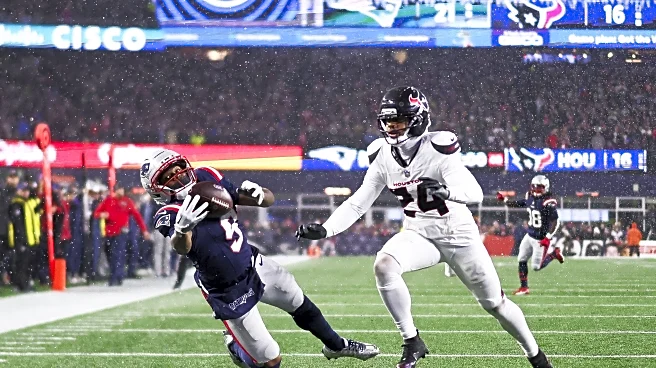
The New England Patriots‘ offense was bad on Sunday. The Patriots had 13 first downs and averaged under 4.0 yards per play. They went 3/14 on 3rd down. The unit had few counters to one of the best defenses in years.
However, when the offense scored, it was through downfield shots to receivers like Kayshon Boutte. Quarterback Drake Maye lived and died by explosive throws, but eventually, the ones that hit got them enough points to win.
To converse this, the Buffalo Bills are a good example. Buffalo’s offense ran the ball very well and moved the ball efficiently, but the unit was subjected to turnover variance via fumbles. It wasn’t able to make up for the turnovers because the Bills couldn’t create explosive throws downfield, which is a byproduct of having poor receivers.
The Chicago Bears are another team that believes in throwing downfield. Head coach Ben Johnson is a huge believer in explosive plays. So, despite quarterback Caleb Williams having a low completion percentage, the Bears’ ability to hit on a big play mitigates some accuracy errors and keeps their offense efficient.
The Los Angeles Rams have built the entire playbook around getting wide receivers Davante Adams and Puka Nacua open downfield.
For the Chiefs, this is the way to improve the offense. It has become a dink-and-dunk unit to the team’s detriment. To counter, there needs to be fear of downfield throws, and acquiring a strong, vertical receiver who can win at the catch point would go a long way.
2. Pocket crushing from all angles limit scrambling quarterbacks
My favorite thing about football is the pass rush. As a kid, my favorite Chiefs players to watch were edge rushers Justin Houston and Tamba Hali. Sacks are cool, but nothing is better than a strip sack. I love watching an offense completely crumble under pressure. My football philosophy is centered around getting pressure from the defensive line and how to create it.
For many years, teams pursued faster defenders who could fly around the corner against slow quarterbacks and chase strip sacks.
However, modern NFL quarterbacks are very athletic. It’s almost a prerequisite for the position to scramble and make plays. As this evolution has happened, teams now have to change the way they create pressure. It wasn’t just about trying to sack the quarterback – pocket integrity is also important.
Giving up open lanes is a nail in the coffin against the best athletes at the position, so teams have countered by getting bigger pocket crushers. Condensing the space the quarterback has can create more chaos. This also allows you to control the offensive linemen and disengage clearly to chase if the quarterback goes out the back of the pocket.
All season, the Denver Broncos, Rams, Texans, and Seahawks had great fronts built around this. The Broncos do deploy speed rushers off the edge with Nik Bonitto and Jonathon Cooper, but the defense makes up for that by having two nasty power players in John Franklin-Myers and Zach Allen in the middle. The Rams have defensive end Jared Verse, plus other defensive linemen who are good at closing space.
The Seahawks’ front four is built with nothing but strong, powerful rushers. Demarcus Lawrence, Leonard Williams, Byron Murphy, and Uchenna Nwosu can knock any offensive linemen over.
The Texans have Will Anderson and Danielle Hunter at ends, and both can chase and knock offensive linemen over while their interior teammates crush space.
Teams are using more slants and stunts to force quarterbacks a certain direction or attack teams’ protection rules; it requires gap discipline. If a defender is chasing upfield, it can leave behind a lane and ruin the call. By crushing the pocket, you can keep gap integrity.