





This is the first part of a three-article series looking at the hypothetical trade value of three of the Colts’ biggest stars. We’re starting with Jonathan Taylor.
This is not an argument that Indianapolis should trade any of them. In fact, the answer in most cases will probably be the opposite. The idea is to look at what would happen if the Colts received serious interest around the trade deadline and determine what each player should realistically be worth.
Taylor is the obvious place to start.
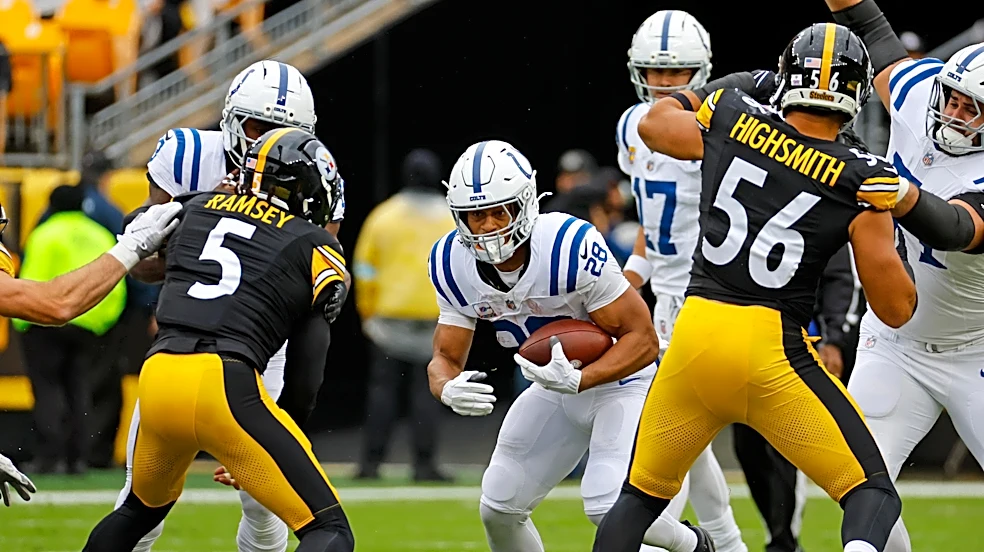
He is 27 years old, coming off a 1,585-yard season and remains one of the best running backs in football. He has nearly 8,000 career rushing yards, three Pro Bowls and a First-Team All-Pro selection. Even during a relatively inefficient start to 2026, Taylor has six rushing touchdowns through five games and remains the centerpiece of the Colts’ offense.
Running backs, however, are difficult to value in trades. The position has been devalued across the league, Taylor has accumulated an enormous workload and a team acquiring him would eventually have to pay the expensive portion of his new contract.
So what is he actually worth?
The recent trade market gives us a floor and a ceiling
There are very few useful running back trades because very few players of Taylor’s caliber ever become available.
D’Andre Swift was traded from Detroit to Philadelphia in 2023 for a future fourth-round pick and a swap of seventh-round selections. Swift was only 24 and had averaged 4.6 yards per carry over his first three seasons, but Detroit had just drafted Jahmyr Gibbs and clearly no longer viewed Swift as part of its future.
Jay Ajayi provides another useful floor. Philadelphia acquired him from Miami for a fourth-round pick in 2017. Ajayi was also only 24 and was less than a year removed from a 1,272-yard Pro Bowl season.
Neither player was Jonathan Taylor.
Swift was a good player who had never topped 617 rushing yards in a season before being traded. Ajayi had one excellent season and a much shorter résumé. Taylor has been one of the best running backs in football for most of his career and has already produced multiple seasons that neither player approached.
If Swift and Ajayi were worth fourth-round picks, I have a difficult time seeing any scenario where a fourth is enough for Taylor. To me, that establishes the absolute bottom of the conversation rather than his actual value.
The much more useful comparison is Christian McCaffrey.
San Francisco acquired McCaffrey midway through the 2022 season for a 2023 second-round pick, third-round pick and fourth-round pick, plus a fifth-round pick in 2024.
That is obviously a massive haul for a running back, and Taylor probably would not get quite that much.
McCaffrey was 26 when San Francisco acquired him, roughly a year younger than Taylor is now, and his receiving ability made him uniquely valuable. He was essentially an elite running back and high-end receiving weapon in one player.
Taylor is also carrying considerably more mileage, which becomes important when projecting what a contender would actually be buying.
Still, Taylor belongs much closer to the McCaffrey end of this spectrum than the Swift end.
How much high-level football does Taylor have left?
I have written about the “running back wall” several times because running backs tend to have a much more dramatic decline curve than most positions.
In my most recent update, I used approximately 3,300 combined college and NFL touches as the baseline point where heavily used backs tend to begin declining. It is not a magical number where a running back suddenly becomes bad. There is roughly a 600-touch standard deviation around it, meaning some players fall off much earlier and others remain productive well beyond it.
Taylor is now around 2,800 combined touches between Wisconsin and Indianapolis.
At his current workload, he is on pace for close to 390 touches this season, which would put him a little above 3,100 by the end of the year. Using the 3,300-touch baseline, he would probably reach the historical wall sometime during the 2027 season.
That sounds concerning until you put it in the context of a deadline trade.
A team acquiring Taylor around the middle of this season would get the remainder of 2026 and all of 2027 before age and workload become a major concern. Even if he crosses the 3,300 threshold sometime next season, that number is an average rather than an expiration date. Taylor is also a better athlete than the average running back included in these studies.
I would feel comfortable projecting roughly another season and a half of high-level Taylor, with 2028 becoming the uncertain year.
That still has considerable value to a contender.
Teams making deadline trades are generally not worried about what a player will look like four years from now. They are trying to win a Super Bowl in the current window. If Denver, Green Bay or another contender believes Taylor could materially improve its chances over the next two postseasons, what happens when he is 30 is not particularly relevant.
And even if the decline begins during the back half of the contract, the acquiring team controls him through 2028. Taylor does not have to remain the best running back in football for the entire deal to provide value.
His contract is actually helpful for a deadline trade
Taylor signed a two-year, $44 million extension before the season that keeps him under contract through 2028. The expensive portion of the new deal essentially begins next year.
A team trading for him during 2026 would have a relatively inexpensive immediate cost.
Taylor’s 2026 base salary is $6.98 million, and Indianapolis has already paid the signing bonus. An acquiring team would only be responsible for the remaining portion of his base salary and applicable bonuses for the rest of this season rather than taking on the Colts’ prorated signing-bonus charges.
That makes fitting him under the cap at the deadline fairly easy.
The bigger commitment comes afterward. Taylor is scheduled for roughly $16 million in cash in 2027 and approximately $18 million in 2028. That is premium running back money, but a contender trading meaningful draft capital for Taylor would obviously be doing so because it considers him a premium running back.
The contract also provides certainty. A team is not trading a second-round pick for a rental that could leave four months later. It gets Taylor for three playoff pushes.
Who could actually want him?
There has to be a market for any trade-value projection to make sense, and I can see several teams where Taylor would provide a major upgrade.
Denver might be the cleanest fit.
The Broncos are 4-2 and have one of the better defenses in football, but the offense remains inconsistent. They managed only 168 total yards in Thursday night’s win over Seattle, with the defense again doing most of the heavy lifting.
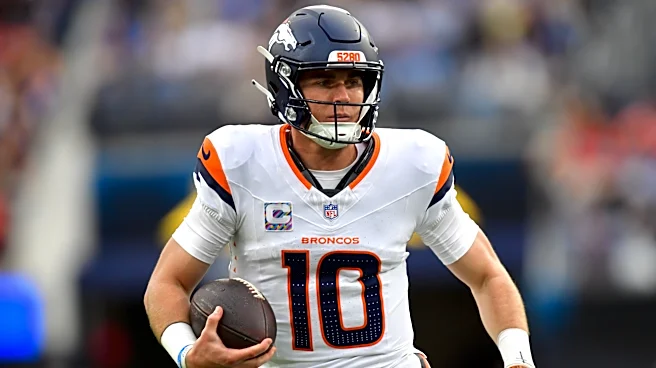
J.K. Dobbins is their veteran lead back, but his extensive injury history makes him difficult to rely on as the centerpiece of a championship run. Taylor would give Sean Payton a legitimate workhorse and take pressure off Bo Nix on a team that appears capable of winning now.
Denver also retains its own first-, second- and third-round picks in 2027, so the draft capital is there.
Green Bay is fascinating for a different reason.
The Packers have always placed a major emphasis on the running game in recent years, but Josh Jacobs has created uncertainty. He rushed for 929 yards at 4.0 yards per carry last season, a noticeable step down from his best years, and he has yet to play in 2026 after spending the start of the season on the commissioner’s exempt list. He is now eligible to return, but his long-term future in Green Bay is hardly guaranteed.
If the Packers decided they wanted to move forward with Taylor instead, the fit is obvious.
Green Bay does not own its 2027 first-round pick, but it does still control its second and third. Conveniently, those are the picks that become relevant to my eventual valuation.
Seattle has one of the most immediate needs.
The defending champions let Kenneth Walker III leave during the offseason and have struggled badly to replace his production. Emanuel Wilson has 303 rushing yards on 87 carries, just 3.5 yards per attempt, and Seattle’s running game has become a weakness.
There is one important complication: Seattle used the 32nd overall pick on Jadarian Price in April. He has since landed on injured reserve with a chest injury after a difficult start to his rookie season, and the Seahawks are currently relying heavily on Wilson while also waiting for Zach Charbonnet to return.
That first-round investment makes Seattle less obvious as a long-term destination than Denver, but a defending champion sitting at 3-3 could still decide that waiting for a rookie running back to develop is not worth wasting a championship window. Seattle also owns its first three selections in the 2027 draft.
New England and Cincinnati would be secondary possibilities. Both are in the playoff conversation, and Cincinnati in particular has questions about whether Chase Brown is good enough to be the long-term answer. Both organizations currently retain early-round 2027 capital as well.
There would be a market with multiple teams.
So, what is Jonathan Taylor worth?
If McCaffrey is the ceiling and Swift/Ajayi represent the floor, Taylor lands much closer to McCaffrey.
I would not expect Indianapolis to get the full McCaffrey package. Taylor is a year older than McCaffrey was, has an enormous number of career touches and does not offer the same receiving dimension. His next two seasons are also expensive.
However, reducing Taylor all the way down to a single second-round pick feels too aggressive in the opposite direction.
He is still a star player under team control for multiple seasons. A contender acquiring him would be getting him for the remainder of 2026, all of 2027 and all of 2028. The immediate salary is easy to absorb, and there are multiple teams where he could instantly become one of the most important players on the offense.
My valuation would be:
A 2027 second-round pick and a 2028 third-round pick.
That takes the McCaffrey package and removes the fourth and fifth-round selections to account for Taylor being older, carrying substantially more mileage and being less valuable as a receiver. The Colts receive a 3rd round pick but a future one.
It also puts him comfortably above backs like Swift and Ajayi, which he should be.
A single fourth would be laughable. A third would not get me interested. A second by itself would at least start the conversation, but it still feels light for a player of Taylor’s caliber.
A second and a third is where the value finally makes sense.
The Colts probably have little reason to entertain that conversation right now. However, if the phone rang around the deadline and a contender wanted to know what Jonathan Taylor was worth, that would be my number.