

“Biweekly” is kind of a dumb word. It means both “twice a week” and “once every two weeks,” and apparently, there’s no effort to create a new word to mean one of those, so that “biweekly” can be reserved for the other. To be clear, by “biweekly” here, I mean “every two weeks.”
In the offseason, someone suggested that we do a more regular check-in on the Braves and their players. I used to do monthly recaps, but those weren’t really ever a “check in,” and there were only six of them a year. (Plus,
I didn’t do the September one sometimes.) On the flip side, doing a very frequent check in series can feel a bit like whiplash, because baseball is a game of accumulation of marginally different rates of stuff happening over long-ish periods, so talking about what happened in one week feels weird. So, there you go, that’s how I got to biweekly. Hopefully this fulfills the request for a “check in.” If there’s something you want to see in this pseudo-review, let me know.
How are the Braves doing?
Through mid-April, the Braves are, nominally, doing pretty well. They’re 12-7, which pro-rates out to a 102-win season if kept up over the entirety of the campaign.
- They have baseball’s third-best record.
- They lead the division by three games (over the Marlins and Nationals).
- They have baseball’s second-best run differential and BaseRuns differential. (BaseRuns is basically just the set of outcomes possible at the plate — walks, singles, doubles, outs, etc., weighted by how valuable they are. BaseRuns differential is basically just the difference between the different types of outcomes the batters have collected, and what the pitching and fielding have allowed to opposing batters.)
- They’re top five in pretty much every position player thing (fWAR, fielding value, offensive outputs, offensive inputs).
- The pitching is a little iffier: they have the league’s best ERA-, but the eighth-best FIP- and 12th-best xFIP-. The defense, and some luck, are going a very long way to making this team look like it has elite run prevention, even though it’s probably somewhat worse than that (but still above-average).
One very amusing consideration is whether you feel the Braves are doing great or not probably depends on your expectations. If you were emotionally pummeled by 2025 (and maybe even by 2024 for whatever reason), 2026 might feel awesome so far. But, the Braves were projected to be a solid team this year, so a 12-7 stretch across a fairly easy schedule (by my estimate, only four teams have had an easier schedule so far) has had very limited impacts on the Braves’ expected end-of-season wins or playoff fortunes. As of April 16, they are projected (FanGraphs Steamer/ZiPS blend, point estimate) for 90 wins, with playoff odds of 84 percent; preseason, it was 90 wins and playoff odds of 79 percent. So, on the one hand, yeah, woo, go Braves — still undefeated in series. On the other hand, this is probably what they should’ve been doing.
A few other considerations:
- If you go game-by-game in terms of odds, the Braves should’ve been somewhere between 10-9 or 11-8. Their “best” win (lowest pregame odds) was the rubber game in Anaheim (8-2), while their “worst” loss was the Athletics game where they started Jose Suarez. So, nothing that weird happened in these first few weeks in terms of specific games.
- The Braves are substantially underperforming their run differential and BaseRuns differential. If they weren’t, then I think everyone would be impressed by their record. But, on the flip side, they’re actually not underperforming their xwOBA offensively for once, which is why I can title this post “so far, so good” and not “welp the increased drag on the balls is killing them once again, hope it improves in the summer.”
How are the hitters doing?
Alright, enough text.

It’s a little irresponsible to include that last column, hence the grayscale, but I wanted to keep it to show how these will change over time. The trio of Drake Baldwin, Matt Olson, and Dominic Smith are killing the ball, with results even better than their inputs. Mauricio Dubon is almost there, but his inputs are notably worse — though much improved from when he was just getting a bunch of hits with almost no oomph very early in the season.
Actually, let’s do a different view:

This should be fairly self-explanatory, but in case it isn’t, bubble size is scaled based on PAs so far. Really, three things to note here beyond much of the team raking: Mike Yastrzemski is sad, Ozzie Albies is lucky, and Michael Harris II is unlucky.
Only one player (Josh Naylor), has both more PAs than Harris, and a bigger xwOBA underperformance. Harris’ inputs are fairly close to say, Olson’s — but their outputs so far are worlds apart. On the flip side, only Yandy Diaz has more PAs than Albies and a bigger overperformance (though a lot of guys are close in terms of PAs and overperformance). It’s not weird to have these sorts of things be true for any few-week stretch, but Albies has a history of overperformance and Harris has a history of underperformance so… watch this space?
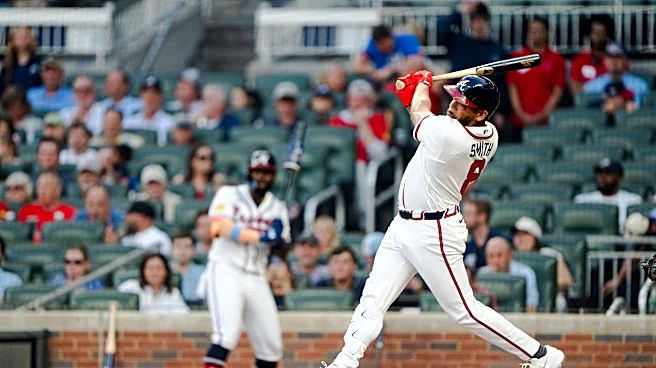
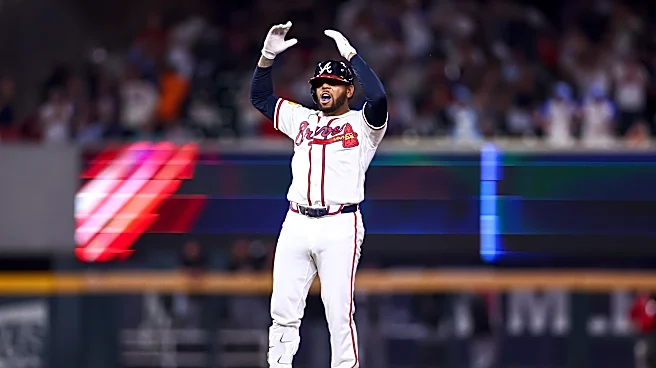
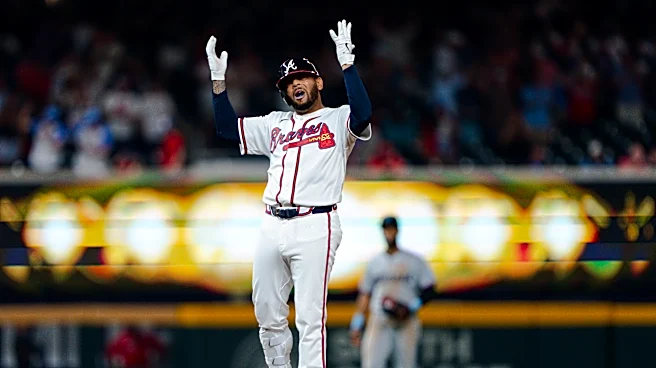
Context-less stats are all well and good, but these guys are playing games where they come up in specific situations. We all know about Smith’s heroics — his 1.12 WPA so far is actually seventh in MLB among position players right now. His game-winning double against the Marlins resulted in the third-highest WPA game for a batter so far this season. That said, I also want to give a shoutout to Olson, who currently leads the team with six games with a WPA above .06. He hasn’t had that huge hit yet, but his consistent production has made big hits unnecessary in many games, as well. And, of course, there’s Austin Riley, whose challenges with the WPA vortex are well-documented at this point. I won’t dwell on it too long, but Riley’s -0.78 WPA is just barely outside the bottom ten in baseball right now, with the biggest insult layered on top of insult coming from the fact that his worst WPA game so far was supposed to be a day off, and instead he ate -0.18 WPA after coming in late and making two outs in key situations.
How are the pitchers doing?
We’re very much in small sample land here:

Bryce Elder has been killing it. Chris Sale was killed in one start, so his through-four-starts line is very un-Sale-like. Grant Holmes and Reynaldo Lopez are somewhat concerning, but it’s only been a few outings, and maybe they find their footing — they were both better in their most recent starts, despite the Marlins sprinkling BABIP all over their box score lines. Still, each of these guys have had positive WPA so far (in large part thanks to the stellar defense behind them) — even if Elder is the unquestionable rotation MVP of these first few games of the season.
I’m not going to bother with reliever stuff at this point because, well, the bullpen innings leader right now is Osvaldo Bido, who just got DFAed. That said, I do want to note that Raisel Iglesias is currently second on the team among pitchers in fWAR with 0.4 — a far cry from his terrible start that kind of doomed the Braves before they ever got going last year. He’s been nearly perfect, and has four of the team’s ten shutdowns (which is a relief appearance with +.06 WPA or more). Among the “steady” relievers that are expected to stay on the roster, only Aaron Bummer has had a rocky start, but we’re still talking just like five innings here.
Anyway, that’s what I got. What else would you like to see (or not see) in future biweekly updates (remember: that means every two weeks here!)?