
It’s the mysterious week between the holidays here in Wisconsin, a snowstorm is coming, and we’re still waiting to see if the Brewers are going to trade their ace, their closer, or sign a backup catcher.
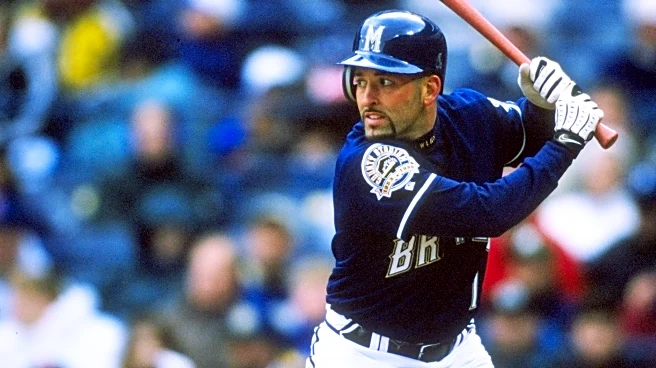
So let’s keep thinking about the Brewers of the past. Today’s installment is a middle infielder who was a staple of the late 1990s squads who made an All-Star team at his peak: second baseman Fernando Viña.
Early Career
Viña was born and raised in Sacramento, California, to parents who’d emigrated from Cuba a year before his birth. In 1988, the Yankees drafted him in the 51st round out of Cosumnes River College, a junior college in Sacramento, but predictably, Viña did not sign and instead went to Arizona State University to play college ball, shortly after another future Brewer, Pat Listach, was drafted from the Sun Devils’ infield. Viña played a year at ASU before the Mets took him in the ninth round of the 1990 MLB draft, and he played his first pro ball in the South Atlantic League in 1991.
The Mets were aggressive with Viña — after he hit .295/.347/.361 with 36 stolen bases in 111 games at High-A St. Lucie in 1992, New York promoted him all the way to Triple-A Tidewater at the end of the season. But even if he wasn’t ready, Viña got an early shot at the big leagues way sooner than he might have expected when the Seattle Mariners took him in the December 1992 Rule 5 draft. Viña lasted 24 games with Seattle, hit .222/.327/.267, and was returned to the Mets’ system, where he went back to Triple-A.
In 1994, the Mets needed an infielder, so Viña made New York’s roster as a utility infielder. He didn’t hit much, but he was patient — a good trait for a part-time player — and had a .372 on-base percentage in 150 plate appearances while filling in defensively all over the diamond: in 1994, he appeared in 13 games at second base, 12 at third base, nine at shortstop, and six in left field.
That 1994 season was, of course, cut short by the strike, which began on August 12. In December of that year, while the players were technically still on strike, Viña was traded to the Brewers for reliever Doug Henry.
Establishing Himself in Milwaukee
The strike was finally suspended on April 2, 1995. Ten days later, Viña turned 26, and 14 days after that, Milwaukee played its first game since the strike had begun the previous August. Viña didn’t start that day, but with the Brewers up big on the White Sox, he entered as a pinch runner for his near-college teammate, Listach, and finished the game at second base.
Listach had won the Rookie of the Year during a magical 1992 season, but things hadn’t gone well since. In 1993, Listach dropped 74 points from his about-league-average OPS, and in 1994, he played only 16 games due to the strike and injuries. Things went further downhill after the 1994 season; he just couldn’t hit. By the end of May, Viña was starting games regularly, and a hot streak in June entrenched him as the team’s starting second baseman.
That first season was just okay for Viña, but it was important in that it was his first major league season in which he got regular playing time. In 1996, Viña came to spring training as the presumptive starter at second, and indeed, he started 131 games at second base for Milwaukee that season. His offensive numbers ticked up in 1996 (.283/.342/.392, seven homers, ten triples), and he played good defense — Baseball Reference lists him as a league leader in several defensive categories. The Brewers weren’t a good team, but they weren’t a bad one, either, and Viña was a solid starter on a team that finished 80-82.
The next year, though, was a challenge. In mid-April, Viña was hitting .321 with an .839 OPS through 13 games and leading off every day, but he suffered a broken ankle while attempting to steal second base. He didn’t make it back into the lineup until almost exactly three months after the injury, on July 18, and it took him a couple of weeks to re-acclimate to being in the lineup every day. Viña finished the season relatively strong, and hit .275/.312/.361 with solid defense in 79 games for the entire season.
Milwaukee Peak
Viña’s best season as a Brewer (and possibly for his whole career) came the following season, in 1998. Once again serving as the Brewers’ leadoff hitter, Viña was a steady, everyday presence at the top of the Brewer order, and he set the tone for the season by going 3-for-5 with two doubles on Opening Day against the Rangers. The Brewers also lost that game, which also set the tone for a rapidly declining team that would finish 74-88 and was on its way to some of the darkest seasons in franchise history.
In ‘98, though, Viña enjoyed a wonderful season. He was healthy and played almost every day — in 159 games, he racked up 722 plate appearances, the fifth-highest single-season total in Brewer history. Viña was never much of a power hitter, but he showed some serious gap power in 1998, which expanded his profile as a solid contact hitter. The Brewer second baseman picked up 198 hits in ‘98, including 39 doubles, seven triples, and seven homers. He hit .311/.386/.427 for the season, career highs across the board, and added 22 steals, though he was also thrown out 16 times. He earned 3.1 WAR in 1998, the best number of his five-year Brewer run.
This was enough to earn Viña a selection to the All-Star Game, the team’s only representative at that summer’s contest at Coors Field, and the first ever National League All-Star for the Brewers after they’d switched leagues before the season. Viña, alongside Cincinnati’s Bret Boone, served as the backup to Houston’s Craig Biggio, who led off for the NL All-Stars. Viña did make it into the game and had a bit of a rollercoaster experience: he entered in the sixth as a pinch-hitter, knocked a single to left, and stayed in at second base in the top of the seventh. He batted again in the bottom of the eighth and with the NL down four, drew a walk to load the bases with no outs. After former Brewer Greg Vaughn hit a two-run single, Viña was thrown out at home by the Yankees’ Paul O’Neill for the first out, and an Andrés Galarraga double play quickly snuffed the rally. In the top of the ninth, a Viña error contributed to a big AL rally, which extended their lead by three runs.
1999 and trade to Cardinals
On May 9, 1999, Viña collided with right fielder Jeromy Burnitz and injured his quad. Initially, this injury cost him only three weeks — he returned on May 27. But his rehab was rushed, and after just another week of games, he was shut down with tendinitis in his knee, likely caused by the extra strain while trying to get back quickly. There was no way to know it at the time, but this was Viña’s last game with the Brewers. He didn’t play again in 1999, finishing with just 37 games played. In December, the Brewers sent him to St. Louis for reliever Juan Acevedo and two minor leaguers who would never appear in a game for Milwaukee, Eliézer Alfonzo and Matt Parker.
If the Brewers thought the soon-to-be 31-year-old Viña was finished, they were mistaken. Viña’s first two seasons in St. Louis went quite well. In 2000, he hit .300/.380/.398 in 123 games and led the majors with 28 hit-by-pitches. In 2001, he played in 154 games and hit .303/.357/.418 with 30 doubles, eight triples, and a career-high nine homers. He also won his first Gold Glove in 2001, then won another in 2002, though his bat fell off considerably that season.
Viña played one more season with the Cardinals in 2003, but at age 34, he struggled at the plate and got hurt again, and was worth negative WAR in 61 games. He gave it one more shot with the Tigers in 2004, and while his glove rated out nicely, he didn’t hit at all, and after 29 games in Detroit, he got hurt and never played in the big leagues again after he was cut by the Mariners in 2006 spring training.
Wrap-Up
Viña finished his career with 12.3 WAR earned across 12 seasons, five of which were in Milwaukee. The best of those years came in his healthy seasons between 1998 and 2001, when he averaged 3.0 bWAR per 162 games. He made one All-Star Game (1998 with the Brewers), won two Gold Gloves (both with the Cardinals), and finished his career with 1,196 hits, 194 doubles, 116 stolen bases, and a .282/.348/.379 batting line.
After retiring, Viña joined the Baseball Tonight crew and worked for ESPN from 2007-2009. While an employee of ESPN, his name surfaced in the Mitchell Report on PED use in baseball, alleging that he’d bought steroids over a five-year period (notably not until 2000, when he was a member of the Cardinals). Viña did admit to using HGH to recover from an injury in 2003, but denied that he’d used them consistently over a five-year period as the report suggested.
Viña was inducted into the Brewers’ Wall of Honor in 2014 and, depending on how you feel about it, is one of the top five or so second basemen in team history (he falls pretty firmly behind Jim Gantner, Rickie Weeks, and Brice Turang, but is in the next group with Kolten Wong, Ronnie Belliard, and Mark Loretta).