
Losing is never fun. Losing pulls the curtain back. Losing creates drama, it invites noise, it turns quiet thoughts into loud conversations.
The Suns found themselves on the wrong end of that reality this
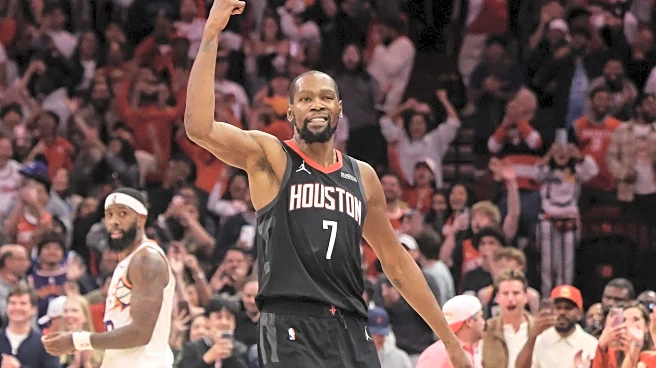
week, dropping a gut punch on a last-second shot from a familiar face. Five seconds left, ball in the hands of Kevin Durant, one hard move to his right, rise up over Royce O’Neale, splash. Rockets win, 100-97.
It landed heavy. Not because it was shocking, but because it was recognizable. Phoenix has lived on the other side of that moment. Those same shots once brought joy when Durant wore purple and orange, when he closed games in the Valley and made the impossible feel routine. This time, it flipped the emotion. The celebration belonged to someone else.
And when games end like that, they do not stay contained to the final buzzer. They spill into locker rooms. They spill into quotes. They open doors. This one did exactly that, giving Durant the floor afterward and giving the rest of us something to chew on.
“I don’t mean to sound too dramatic, but I will,” Durant said in the post-game presser following beating his former team. “To be kicked out of a place and I felt like I’d been scapegoated for the issues we had as a team last year, yeah, it felt good to beat them and hit a game-winning shot.”
It is interesting. And I am not here to tell a grown man how he should feel. But I am here to tell you how it felt from this side.
For everything that happened during Kevin Durant’s time in Phoenix, I am not sure “scapegoat” is the right word. Frustration, sure. Criticism, absolutely. Accountability, without question. When one player takes up 36.4% of the cap at $51.2 million, accountability comes with the territory. That is not cruelty, that is math. And while fans groaned about isolation possessions and teammates standing around watching greatness happen in real time, scapegoating never really fit the relationship between Durant, the organization, or the fan base.
There were too many fingerprints on the mess for that.
Durant was not innocent. His hands were not clean. The numbers looked pristine, efficient, clinical. The results did not. What Phoenix lived through was a locker room without identity, without connective tissue, without a shared edge. That does not land on one player alone. Everybody had a role in producing an underwhelming version of the Suns.
Management deserves its share. Opportunities to properly build around Devin Booker and Durant were burned chasing a broken version of Bradley Beal, complete with a no-trade clause that now sits like an anchor on the books for the next four-and-a-half years. That decision does not fade quietly. It lingers for years, with dead money and limited flexibility as the receipt.
And then there was the coach. The lack of accountability, the absence of a clear structure, and the nightly question of whether effort would show up all pointed back to leadership. From a head coaching perspective, what Phoenix got under Mike Budenholzer was baffling. Schemes felt loose. Standards felt optional. The day-to-day hunger to compete never fully arrived.
So no, “scapegoat” does not quite capture it. This was a shared failure. A group effort in the worst sense. Durant was part of it. So was everyone else.
Did the organization try to move Kevin Durant to the Golden State Warriors before the deadline last season without looping him in? Every rumor worth listening to points to yes. That is life in the NBA. Cold. Transactional. Relentless. And maybe what stung Durant most was not the business itself, but the realization that the franchise was scrambling to clean up its own mess.
Some people want to frame Durant as the mistake. That is lazy. The real problem was Bradley Beal. But Beal had the no-trade clause. Durant did not. One guy was immovable. The other was not. So Phoenix shopped the piece they could move, and that reality probably fed the feeling of being pushed out.
Should they have told him? 100%. That part matters. That was poor form, and it should stick as a learning moment for a young owner.
The only version of reality where Durant truly becomes a scapegoat lives online. Specifically, on Twitter. That is where Durant discourse lived at maximum volume during his entire run in Phoenix. Not because it reflected the real pulse of the fan base, but because social media rewards the loudest, angriest, and most reaction-hungry voices in the room. What you get there are the extremists. The professional outrage merchants. The Stans charging into comment sections like Link, Master Sword raised, ready to battle Calamity Ganon in the name of their chosen hero, KD.
That noise feels personal when you are inside it. It feels like reality when you stare at it long enough. But it is not the whole story. It never is.
There is no doubt that Kevin Durant lives in that space. He has talked about it openly, even referenced it on Starting 5. I have talked with him on the platform myself. He is plugged into that corner of fandom, the replies, the quotes, the noise. He sees it. He feels it. He engages with it. But that slice of the fan base is tiny. Loud, absolutely. Powerful in volume, sure. But small.
There is a quote from Drew Michael on an HBO special that I keep coming back to because it nails this thing perfectly.
“Who’s on Twitter? It’s only people who think it’s a good idea to be on Twitter. It’s not everybody. Most people aren’t on it. 80% of the public doesn’t use it. Everyone on Twitter is somebody on Twitter. There’s an inherent insanity in the medium.”
That line sticks because it is dead on. Everyone on Twitter is somebody on Twitter. It feels massive when you are inside it, but it is not reality. If you drop 17,000 people into Footprint Center on a random Suns night, maybe 20% of them are active on Twitter. And even that might be generous. My point? KD heard the loudest, most obnoxious part of the fan base and lived in that reality.
So yes, Durant believes his narrative. He is allowed to. He lived it. He felt the heat. The fan base had frustrations, no question. Isolation late. Flow breaking. The team not becoming what anyone hoped it would. But there is no version of reality where he was the lone villain, the singular problem, the guy everyone pointed at and blamed for everything that went wrong.
At the end of the day, that chapter is behind us. Kevin Durant hitting the game-winner opened the door one more time, gave him a moment to look back at Phoenix, and gave the fan base a reminder of who he was here. As time moves on, that story will shift. It always does.
For me, the narrative is already settled.
We experienced Durant in Phoenix. He is an all-world talent, a scorer pulled from some other basketball dimension. But it was the intangibles that went missing. When he is on the floor, the offense can drift into isolation and ball watching. Teammates pause. The flow stalls. Movement dries up. The rhythm clogs everything they are trying to become.
Yes, he makes shots that feel illegal. Shots that bend logic. Shots that rip the air out of a building. But the cost shows up around him. Cuts disappear. Energy dips. The offense turns into spectatorship.
I would rather live with this version of Suns basketball. One built on movement. One powered by defensive intensity. One where the ball finds everyone and everyone matters. No star watching. No personality swallowing the room. Five guys moving in the same direction, playing with purpose, making the game feel alive again. Five guys…and no scapegoats.