



We’re a little more than two months away from Phoenix Suns preseason basketball, which tips off on October 5 in Detroit against the Pistons. Damn, that feels like a long time. I guess that’s because it has been. Sometimes I forget how long the offseason really is. During the season, it feels like the schedule never ends. Then suddenly you hit July and August, and the wait feels endless.
As I formulate my expectations for what this team is going to be next season, study the depth chart, and try to understand
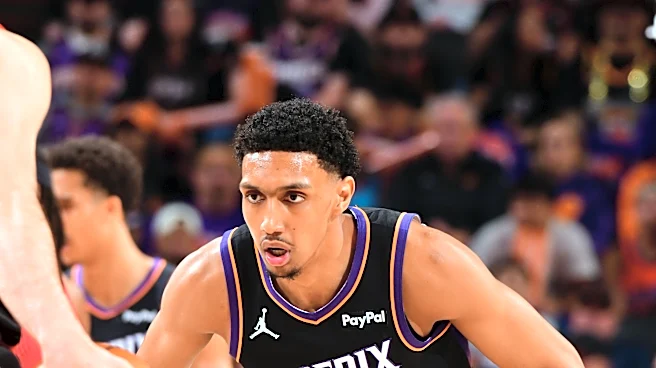
how all the pieces fit together, there’s one player I consistently overlook. Ryan Dunn.
Two offseasons ago, when the Phoenix Suns drafted him out of Virginia, there was a real level of excitement. Part of that was because he was the first player the Suns actually drafted and kept since Jalen Smith in 2020.
When Ryan Dunn arrived, there was hope that he would be the beginning of the Suns’ next youth movement. We understood his limitations as a shooter and hoped that part of his game would develop over time. In some ways, it has. The one thing Ryan Dunn possesses that you can’t teach is his defensive instincts. He has a natural feel on that end of the floor, and those instincts consistently show up.
The challenge is that the statistical production, combined with the eye test, has been inconsistent through his first two seasons. Last year, he actually played more minutes than he did as a rookie, yet averaged 1.1 fewer points per game, finishing at 5.8 points while shooting 45/33/49. That’s what many of us feared when the Suns drafted him. That the shooting would never come. So far, it hasn’t.
The concern was that he’d become a one dimensional player, and through two NBA seasons, that’s largely been the case. When a player can’t shoot 50% from the free throw line, your mind immediately goes to Shaquille O’Neal. Dunn ranked in the 0%-tile in free throw percentage last season.
As I look ahead and try to project what he’ll be next season, it’s difficult to find a clear path. The addition of Miles Bridges means Dillon Brooks is likely sliding back to the three. The Suns also drafted Koa Peat, who brings intriguing offensive upside along with the kind of physicality and size the roster previously lacked.
Then there’s the power forward spot. According to Cleaning the Glass, Dunn spent 51% of his minutes there last season. The results weren’t encouraging. He posted a minus-8.1 net rating at the position, ranking in the 20%-tile. Because of that, I don’t think Dunn should be the backup power forward. Rasheer Fleming has already shown he can fill that role effectively as a three and D player. At this point, that’s something Dunn simply hasn’t proven he can be.
The advantage of having Ryan Dunn on the roster is that you have a defensive player you can throw into a game to disrupt an opposing offense. That role has value. But for someone entering his third season and trying to establish himself in the NBA, that’s probably not the role he envisioned for himself, nor the one we hoped he’d have by this point in his career. The hope was that he would develop into a consistent rotational player, not a situational defensive specialist or an injury replacement.
That’s my concern for Dunn this season. I’m worried he won’t develop because he won’t get the opportunity to. He’s 24 years old, and he is no longer standing in one foot of water when it comes to competition at his position. The water has risen, and it’s becoming harder to swim. If it keeps rising, you might drown.
Factor in that the Phoenix Suns have potential extensions looming for both Miles Bridges and Dillon Brooks, and Ryan Dunn’s situation becomes even more interesting. Dunn is set to count roughly $5 million against next year’s cap, but the Suns hold a team option. That means a decision is coming. This season will be his proving ground. The question is, how much of a proving ground will he actually get? That’s the Ryan Dunn conundrum.
Ryan Dunn’s future may depend less on whether he’s capable and more on whether the opportunity ever materializes. The Suns are deeper, more balanced, and far more competitive at his positions than they were a year ago. That’s good news for Phoenix. It may not be good news for Dunn. Third seasons are supposed to provide clarity. For him, this one feels like it will determine whether he’s part of the Suns’ long-term plans or simply caught in the numbers game of a roster that’s moved ahead without him.