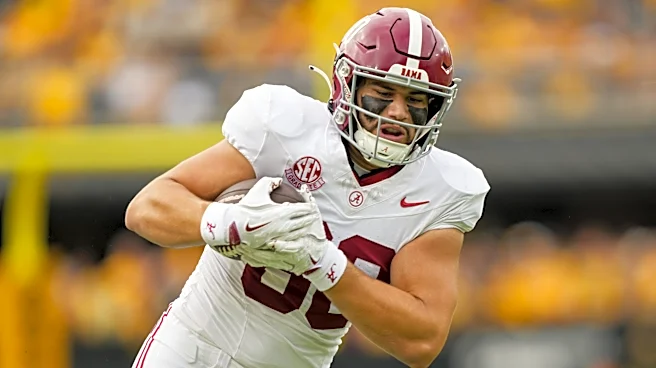


Yuri (@Yuri_Ravens) is back with another Ravens rookie scouting report for fifth-round pick (No. 173 overall) out of Alabama, Josh Cuevas. When Baltimore has double-dipped on tight ends in the past, their second one has emerged as the better player. Will that be the case once again with Cuevas?
- Vega Ioane (G, Penn State, No. 14 overall)
- Zion Young (EDGE, Missouri, No. 45 overall)
- Ja’Kobi Lane (WR, USC, No. 80 overall)
- Elijah Sarratt (WR, Indiana, No. 114 overall)
- Matthew Hibner (TE, SMU, No. 133 overall)
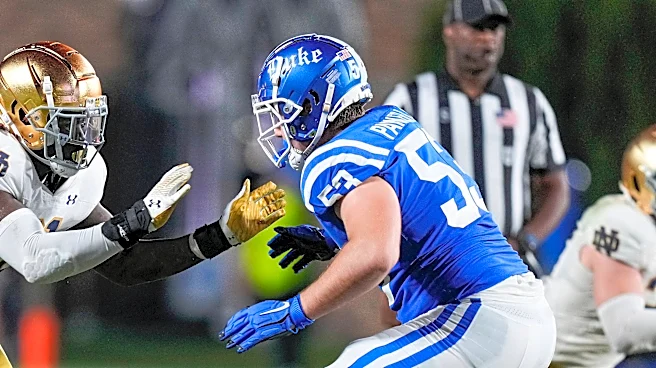
- Chandler Rivers (CB, Duke, No. 152 overall)
Short/Long-Term Projection
With the departure of Isaiah Likely and the loss of his pass-catching production, slot versatility, and playmaking ability at the tight end position, the Ravens face an immediate need
for a complementary receiving threat. Josh Cuevas projects as a potential early candidate to fill aspects of Likely’s role, offering positional flexibility and receiving upside as a Day 1 developmental replacement. Long term, Cuevas profiles as a potential TE2 or high-end TE3 option, contingent upon his continued development, refinement, and overall growth as a player.
Strengths/Weaknesses
Cuevas projects as a receiving-oriented tight end with clear value in the passing game. He displays strong coverage awareness, consistently identifying soft spots against zone coverage and presenting himself as a reliable target for quarterbacks. As a pass catcher, he possesses dependable hands, recording only three drops over his last three collegiate seasons while also demonstrating strong ball security with zero career fumbles. His straight-line speed is evident after the catch, reflected in his 4.60 forty-yard dash, allowing him to generate yards in space. As a blocker, Cuevas shows sound initial strike technique and is effective in a chip-and-release role, where he can briefly assist in protection before entering routes and leveraging his receiving skill set.
However, Cuevas presents some limitations that may cap his ceiling at the next level. At 6’3”, 245 pounds, he projects more naturally as a slot tight end or H-back rather than a traditional in-line option. He lacks the raw play strength to consistently generate movement as a run blocker and struggles with grip strength, leading to difficulty sustaining blocks and frequent slips off contact. With the ball in his hands, he can be too easily brought down on first contact and does not consistently play through tackles
Scheme Fit
Cuevas projects as an F/slot-style tight end within Doyle’s offensive scheme, where his receiving ability and positional versatility can be maximized. His most productive collegiate season came at Cal Poly, where he aligned in the slot on 68.4% of his snaps, highlighting his comfort operating in space and functioning as a receiving mismatch. By comparison, his role at Alabama was more limited from a deployment standpoint, with only 29.4% of his snaps coming from the slot. Within the Ravens’ offense, Cuevas could also provide value as a wing tight end aligned off the line of scrimmage, allowing him to build momentum prior to engaging defenders as a blocker and helping mitigate some of his functional strength limitations in-line.
Intangibles
Cuevas demonstrates a strong understanding of the nuances and responsibilities associated with the tight end position. In an interview during his time at Alabama, he emphasized the importance of the “small things” required to play tight end effectively, detailing the multiple responsibilities and role versatility demanded by the position, which reflects a high football IQ and appreciation for offensive detail. Additionally, Cuevas’ path as a former walk-on speaks to his resilience, work ethic, and determination, illustrating the level of grit and persistence required to develop into the player he is today.
Comparisons: Ed Dickson, Ian Thomas