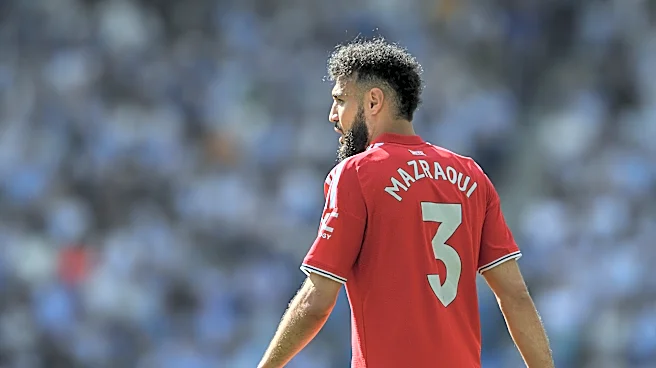





12 months ago there was not a lot for Manchester United to be positive about. The team had finished 15th in the Premier League and had lost the Europa League final to an equally struggling Tottenham Hotspur side. Nevertheless, with the end of the season being the time for accolades and superlatives to be given out you have to find something to be positive about.
For many, that something was Noussair Mazraoui. In an article for The National, Andy Mitten claimed that “multiple insiders on the football
side at United say Mazraoui is the best signing United have made for years.” This was a very popular sentiment shared by many different fans and social media accounts.
The basis for Mazraoui being the best signing in quite some time came down to two things. Transfer fee and availability. Mazraoui was signed for a modest £12.8 million fee and was always available, making 52 starts in all competitions in four different positions. He wasn’t particularly great at any of them, but he was reliable, often described as a “steady eddy.”
Calling a “steady eddy” one of United’s best transfers in recent years was, unfortunately, justified. That’s not a knock on Mazraoui, it just shows how low the standard had become at United that so many recent transfers couldn’t even provide that level of contribution.
Still, 52 starts isn’t anything to scoff at. It’s a number you’d dream all your new signings will achieve. You’re obviously not going to start 52 games if you can’t stay fit but you’re also not going to start that many games if there are better players than you in the squad. Mazraoui performed better than most United players and was held in high regard by his teammates. He reportedly finished runner-up for the Matt Busby Player of the Season award as voted on by the players.
In a related story, Manchester United finished 15th.
That’s not a coincidence. Mazraoui may have been the second best player in the team but if your second best player is Noussair Mazraoui, you’re going to finish around 15th. Bayern Munich do not typically let good players leave, let alone leave for just £12.8 million. They sold off Mazraoui for cheap because Noussair Mazraoui is not a very good footballer.
Noussair Mazraoui was signed to play right back for Manchester United. In two seasons, he has started 28 Premier League games at right back or right wing back – United’s record in those games stands at 9 wins, 7 draws, 12 losses (32.14 win percentage, 1.21 points per match). In Ruben Amorim’s back three system, Mazraoui would often feature as a wide center back. However, United’s record wasn’t any better – 4 wins, 5 draws, 7 losses (25%, 1.06 PPM), with one of those wins coming under Michael Carrick in a back four. When Mazraoui hasn’t been in the starting XI at all, United’s record stands at 18 wins, 8 draws, 5 defeats (58.06%, 2.0 PPM).
Now With or Without You (WoWY) stats can be a bit dangerous if you don’t flood them with context, as there’s a ton of things you need to control for.
The first is obviously that most of this time was during the Ruben Amorim era where United were plain old bad. You can’t pin that on any one player but the same trend is there. United won 0.46 more points per game when Mazraoui wasn’t in the team during the Amorim era.
At the most basic level, United’s turnaround under Michael Carrick has been down to one thing. Carrick has taken a very simple approach and the simplest thing he’s done has been play United’s best players (in their best positions) and not play their worst ones. This was also the key to United getting much better results under Amorim earlier this season compared to last year. United got better players in attack but their worst players played a lot less. Manuel Ugarte and Mazraoui went from starting nearly every game last season to barely playing at all this year.
The Amorim era brings another caveat as it often meant Mazraoui was deployed as a wingback, which is objectively not his position. This is a valid point but it’s not an excuse to dismiss the entire period.
While Mazraoui wasn’t signed with wingback in mind, he was signed to play fullback for Erik Ten Hag, and the way Ten Hag set up his team his fullbacks were almost just as crucial to the attack as wingbacks were for Amorim.
Ten Hag had his wingers taking up very wide positions, pinning them to the touchline while the fullbacks would push forward into the most dangerous spaces.

United would often find themselves with Diogo Dalot being the highest man up the pitch. That United’s best chances would routinely fall to Dalot wasn’t an Amorim thing. It was a Ten Hag thing that continued under Amorim.

In order for this to work you need fullbacks who are good attackers. Knowing what he needed, Ten Hag pushed to sign Mazraoui. He felt so highly about Mazraoui’s attacking ability he started him as the no. 10 one game!
The type of fullback Ten Hag needed wouldn’t have much an issue shifting to wingback. It’s also worth noting United’s record under Amorim was better when Mazraoui started at wingback then when he played as a centerback.
The WoWY numbers hold up under scrutiny but WoWY stats are not actually good for determining the quality of a player. You don’t need WoWY stats to know that Casemiro is better than Ugarte. But it’s rarely that clear cut.
What WoWY stats do is flag something and let you know there might be something here. If the team gets better or worse when a certain player plays why is that? What is that player doing or not doing that their replacements are or aren’t? It’s showing you where you need to dig deeper.
In the case of Mazraoui, those numbers were waving a big red flag. So let’s dig deeper.
On the pitch, Mazraoui is, safe. He’s not a particularly great defender, but he wasn’t bad enough to be considered a liability either. He was calm and assured on the ball. He wasn’t adventurous in attack but he didn’t turn the ball over either. The latter is a trait that particularly stands out to fans. Fans don’t like it when players give the ball away. Even players who are making things happen draw the ire of fans when one of those passes gets misplaced (see Fernandes, Bruno). This leads to overrating overly safe players.
When you don’t give the ball away you’re not making visible mistakes. Fans like players that don’t make mistakes. Sure if you’re not pushing the needle you’re making it more difficult for your team to score goals but it’s so difficult to measure something that isn’t happening. It’s hard to assign blame there either. After all Mazraoui is a fullback, it’s not the fullbacks’ job to score goals.
Years ago Mazraoui being a water carrier as a right back would have been no problem whatsoever. Unfortunately in 2026, fullback has emerged as one of the most important positions on the pitch. In modern football the fullback’s job has become to support pretty much everything. They help out with ball progression, they invert into midfield to solidify the defense, they provide support to the wingers, they get up on the last line of defense to join the attack and provide creativity. Nobody can do all those things but most clubs typically need their fullbacks to do at least two of them.
There are so many different ways for a fullback to contribute to an attack and make an impact, how can we actually measure them. Mazraoui hasn’t scored a goal for United yet. He has two assists in all competitions. But using goals and assists (and their underlying xG & xA) hardly tells us the whole story as those are very role-dependent statistics.
Players like Andy Robertson in his prime or Achraf Hakimi are often tasked with being primary creators in their team. They’re naturally going to have very high underlying numbers. But most teams don’t ask their fullbacks to be primary creators. Some ask their fullbacks to be secondary creators, mostly by providing crosses into the box after making an overlapping run off the winger.
Others merely ask their fullbacks to help support the attack. This is the came that Manchester United currently fall into.
What does supporting the attack actually mean though? At it’s most basic level it means providing the attackers what they need to do what they do best. It can come in many different ways. The most important thing is to be able to get your attackers the ball in situations where they can be at their most dangerous. It can also entail making runs to give them space and draw attackers away from them. It can be a matter of taking up the right position on the pitch. An attacker who knows his fullback is always in the right spot to cover for him can feel that he has more freedom to be aggressive with his attacking.
In this situation a good fullback isn’t going to be the guy who receives the accolades. A good fullback is a guy who is doing things that allow his teammates to thrive. These things don’t necessarily even involve touching the ball, so they’re not going to show up in your progressive passes, final third entries, xA, or any other stat. How the hell are we supposed to measure that?
There’s no good way to do it, so I came up with an imperfect measure of my own. If the job of a fullback is to support the players around him so they can perform, why don’t we look at how the players who played next to him actually performed?
When Mazraoui was playing right back, how did the right winger perform? Did he score goals, did he create chances? When he was deployed as a wing back, how did the right side number 10 do? I went through all the matches and looked at the numbers, then I did the same thing for the left side when he played there (this excludes minutes played as a center back). It’s not a perfect measurement as teammates miss chances all the time or they can score goals that have absolutely nothing to do with the fullback, but if players seem to perform better – or worse – when someone is playing on their side that can us something.
What were Mazraoui’s teammates doing when he played behind them? Were they scoring goals or creating them? Not all that much.

Over two seasons it’s just the four goals and two assists. Of course this doesn’t really mean anything without context. How does this compare to other players? Here’s United’s other right back, Diogo Dalot.

Right wingers or no. 10s actually score more with Mazraoui at right back than Dalot, though production for Dalot remains fairly consistent when he moves over to the left. The creativity is also a bit better with Dalot, albeit 0.12 isn’t something anyone should be bragging about.
Dalot and Mazraoui are natural fullbacks who spent a lot of time playing as wingbacks, so it’s only right to take a look at the numbers of United’s two other wingbacks as well.

I’m sure no one is surprised to see Amad’s numbers looking significantly better than those of Dalot and Mazraoui. That’s what happens when you put a natural winger in that position. Unfortunately it’s not particularly helpful for United now that they’ve gone back to a back four.
Patrick Dorgu has done some good things in very limited minutes as a left winger, but those numbers don’t bode well for any ideas of him being able to usurp Luke Shaw at left back. While Shaw was almost exclusively used as a center back under Amorim and only played about half a season at fullback, here’s what his numbers look like.

Nine goals from three different left wingers! In only half a season. Matheus Cunha’s season exploded when he started playing with Shaw outside of him. It’s hardly the first time we’ve seen this either. For nearly the past decade, nearly everyone who plays on the left wing seems to perform much better when Shaw is in the team. It’s why Shaw’s been described as the spice that makes the sauce. It’s a big reason why United win a hell of a lot more often when he’s in the team.
Shaw’s individual stats aren’t all that grand, so the question is what is Shaw doing that helps his teammates so much? Or rather is there something Mazraoui isn’t doing that makes it so much harder for the right wingers?
Let’s go to the videotape.
Once you start watching Mazraoui – actually watching him rather than the actual game/ball – something becomes very obvious right away. Noussair Mazraoui does not provide support to his wingers. He doesn’t show for them, he doesn’t make runs to help alleviate pressure, he doesn’t overlap.
Take this situation against Newcastle. Bruno has the ball in the middle of the pitch. Bryan Mbeumo is out wide, Mazraoui is behind him with no Newcastle players around.

Bruno plays the ball out wide to Mbeumo. Two Newcastle players come over to double-team him, giving Mbeumo no options.

If Mazraoui makes an overlapping run, even if Mbeumo doesn’t give him the ball the left back will have to go with him. That would put Mbeumo in a 1v1 situation against the defender, giving him a better chance of making something happen. Instead, Mazraoui stays put, and Mbeumo has no options going against two men.

Mbeumo was nullified and ineffective and against Newcastle. He drew the ire from fans after the match. But he spent the entire match facing double teams and completely isolated from his teammates. It’s hard for a winger in the best of situations but getting no support from the fullback makes it almost impossible.

It doesn’t matter if you’re a good attacker or not, just making the overlap helps your winger out significantly. Just look at how much space Marcus Rashford gets when Aaron Wan-Bissaka provides him with an overlapping run here. Wan-Bissaka was not a great attacking fullback, especially not from the left side. But just by making his run the defender has to go with him and Rashford doesn’t have to face a double team.

If you scroll back up and look at Dalot and Mazraoui’s charts you’ll notice that for both players all but one of those goal contributions have come before Michael Carrick took over. That suggests there’s likely some tactical instructions at play here.
The numbers suggest that Carrick has his right back playing much more conservatively (which the video tape agrees with) and not pushing up into the attack as much. We can see this clearly with Diogo Dalot. As mentioned before, a staple under Ten Hag and Amorim was Dalot routinely getting behind the defense and getting United’s best chances. Dalot took one more shot under Carrick this season than he did under Amorim, but his xG per 90 fell from 0.08 to 0.05. His xG per shot went from 0.11 to 0.06. He was no longer getting great chances, his shots were reduced to mostly being the type fullbacks take after corner kicks where they blast the ball into the stands so everyone has a chance to get back on defense.
The right back being told not to get forward would answer a lot of questions on this matter. But when you watch Mazraoui, you’ll notice that not only does he still get forward, he’s doing it often. It’s the positions that he takes up when he goes forward that highlight the problem.
Mazraoui likes to stay very narrow.

He’s taking up positions that will see him get into spaces that players are going to try and create chances for him.

If Mazraoui is in the dangerous positions, that means better players than him aren’t. This is even more pronounced when Mazraoui plays on the left side. As a left back he takes up very narrow positions, forcing the left winger to stay wide and hold the width.
This leads to situations where Mazraoui is getting on the ball in the dangerous spaces.

Here Cunha has tucked inside and has plenty of room to get into a dangerous space.

But Mazraoui is still further inside than Cunha and he’s bombing towards the box. Therefore when Bryan Mbeumo plays the pass across to Cunha, Mazraoui is in position to get there first.

If you’re Manchester United’s opponent this is exactly what you want. You don’t want the dangerous shot going to the dangerous player. You want it going to the harmless fullback who has almost no attacking ability. If this is happening by design, that’s really bad coaching. When it doesn’t seem to be happening with Luke Shaw or Diogo Dalot, then it doesn’t seem to be the tactical instructions behind this. That’s a problem.
When Mazraoui takes up these narrow positions, it essentially turns him into an attacking player. That makes the no goals and one assist in two years numbers matter, because he’s taking up positions that require output. By doing that he’s hurting the team in two ways. Not only is he not producing from these high-value positions, but he’s forcing better players to take up lower-value positions, making it much harder for them to produce and impact the game.
Nowhere was this on display more than the match against Newcastle. Mazraoui started the game at right back and did not support right winger Bryan Mbeumo, who dealt with double-teams all game. In the second half, left winger Matheus Cunha started to come into the match and look really dangerous. An hour into the match, Luke Shaw had to come off, and Mazraoui moved over to left back. That was it for Cunha, who immediately stopped looking threatening.
Cunha’s touch map from before and after the Shaw substitution tell the entire story.

Over the first 60 minutes Cunha is getting on the ball all over the pitch. Once Mazraoui comes over he’s reduced to just having it along the touchline where it’s harder to be effective.
That’s the difference in a nutshell. Luke Shaw doesn’t play aggressively but he helps out his teammates. He shows for them in buildup, he creates passing triangles to relieve pressure from them and then get the ball back to them. He provides overlaps for them even if they’re not going to use it.

Most importantly, he takes up positions that allow his teammates to go and do what they’re best at. He stays wide so the attackers can be the ones getting closest to the goal.

Most important of all is he does it consistently. The left wingers in the team know that Shaw has their back. They know that no matter where they go Shaw will be in position to cover for them if things don’t work. That gives the freedom to move around the pitch and attack dangerous spaces where you might not expect the left winger to pop up in.
It doesn’t have to be complicated. After watching hours of Mazraoui footage from the last two years it’s astonishing how rare it is to see him to do these very simple fullback things. Since Carrick has taken we’ve only seen Mazraoui push forward and stay wide just a handful of times.
The first was in transition against Newcastle where Mazraoui drew a foul.

United scored the equalizer off the subsequent free kick.
The last time we saw him do it was against Brighton, when he held a wide position outside the box while Amad tucked inside. Mason Mount picked him out with a clever ball, Mazraoui fires it inside to Amad, whose link-up play with Mount leads to a goal.

It really is that simple sometimes. Yet we so rarely see Mazraoui do these simple things. He doesn’t do things that will increase your chances of losing a game, but him not playing his position well make it harder for everyone else, which makes it more difficult for you to win games.
This is a very important summer for Manchester United. They have a lot of holes that need to be filled, addressing a backup right back shouldn’t have to be a high priority. Unfortunately it’s probably more important than many people think.
United have high ambitions for next season but unless Mazraoui magically becomes a different player over the summer, an extended run in the team from him next season will make it very hard to achieve those ambitions. If we knew Mazraoui would only have to start 10-12 games in all competitions next season then there wouldn’t be a problem. But what are the chances that will happen?
Diogo Dalot has been a fitness machine over his career. He’s a safe bet that he could play 50 matches if he was asked to. The issue is on the other side of the pitch. Luke Shaw started all 38 Premier League games this year. It’s a great accomplishment but there’s no way he’s doing it again next year.
Shaw has never played two thousand minutes in consecutive seasons. Unfortunately, we have to assume he’ll run into injury problems next season. Patrick Dorgu has been very good in limited minutes on the left wing, but hasn’t shown any attributes that would translate to being an adequate replacement for Shaw as a left back – nor has Carrick even looked at him there. That would leave Dalot (or Mazraoui) potentially having to cover a lot of minutes on the left side. Regardless of who it is, it would mean Mazraoui is in the team.
United’s priority needs to be the midfield. Once that’s taken care of they need another fullback. That can be a left back where they need to find a long-term successor to Luke Shaw (and would be a bonus if he could also play on the right if needed). If that player isn’t there you can also sign a right back that could potentially push Dalot into a backup role (on either side). Regardless of how they do it, it’s a position that needs to be addressed.
United’s attackers are broadly good but the front three doesn’t feature any superstars that can put the team on their back. The success of the team comes from players working together to ensure they all can succeed. If United are going to succeed next season, they can’t afford to have players who make other players jobs more difficult.