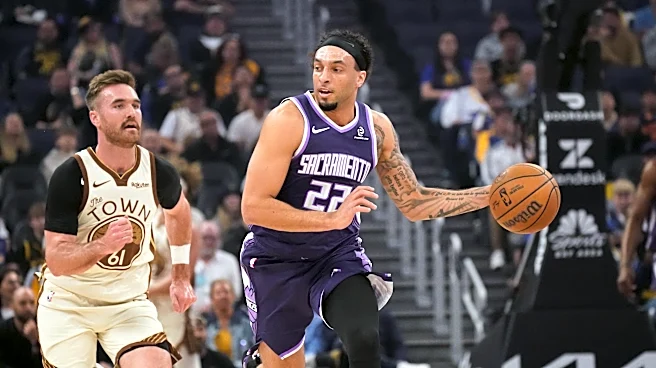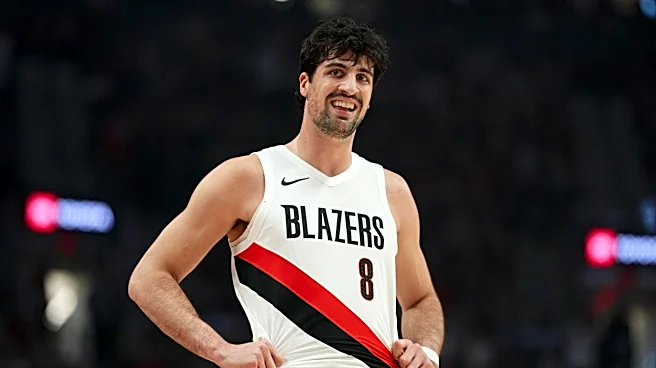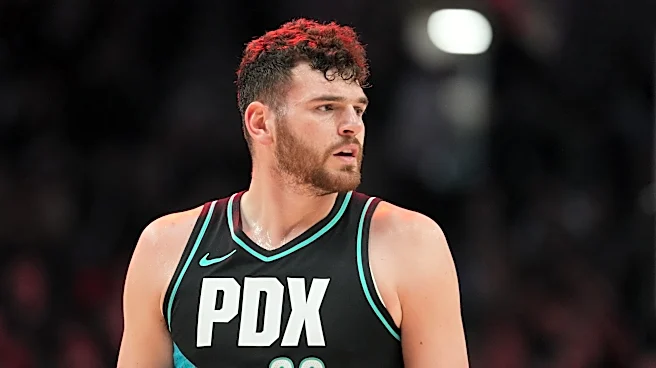



The Portland Trail Blazers might own the league’s biggest predictive chasm between ceiling and floor this coming season. While guards Damian Lillard and Ja Morant appear to be big additions on paper, the makeup of the broader roster is perplexing and far from what you would consider complementary.
One of the biggest factors dictating the fate of this campaign is located in the frontcourt as Donovan Clingan prepares for his third season — at the end of which could lie a healthy contract extension.
Arguably the second-best player from the 2024 NBA Draft class, the former UConn product is in a position to solidify himself as this franchise’s future defensive anchor.
Clingan turned a lot of eyes last season, flipping the switch on a less-than-ideal rookie campaign. That first season raised questions about the 7’2 big man’s motor and his ability to contribute on the offensive side of the ball. Those concerns were allayed as soon as Deandre Ayton was bought out and Clingan was given the keys to the center spot.
Perhaps it was also the Blazers’ selection of Yang Hansen with their one and only 2025 first-round pick that inspired Clingan to push closer to his potential. By the end of last season, he’d lifted his averages, registering 27.2 minutes, 12.1 points, 11.6 rebounds, 2.1 assists and 1.7 blocks. That included league-best marks for 4.5 offensive rebounds a game and 892 total rebounds.
He also managed to develop a skill on the offensive end, lifting his three-point attempts from 0.7 to 3.2, while making 34.1 percent of them. While no one’s calling him a stretch five just yet, the fact that he was able to more than quadruple his attempts and set a league-average conversion rate is promising.
Unfortunately, he was found out during the Blazers’ first-round playoff series where Clingan was well and truly outplayed by Victor Wembanyama and, to a lesser extent, Luke Kornet. Though nobody has found a way to stop San Antonio’s French superstar, the Blazers looked to Robert Williams III to take on a larger role to combat the Spurs big men.
In those five games, Clingan’s numbers fell to 21.4 minutes, 7.0 points on 20 percent shooting from three, 7.8 boards, 2.2 assists and a disappointing 0.6 blocks per game. Conversely, Williams’ numbers rose to 21.6 minutes, 9.6 points, 7.4 boards, 2.6 assists and 1.2 blocks. He also debuted a real three-point shot, hitting 33.3 percent on 1.8 attempts, and looked more capable of defending the more athletic Spurs squad.
Tiago Splitter’s decision to defer to the more experienced big shouldn’t be read as a sign that Clingan won’t ever be up to the task, it’s just that Williams’ experience was, at that time, a safer bet in the higher-stakes games. But it did confirm that Clingan still has plenty to work on.
I’ll be the first to acknowledge that I was on board with trading Clingan to the Boston Celtics for Jaylen Brown a couple of months ago. Not because I wanted him gone but because including him may have dramatically reduced the number of assets the Blazers would have parted with to get Brown. While Brown would have been a nice addition, I’m partially relieved Clingan is still in Portland, but where do we go next?
This Season
In an ideal world, Clingan makes a similar-sized leap in year three. But what does that look like? Let’s start with the baseline. Clingan playing at least 75 games averaging 30 minutes a night should be the benchmark. That’s 2,250 regular season minutes to work out further kinks and solidify his role as an above-average starting center.
There’s nothing stopping him from contending for the rebounding title, pulling down 12-plus boards a game, while maintaining his supremacy on the offensive glass. Wembanyama’s 3.1 blocks a game won’t be touched but with Clingan’s natural rim protection ability, his blocks per game should match fellow 2024 draftee, Washington Wizards big Alex Sarr, who posted 2.0 a game last year.
On offense, I’m fine with Clingan’s 3.2 three-point attempts a game. Any more than that and the Blazers likely lose out on those offensive boards he’s so adept at fighting for. But there’s room for improved efficiency and the hope that he boosts that rate from 34.1 percent to 37-38 percent. This kind of accuracy turns him more into a stretch five, opening the floor for Damian Lillard, Ja Morant and Deni Avdija to get to the rim.
The biggest difference Clingan can make is within four feet of the rim. For a guy his size, his conversion still leaves a lot to be desired. Last season, Clingan averaged 65.7 percent at the rim, good enough for 101st among bigs. Outside rim attempts, that rate falls to 41.0 percent, worthy of 103rd among bigs and probably a source of a number of offensive boards.
For Clingan to find realistic supremacy, I want that rim rate to jump to Jarrett Allen’s 77.4 percent, which is still just 16th among bigs. Shots within four feet should be up somewhere around Robert Williams’ 56.7 percent, ranking 21st among bigs. Whether it’s a post move or a roll to the rim, both statistics should be more than reasonable to achieve and will give opposing teams another headache to consider.
If he repeats or reduces on last season’s output, the Blazers are still fine, but Clingan would remain just another defensive-minded big who can’t impact the game much on the other side of the ball.
Conclusion
Though Clingan will always be more comfortable in drop defensive coverages, the hope is that he can continue to work on his mobility in order to come out to the perimeter in select situations. No one will ever conquer Wembanyama, but Clingan has the tools to make a contest when the two are in the paint.
On offense a little more efficiency from beyond the arc will help, but it’s closer to the rim where Clingan can make the biggest improvement. If Clingan can give the Blazers a better scoring option in the paint, this team has another outlet to score points.
We all know what Deni Avdija is capable of and there’s hope that both Damian Lillard and Ja Morant can rediscover former glory. But if Clingan can be a genuine two-way option, this roster moves closer to that ceiling and further away from the the floor.
Not every franchise has a guy standing 7’2 with a 270lb-plus frame who can do what the former UConn champion can do; we just need to put theory into practice and more shot attempts to become makes.