

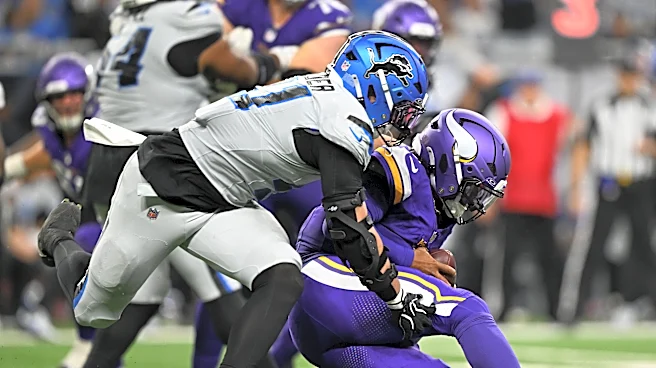

On Thursday, all three Detroit Lions coordinators spoke with the media. The three sessions were highlighted by defensive coordinator Kelvin Sheppard talking emotionally and passionately about Jack Campbell, and the team’s response to his serious injury.
Here are my eight takeaways from the entire day of press conferences.
Offensive coordinator Drew Petzing
Where do these unique ideas come from?
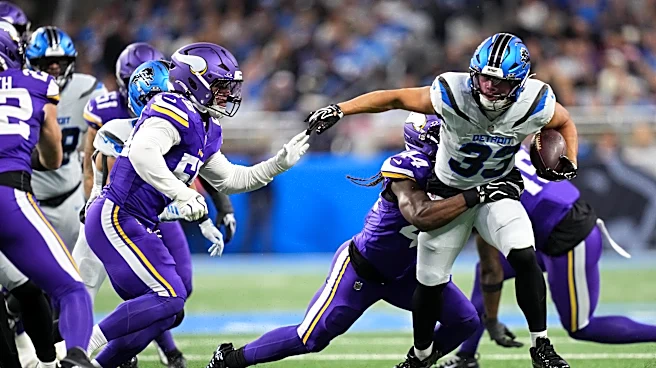
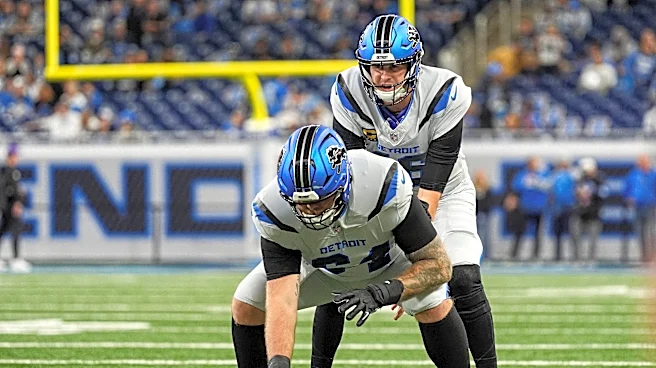
The Lions pulled out a couple of new tricks last week against the Vikings: a “sidecar” formation with two tight ends hugged to one side of the backfield,
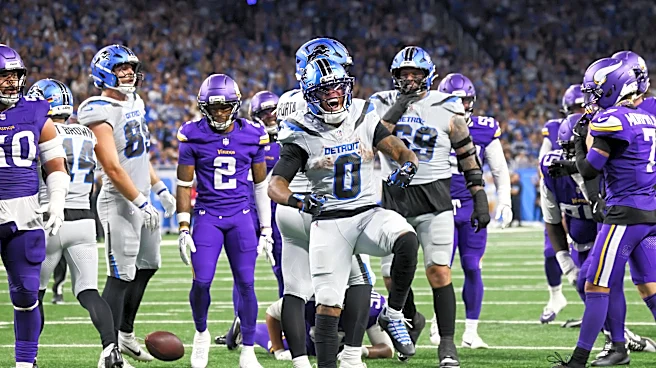
and a semi-trick play involving Amon-Ra St. Brown lined up 15 yards off the line of scrimmage to get a running start before catching the ball.
Both adjustments were extremely successful for Detroit, so Petzing was asked where he found inspiration for them.
When it comes to the tight end formations that helped out the run game, Petzing said they take ideas from everyone, but singled out run game coordinator/offensive line coach Hank Fraley.
“A lot of the run game starts with Hank,” Petzing said. “And I think he does a great job of putting that stuff together and staying creative and making it hard to defend, but also doing things that are comfortable to us that we can go out and execute at a high level.”
As for the St. Brown play, that has been credited to pass game coordinator Mike Kafka. While the exact origin of that play isn’t clear, Petzing thinks Kafka’s connections to Northwestern—where Chip Kelly is doing some unique things—may have played a hand.
“He’s a Northwestern grad and Chip Kelly’s over there doing some pretty innovative stuff right now. So, I’m sure some of it came from there,” Petzing said.
He also admits there’s been some CFL influence lately.
“The CFL, I’ve seen some CFL tape over the last two months, but you’re always looking for just different ways to be hard to defend,” Petzing said.
Believing in 12, 13 personnel
Through the first seven games of the season, the Lions were not running the ball well with more tight ends on the field. Exhibit A:
But Detroit was fantastic with 12 (one running back, two tight ends) and 13 personnel against the Vikings. So I asked Petzing why he chose to stick with it. The answer is that it was sometimes not about the personnel, but either execution or finding the right matchups for each week.
“Some of those metrics to me are, ‘Was it scheme? Was it execution? We lost somewhere that didn’t have anything to do with the personnel we had on the field,’” Petzing said. “So, I generally think of it much less from that standpoint and much more from a, ‘Can we dictate a defense? Can I move gaps around? How do they want to play those personnels?’ It probably has a lot more to do with what they’ve put on tape against certain areas than necessarily how we’ve been against teams that aren’t them, if that makes sense.”
Defensive coordinator Kelvin Sheppard
Finding strength through his own players
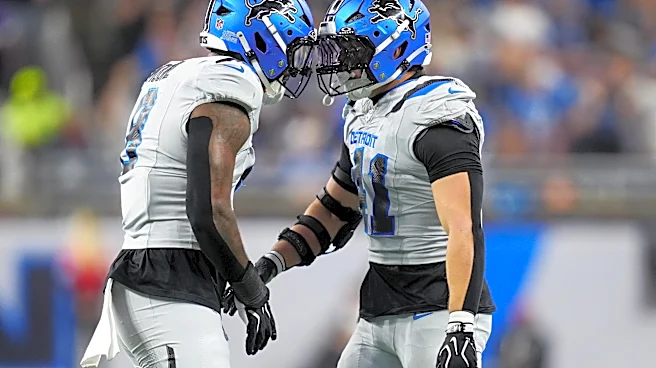
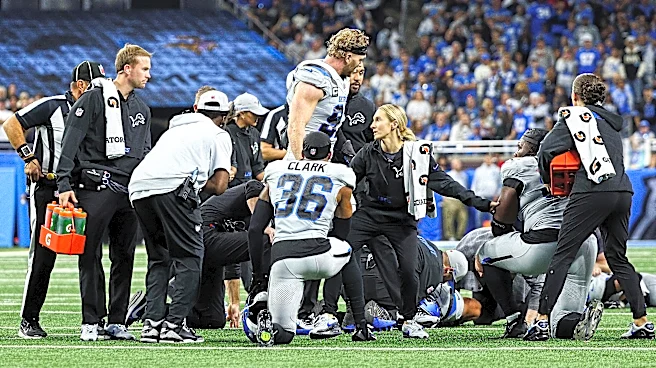
When Jack Campbell went down in the fourth quarter of Sunday’s game, Sheppard admitted he couldn’t hold back the tears. As he fought through his own emotions, he found strength looking at the players around him. While they, too, were obviously emotional, he was inspired by how players like Aidan Hutchinson were using the moment as a rallying cry.
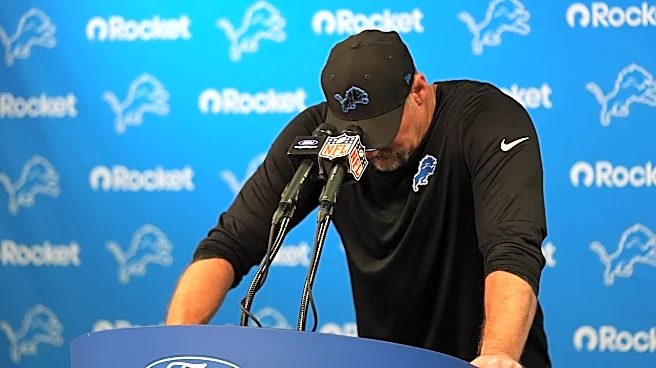
“As I looked at players crying on the field, keeping my emotions intact, I’ll be lying to say I wasn’t crying. And where I was able to find my strength was my players,” Sheppard said. “And seeing tears roll down Aidan Hutchinson’s eyes and hearing them say, ‘We’re about to do this for 46.’ And once we have got to the sideline, I know you guys saw the moment of unity was prayer. Because in that time, I believe there’s times in life where you can lean on people. You can lean on people that are strong.”
Then, on the first play back from the break—a critical defensive fourth down—Sheppard did something he rarely does: blitz on fourth down. Why? He saw the passion in his players.
“We’ve never pressured on fourth down. And I know I’ve gotten asked why, what call, why that call in that moment? And it’s because when I looked at our players, I looked at that call sheet and I said, ‘Let’s go for 46.’ I heard Aidan and I said, ‘Let’s do it,’” Sheppard said.
Sheppard called the performance from Hutchinson and Derrick Barnes on that play “remarkable,” as they pressured Kyler Murray into a rushed, incomplete pass.
Awesome Jack Campbell story
To put that previous story in context, Sheppard explained just how much Campbell means to him. He brought up a moment from earlier this year. After the first four games of the season, there was a lot of outside noise about Sheppard and his job security. As the team prepared for the Arizona Cardinals, Campbell visited Sheppard in his home, and promised he would play his heart out for him.
“When the heat was on me, that’s why I spoke the way I did—because of what my players were telling me. You guys have no idea. Jack (was) sitting on my couch before the Arizona week telling me he’s going to play for me. I’ll leave it at that,” Sheppard said.
Putting football aside
Sheppard said that the messaging on Wednesday for the team was to put football aside first before they can transition to game-planning. That goes back to one of his main tenants of coaching football.
“You better understand the person before the player or you’ll never get to the player, ever,” Sheppard said. “You’ll never know how to talk to him. You’ll never know how to make him go. You’ll never understand why he’s doing things. You’ll never understand why he’s playing football if you don’t know that stuff. So, I always start there. I always have. I’ve always believed in that.”
Sheppard also credited Dan Campbell with starting the week by immediately putting to the football to the side and allowing players a platform to talk through things.
“When he starts the team meeting, football’s over there right now. Let’s talk about it. ‘Does anybody want to stand up and talk? Does anybody?’ And allowing that platform, allowing the vulnerability of people, everybody sees this game as a macho game. Real, real strength, real leadership is being vulnerable, understanding your weaknesses, understanding you don’t have it all figured out and knowing where to lean on people. And that’s what we’ve done as a team. That’s what we’ve done as an organization. And it’s the reason why we all enjoy being here.”
The linebackers that remain
With the Campbell and Jimmy Rolder injuries, focus turns back to the likes of Derrick Barnes, Malcolm Rodriguez, Trevor Nowaske, and Joe Bachie to step up. These players have been around the defense for several years now, and Sheppard knows them well and trusts them.
“I raised these other guys that’s about to play. Malcolm Rodriguez and Derrick Barnes. Those are my little brothers and they know the standard,” Sheppard said. “They both have worn the green dot before. So, this isn’t like a first time ordeal for either one of them because that load might get shared. We’re still working through that, but I’m confident in either one of them. And even a guy like Bachie, who everybody in this room is like, ‘Bachie, Bachie’, he’s number 35. He’s going to have a role in this game and we trust him wholeheartedly if he needs to put on the green dot to stand in front of that unit.”
Special teams coordinator Dave Fipp
Jake Bates’ miss wasn’t really his fault
Fipp revealed that Jake Bates’ missed 40-yard field goal—his first missed kick of the season—wasn’t really his fault. Holder Jack Fox’s non-holding hand was a little too close to the football, and Bates struck his hand simultaneously with the ball.
“Ultimately the ball ended up kind of hitting Fox’s down hand. So, his hand was a little bit in the way on the thing,” Fipp said. “So, he really hit a good ball. It didn’t look like that obviously to us and hitting the upright, but that was really the cause of it.”
Here’s a replay of it:
Sione Vaki’s graduation
One of the hardest parts of being a special teams coordinator is the personnel is always changing, not just year-to-year, but week-to-week. Injuries force players into bigger roles on offense and defense, forcing them to scale back on special teams snaps and another player to step up in their place. That’s a big challenge for Fipp this week, particularly at the linebacker position—where Trevor Nowaske and Malcolm Rodriguez are likely to take on bigger defensive roles.
But he also may have less of Sione Vaki, who established himself last week as a reliable RB2 on offense. Fipp talked about his pride in watching Vaki succeed, comparing his rise on offense to a graduation—a new step in his football career.
“There’s a couple of things I love. Watching a player like that explode on the offensive side of the ball or on the defensive side of the ball, we talked about it earlier. I call it graduating, you’re starting to graduate and work yourself up the ladder,” Fipp said. “People are starting to realize what you can do and bring to the table. He’s obviously been a great player. It’s no surprise to me that the guy’s a good running back too. But yeah, there’s nothing like seeing it. It’s like watching your kid out there, a guy that you’ve been close to and worked a lot with and hasn’t had the chances carrying the ball and doing that stuff that he’s wanted, I’m sure forever, but he got the opportunity and made the most of it is definitely gratifying.”