




The Cleveland Cavaliers finished the season 52-30 and have a first-round date with the Toronto Raptors on Saturday.
Before we look ahead, let’s reflect on the regular season and hand out some report cards.
All grades are based on our expectations for each player before the season began.
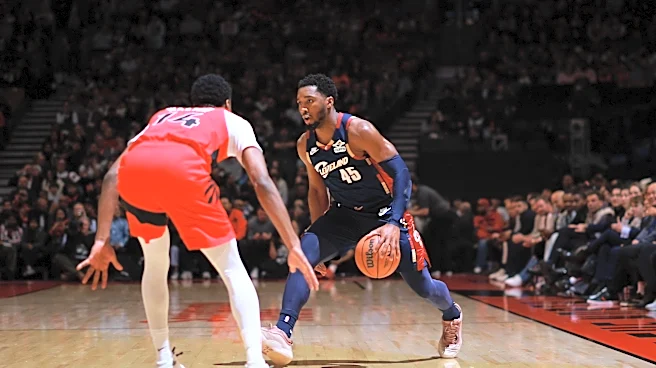
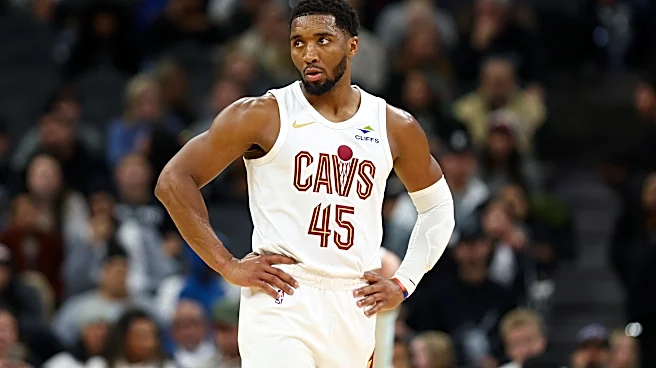
Donovan Mitchell
27.9 points, 5.7 assists, 4.5 rebounds, 1.5 steals
It’s not a stretch to say this was maybe the best individual season of Mitchell’s career. He scored more points than ever (1,952 total) and the 10th most in a single
season by a Cavalier ever. All on an efficient 56.3% effective field goal percentage (82nd percentile).
Mitchell carried the Cavs throughout the season. He had 15 games of 35+ points, in which the Cavaliers went 14-1. Just two of those performances came after the All-Star break, a testament to how vital Mitchell was to Cleveland staying afloat during their slow start to the season.
Some factors hold him back from the A+. This was the highest usage that Mitchell’s recorded since being in Cleveland. That’s because the Cavs needed him to carry a heavier load. Still, it’s not the idealized version of Mitchell. Things have always looked smoother when he’s paired with another lead ball-handler. We didn’t see that for most of the season — not that Mitchell had any control over that.
Partnered with his higher usage, I’d argue this was the worst defensive season Mitchell has had in Cleveland. The Cavs fell out of the top-10 defensively for the first time since 2021. Mitchell’s inconsistent effort on that end of the floor played a role.
Nevertheless, this was a special offensive season from Mitchell and one of the best in franchise history. I shudder to think of where this team would have finished without him.
Grade: A
James Harden
20.5 points, 7.7 assists, 4.8 rebounds
Trading for Harden was the shock of the season. We won’t re-litigate the trade today, as only the playoffs can tell us whether or not it was worth it. But as of typing — I find it hard to believe there’s anyone in Cleveland who isn’t bought in right now.
Harden won us over almost immediately. Clutch shot making and some of the best pick-and-rolls the league has ever seen will do that. It became obvious how Harden can help raise this team’s ceiling. His instant chemistry with the bigs, along with not taking anything away from Mitchell’s scoring, is about as exciting as it gets.
Concerns remain. Can Harden play defense at a championship level? Will his turnovers be backbreakers in the playoffs? Or, can Harden step-back his way into leading a deep playoff run? That remains to be seen. Either way, I think he’s earned a little bit of faith. I’m willing to go down swinging with Harden at the helm.
Grade: A-
Jarrett Allen
15.4 points, 8.5 rebounds, 1.8 assists
For years, Allen has been considered an unsung hero. I’m not sure that’s the case anymore. His heroic efforts in the back half of the season were as important as any other member of the team.
Allen averaged 22.3 points and 11.5 rebounds in February as the Cavs relied entirely on him to steady the ship. After multiple injuries and seismic changes at the deadline, it was Allen who kept everything running smoothly. His consistency made him an anchor on both ends of the floor, and it led to the best stretch of Allen’s career.
The only thing holding him back from an A+ or even an A+++ is the first month of the season. He suffered injuries to both hands and as a result, struggled to catch the ball or finish with his usual efficiency.
Grade: A–
Darius Garland
18 points, 6.9 assists, 2.4 rebounds
I think I speak for every Cavs fan when I say my heart sank during Garland’s first game back from the toe injury. The realization that a full summer of recovery wasn’t enough to overcome this setback was worrying.
Garland delivered a number of great games before being traded this year. The issue, of course, is each step forward came with an aggravation that felt like three steps backwards. The Cavs were left with no choice but to cut their losses and pivot to Harden in an attempt to save their season.
Grade: D+
Evan Mobley
18.2 points, 9.0 rebounds, 3.6 assists, 1.7 blocks
Yeah… this is a tough one to type.
Mobley entered the season with dark-horse MVP written all over him. Fans expected another leap. Instead, they got more of the same — with some minor improvements on the margins.
It’s natural to feel disappointed by that outcome. Though, I do believe this was a strong season for Mobley if you can remove those preseason expectations and instead view this year for what it was.
An efficient 18 points per game as the third option on a 52-win team is pretty sweet. Especially considering he stayed at an All-Defensive level throughout the season. His finishing around the rim, as always, was a highlight. And Mobley ended the regular season with an elite stretch, averaging 20.1 points, 10.2 rebounds, and 3.1 assists per game in his final 20 games.
Still, I have to significantly ding his grade for not living up to expectations. Never fret, there’s more than enough time for him to make up for this in the playoffs.
Grade: C+
De’Andre Hunter
14 points, 4.2 rebounds, 2.1 assists
I still don’t know what happened to Hunter. He checks all of the hypothetical boxes. Great size, good shooter, strong athlete. But none of that translates to the court. He struggled to shoot this season, played some of the worst defense I’ve seen, and overall felt as out of place as you can possibly get.
Grade: F
Jaylon Tyson
13.2 points, 5.1 rebounds, 2.2 assists
Tyson might be the Valedictorian this year. Seriously, I can’t think of a Cavalier that has exceeded expectations more than Tyson.
I entered this season unconvinced that Tyson would be in the rotation, let alone a core piece of the team. I just didn’t think he’d be able to put so many things together in such quick fashion. But Tyson’s sophomore season felt like a launching point for an elite career.
The most impressive part of Tyson’s game is how effortlessly he adapted to whatever the Cavs asked of him. He played without the ball, shooting 44.6% from downtown and finishing as one of the best catch-and-shoot players in the NBA. That’s a role he wasn’t super comfortable playing before this season.
That expands to other aspects of the game. Tyson admitted he never played as the roller in pick-and-rolls before this season. Yet, he was a seamless fit as a screening partner with Mitchell and Harden. His below-the-rim finishing and processing speed as a playmaker allowed him to dominate in those actions.
The same goes for his defensive effort. Tyson wasn’t known as a defensive engine in college. But in the NBA? Being a scrappy, hustle player is what he needed to do to earn minutes. That was the initial bar he had to clear before breaking into Cleveland’s rotation and showing the rest of his skills. Check and check.
Most of all, Tyson proved one thing: he’s a winner. This is a dude who wants nothing more than to help his team get to the finish line. That’s going to keep him in the NBA for a long, long time.
Grade: A+++
Sam Merrill
12.8 points, 2.6 rebounds, 2.4 assists
We all knew that Merrill could bury triples. Still, I wouldn’t take a career-high 158 three-pointers in just 52 games for granted. If he had been more available, Merrill would have easily become just the fourth Cavalier to hit 200+ three-pointers in a season. JR Smith, Darius Garland and Donovan Mitchell are the others.
More impressively, Merrill proved that he isn’t just a three-point shooter this season. He began attacking the basket at a career-high rate, nearly doubling his previous high for two-pointers in roughly 20 fewer games. He also threw in a personal-best 125 assists, using his gravity to backdoor cut opponents and then kick the ball out to his teammates.
All the while, Merrill fought like hell defensively to hold his own more often than not. Effort goes a long way towards juicing your grade.
Grade: A-
Lonzo Ball
4.6 points, 4 rebounds, 3.9 assists
I’m not going to pile on Ball, whose career was totally derailed by injuries. We all saw how much he struggled to be imapctful this season. Whether it be clanking open jumpers or missing transition layups — let’s just acknowledge that this went sideways and move on.
Grade: F
Dean Wade
5.8 points, 4.2 rebounds, 1.5 assists
This was the most Dean Wade season I’ve seen from Dean Wade. That’s to say, I don’t think we learned anything new from Wade this year.
The Cavs need Wade. They play well when he’s healthy and shooting three-pointers with confidence. Neither of those things happens as often as you’d like, but they’re just common enough to hold onto the dream.
Grade: C
Thomas Bryant
6.2 points, 3.4 rebounds
Bryant was the best addition of the offseason. It turns out the bar wasn’t very high, after Lonzo Ball played his way to a podcasting career and Larry Nance Jr. became an end-of-bench veteran. But hey, Bryant earned this one.
Seriously, though. Bryant was super helpful off the bench as a backup big. The Cavs relied on him to bring energy, toughness and even some three-point shooting throughout the year. He isn’t mobile enough to hang in certain matchups — and he gave diminishing returns as his minutes grew higher. But for a last-second addition, this is as good as it gets.
Grade: A-
Larry Nance Jr.
3.7 points, 2.7 rebounds, 1 assist
I’ll admit, I was bummed that Nance wound up being out of the rotation entirely this season. I fully expected him to be an X-Factor for this team. He had all of the tools to be a glue guy. Instead, it’s clear that Nance isn’t the same player he used to be. His mobility has declined significantly and he doesn’t have the size or fine-skills to make up for it.
It’s still fun to have Nance on the roster. He’s a great locker room guy and fully accepted his role on the bench. Maybe he’ll surprise us in the postseason, should the Cavs elect to break glass and put him on the floor.
Grade: D+
Keon Ellis
8.3 points, 2.8 rebounds, 1.6 assists, 1.3 steals
Ellis was a sweet pickup at the trade deadline. A springy, 6’5” guard who can generate turnovers and play without the ball offensively. He’s an efficient catch-and-shoot player who has shown he can do more than stand in the corner. Ellis took strides as a pick-and-roller this season while also finding success as a cutter.
His defensive impact is shakier than we thought it would be. He isn’t an elite one-on-one defender or the type of guy who is going to suppress shot attempts. Ellis is, however, capable of making some incredible defensive plays by recovering and blocking shots, or using his active hands to pick up steals.
Grade: B
Craig Porter Jr.
4.5 points, 3.4 rebounds, 3.2 assists
Porter showed that he has more defensive tenacity than previously known. He turned himself into an energizer, darting into passing lanes and embracing the challenge of ruffling his opponent’s feathers. I’m still not sure he has the foot speed to be an elite defender, but this was a strong step in the right direction.
His lack of a jumper holds him back. Porter doesn’t even attempt enough three-pointers to keep a defense honest. That will have to change if his blocks, steals, rebounds and assists are ever going to be properly utilized.
Grade: B-
Dennis Schroder
8.2 points, 4.3 assists, 2.3 rebounds
Schroder was an add-on to the Hunter trade. He doesn’t fit particularly well next to either Mitchell or Harden. That’s because he’s not adept at playing without the ball, and some of his defensive impact has faded as he gets older.
To his credit, Schroder can still muck up a game and make things interesting. He also has a knack for getting to the rim and creating in the pick-and-roll that makes him worth a spot in the playoff rotation. At least he’ll get a chance to play serious minutes depending on the matchup.
Overall, some of the poor shooting and defense hold him back from a strong grade in the regular season.
Grade: C-
Tyrese Proctor
5.4 points, 1.5 assists, 1.3 rebounds
There’s not much to take from Proctor’s rookie season. His minutes were limited and mostly restricted to garbage time.
I’d happily take any stock moving forward. He’s a guard with good size and defensive instincts. Package that with his natural gift for shooting and I can’t see how this doesn’t pan out for him at some point in the future.
Grade: B
Nae’Qwan Tomlin
5.8 points, 2.8 rebounds
Tomlin went from a two-way to a standard contract this season. That’s enough for an A on its own.
Sure, his impact fell off a cliff in the second half of the year. We saw some warts emerge, such as his poor defensive awareness or his total lack of a three-point shot. But he eventually got the wheels back on track to end the season, again using his athleticism to impact games.
Tomlin, at his best, is a frenetic player who crashes the glass and runs forcefully in transition. That’s a lot of fun to watch, even if we understand that can only take a player so far.
Grade: A-
Max Strus
11.2 points, 5.4 rebounds, 2.0 assists
Listen, no one wanted to wait until March to finally see Max Strus play basketball again. Even Strus himself was frustrated with the process. But once he returned, it was obvious that Strus still had the juice.
Strus played just 12 games in the regular season. In those games, he hit 6+ three-pointers three separate times. He shot above 40% from downtown and nailed some clutch shots along the way. It was all the evidence you needed to know that Strus can still swing games with his prolific shooting.
It wasn’t all pretty, of course. Coming back from a months long injury takes time. Strus’ foot-speed looks slower than before and his defense is a slight concern. He also reminded us of how streaky he can be, shooting 1-9 and 1-10 in two games before the season ended.
Grade: B