
There have been a lot of ups and downs throughout the season for the Minnesota Timberwolves. There have been moments where the Wolves looked like they could beat any team in the league, and there have been stretches where it felt like they would never win a game again.
In a lengthy 82-game NBA season, it can be easy to forget everything that has happened even just a few games ago. Often, the topics and narratives that once seemed paramount to the success or failure of the team fade away into obscurity
as new triumphs and problems arise.
A lot has changed for the Wolves in just a few short months. They came into the season expecting some combination of Terrence Shannon Jr, Jaylen Clark, and Rob Dillingham to fill out their rotation, none of whom were able to take hold of a permanent role. Julius Randle seemed destined to make an All-Star team after a blistering hot November, and at one point early in the season, they seemed unable to beat a team with a winning record.
All of those ideas, which at one point or another seemed like crisis points, have faded into obscurity. As more games went by, they stacked up some quality wins, had many inexplicable losses, and new players joined the team both before and after the trade deadline.
With just five games remaining on the Wolves’ schedule, let’s take a look back at the best and the worst moments of the Timberwolves’ regular season.
Ant in the clutch on opening night
The Timberwolves started their season out west against the Portland Trail Blazers. The season got off to a bit of a rocky start, as before the game even began, it was announced that Mike Conley would be moved to the bench with Donte DiVincenzo taking his spot in the starting rotation.
It was an ominous sign for the 38-year-old point guard who, during training camp, was presumed to again be in the starting lineup, but struggled to find his role with the team coming off the bench. Specifically, Conley’s 3-point shot deserted him, as he sat below 30 percent shooting from beyond the arc most of the season.
DiVincenzo initially struggled with the added point guard duties, as he turned it over six times on opening night due to Portland’s full-court ball pressure. After the first month, though, DiVincenzo became more comfortable in his new role, which has made the opening night point guard switch look like the right decision.
Once the game began, the story quickly shifted to Anthony Edwards, who was sensational all game, especially down the stretch in clutch time. Edwards finished the game with 41 points, ten of which came in the final five minutes.
The Wolves trailed the entire second half, including by as many as eight points in the fourth quarter, but fought back to take the lead with less than four minutes left after a 3-pointer by Edwards. The two teams traded leads until Ant gave the Wolves the lead back for good, knocking down another shot from deep on a stepback over Jerami Grant.
Edwards wasn’t done there.
A few possessions later, with the Wolves up by two points, Ant hit another step-back jumper, this time in the midrange, to put Minnesota up by two possessions, effectively sealing the win.
So many times, the season prior, Edwards would have settled for a much worse shot in that situation. He would have dribbled the air out of the ball, at no point tried to drive to the rim, and launched an incredibly difficult deep 3-pointer.
Instead, Ant drove a little bit closer to the basket, created a ton of space from his defender, and knocked down a midrange shot. All offseason, after getting eliminated by Shai Gilgeous-Alexander and the Oklahoma City Thunder, Edwards focused on improving his midrange shot and immediately put it to use in the first game of the season.
The win felt like more than just a single victory. It felt as though Ant was on the verge of taking another leap as a superstar. That feeling ended up being mostly correct as Edwards has had the best scoring season of his career, increasing both his volume and efficiency numbers.
Overtime Thriller on Christmas
The Timberwolves came into their Christmas Day matchup with the Denver Nuggets with a 20-10 record. Two of those ten losses had already come against the Nuggets, with the Wolves losing two back-to-backs against the Nuggets at Target Center, one without Edwards.
With the game tipping off at 9:30 PM CT, and much of the Christmas Day festivities over, the Wolves looked to grab a win against a playoff rival. What ensued was another classic matchup between the Wolves and Nuggets.
The first half was back and forth with both teams getting out to moderate leads, but with Rudy Gobert getting in third-quarter foul trouble, Minnesota fell behind by as many as 16 points in the third quarter.
For almost the entirety of the second half, it appeared the Wolves were trending toward a decisive loss, but with less than five minutes left, they made a comeback. The Timberwolves went on a 16-2 run to cut the Nuggets’ lead all the way down to one.
A Jamal Murray 3-pointer and a Spencer Jones putback layup to put Denver back up by six with under a minute to play could have been the dagger, but the Wolves kept fighting. Edwards got fouled on a 3-pointer and made all three free throws to cut the lead back to three before stealing a Murray entry pass to Nikola Jokić to give them a chance to send the game to overtime.
Ant did just that, as after a beautifully drawn up play from Chris Finch, Edwards got the ball in the corner and, all in one motion, turned around and knocked down the game-tying shot.
The Wolves kept it rolling in overtime. They came out and scored the first nine points of the extra period, highlighted by another Edwards 3-pointer.
That is when the wheels fell off for Minnesota. Denver responded by going on an 11-2 run to tie the game. With less than a minute left, Murray hit another dagger 3-pointer, giving him 35 points on the night as the Nuggets went on to win 142-138.
The nine-point comeback from the Nuggets tied the largest overtime comeback since play-by-play started getting tracked, a record that would stand for only a few short months.
New Year’s Eve Disaster in Atlanta
After the Christmas Day loss, the Wolves followed up that performance with a lifeless loss at home to the tanking Brooklyn Nets. A few days later, on New Year’s Eve, the Wolves put together another dispiriting effort as they seemed preoccupied with which Miami party they would be going to that night, as they got blown out 123-102 by the Atlanta Hawks.
Before the final buzzer sounded, Edwards threw his towel up in the air during the timeout huddle and left the floor before the game ended. In the locker room after the game, Edwards declined to speak with the media.
“Do we care?” was the question Gobert asked of himself and the team after the game. “Does something happen when we like we played the first quarter tonight? Or is it just cool? Make a lot of money, we play basketball, do what we do, and go home and be happy. I think that’s the fine line between a team that’s playing for a championship and a team that’s full of talent but doesn’t accomplish shit.”
When asked about how he felt the team was playing at that time, Gobert responded, “Not like a team that wants to play for a championship. That’s for sure.” DiVicenzo had similar feelings, saying, “How many meetings, how many film sessions, how many times has Finchy had to talk to us? It’s just frustrating because you go out in Chicago, you play well, you respond, and then you come in here and lay an egg.”
There was a feeling from the outside looking in that something in the locker room wasn’t quite fitting together. There may not have been a specific incident that caused friction within the team, but something just seemed off from an interpersonal standpoint.
The Wolves did respond by winning six of their next seven games, but the inconsistency Gobert and DiVincenzo alluded to in their comments became a pervasive issue throughout the season.
Late-game Comeback Against the Spurs
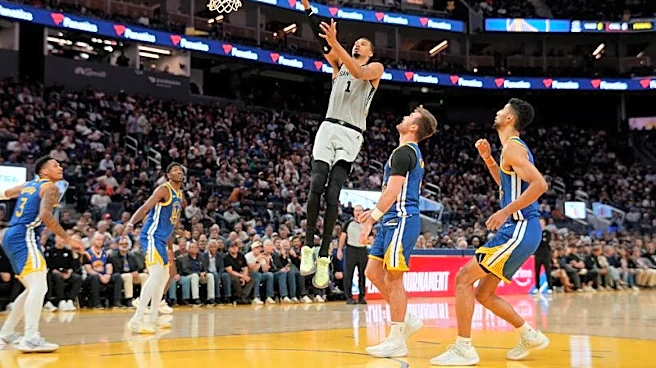
One of the wins that came after the New Year’s Eve debacle came against Victor Wembanyama and the San Antonio Spurs.
The game quickly got out of hand for the Timberwolves as they gave up the first 16 points of the game. With the Target Center crowd begging them to put the ball in the basket so they could sit down, the Wolves finally scored their first points more than four and a half minutes into the game.
Minnesota trailed almost the entire game, including by as many as 19 points midway through the third quarter, but like they did about two weeks prior against Denver, they clawed back. Down by ten, they put together a 15-5 run to get the game tied on a Randle and-1 layup.
Then, with just over two minutes left, Edwards gave the Wolves their first lead of the game with a beautiful turnaround midrange jumper.
The two teams traded leads into the final minutes of the game. With the Wolves down by a single point, Edwards hit a running layup around a Randle screen that took Wembanyama out of the play to give Minnesota the lead back with 16.8 seconds left.
On the next San Antonio possession, Minnesota forced a pair of misses, including fantastic defense from Randle on Wembanyama, to seal the 104-103 win.
The game felt like another example of the Wolves, especially Edwards, leveling up in the late moments against great teams. It was another data point toward the idea that the Wolves could beat any team in the league on their best night.
The only question was whether they could sustain that level of play for more than just a single night.
A Postponement and a Five-Game Losing Streak
Following the win against the Spurs, the Timberwolves, without Edwards and Gobert, wiped the floor with the flailing Milwaukee Bucks, putting their record at 27-14 for the season.
Just when it seemed as though the season was going in the right direction for the Wolves, the bottom fell out. They lost hard-fought games against the Houston Rockets (again without Edwards) and to the Spurs before following them up with two sour performances in losses to the tanking Utah Jazz and Chicago Bulls. The Wolves’ losing streak reached five games in a 26-point loss to the Golden State Warriors.
During that time, Minnesotans were going through an incredibly hard time. Federal officers, including the U.S. Immigration and Customs Enforcement (ICE), had invaded Minneapolis and the surrounding Twin Cities, leading to widespread protests across Minnesota.
The morning the Wolves and Warriors were set to play the first of two games against each other at Target Center, Alex Pretti, an ICU nurse, was shot and killed at the hands of federal officers just weeks after Renee Nicole Good, a local mother of three, was also killed in a similar incident.
The game between the Wolves and Warriors was postponed 24 hours “to prioritize the safety and security of the Minneapolis community.” When the game did take place the next day, it was clear the Timberwolves were not in the right headspace to play basketball.
“What I felt was that their group was suffering,” Warriors Head Coach Steve Kerr said after the game. “I thought the vibe in the stands, it was one of the most bizarre, sad games I’ve ever been a part of; you could feel the somber atmosphere.”
Despite the incredibly poor performance, there wasn’t much to take away from what happened on the court that night because of everything else that was going on at the time. The Timberwolves responded by winning their next four games, continuing a pattern of playing their best basketball just when people start to count them out.
This is the first part of a two-part season recap series. Check back on Monday for part two