


It’s 2026 NFL Draft review season — the week that rolls around every year when we spend countless hours absorbing as much as we can about everyone’s thought on our favorite team’s draft class.
And plenty within NFL organizations — those who live on our feeds in anonymity, only known as “sources” — are ready to chime in with their opinions on each club’s haul. Many of those sources’ takes were collected and methodically structured into a single piece by ESPN’s NFL Insider Jeremy Fowler that featured
a paragraph or two (or three in some cases) on all 32 teams.
Here’s Fowler’s section on the Bills:
The Bills’ three trade-backs from No. 26 to outside of Round 1 were emblematic of a weaker draft as well as modernized thinking. More teams are leaning into the concept of taking more swings and prioritizing the number of picks they make. Many teams we spoke to about the draft considered the late first round similar to the early second round as far as talent. The drop-off was minimal, if nonexistent. And as one team source acknowledged, Buffalo felt “a few bullets short” this year because of the D.J. Moore trade, which cost the team a second-round pick. In the end, Buffalo turned picks 26, 91 and 165 into 35, 66, 101, 125 and 167.
Multiple scouts see fourth-round receiver Skyler Bell (UConn) contributing right away. He has polish to his game and tested well predraft. There was an outside chance he would go in the third round but was appropriately picked in the fourth.
Those first two sentences are truly glorious. I don’t know if I’ve ever read two consecutive sentences more satisfying to my brain regarding the way to approach the draft (and the 2026 draft in particular). The trade down process is the correct process. If you don’t believe me, that’s fine. Take an economist’s word for it.
There’s no biased hindsight baked into that take either — I’ve had “trade down” in my Twitter/X bio for years now.
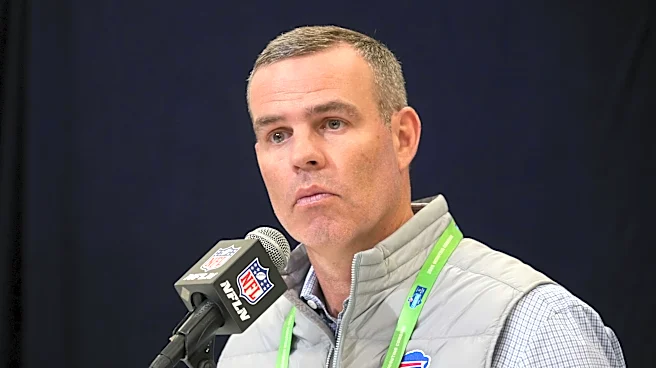
The 2026 draft haul marked the second time in the past three years president of football operations/general manager Brandon Beane made 10 draft selections. The one year he didn’t, 2025, he made nine.
For as much as we — see: I — obsess over pre-draft evaluations, the optimization of grades, and how to synthesize them into actionable rankings, from the broadest perspective possible, the draft is largely a crapshoot. Now, specific edges can exist, but there are no teams regularly hitting on even 50% of their draft selections. Heck, a 40% “hit rate” — which is a naturally subjective term in the first place — would be outrageously good across two or three years for the GM of any franchise.
The only thing the teams — or any of us, in any aspect of life, really — can be in complete control of is process. And in this case, because of the volatility of the draft, even with the temptation of trading up for a “sure thing” always lingering, getting more rolls at the table is the smartest approach.
The logistical counter to all this centers around the idea that 10 draft picks can’t feasibly make a roster, so you’re essentially throwing away picks who’ll ultimately play for other teams. And while that is a negative downstream aspect of this philosophy, built in here is the luxury of getting those players in-house for your own evaluation in minicamp, training camp, and preseason before determining who of the bunch is worthy of a full-time role, rotational responsibilities, or simply a longer look… before any other team can secure their services, as opposed to never having them on your roster to begin with if you adhere to the opposite ideology.