


The Seattle Seahawks’ early free agency activity suggests a front office trying to offset the lack of draft capital in 2027 while maintaining flexibility in the present. Rather than committing major resources to long-term starters, the Seahawks largely targeted rotational players, depth pieces, and special teams contributors. That approach hints that the organization expects to find several future starters during the draft.
For this mock draft exercise, the PFF Draft Board was used as the reference
point for player value and availability.
Seattle originally held the 32nd overall pick, but in this scenario executed a trade down with the Houston Texans, moving from No. 32 to No. 38 while adding picks 104 and 128. For a roster that still needs young contributors across multiple positions, gaining extra Day 2 and Day 3 capital is a logical move.
Below is how the full class came together.
Pick 38 — Chris Johnson, CB, San Diego State

The Seahawks still land an intriguing defensive back after the trade down, selecting Chris Johnson from the San Diego State Aztecs football program.
Johnson developed into one of the most productive corners in the Mountain West during his final collegiate seasons. In his most recent year, he recorded:
- 52 tackles
- 4 interceptions
- 11 pass breakups
Johnson played primarily on the boundary and consistently matched up against opposing top receivers. His game is built around length, physicality at the line of scrimmage, and strong ball skills, traits that historically fit the Seahawks’ prototype for outside cornerbacks.
Under head coach Mike Macdonald, Seattle’s defense mixes coverages and disguises looks pre-snap. Having corners capable of holding their own in man coverage while also playing disciplined zone is critical for that system.
Johnson’s ability to disrupt routes early and attack the football at the catch point makes him a strong developmental candidate to eventually compete for a starting role on the outside.
Pick 64 — Mike Washington, RB, Arkansas

Seattle turns to offense with their second selection, drafting Mike Washington from the Arkansas Razorbacks.
Washington emerged as a dynamic offensive weapon in Arkansas’ offense, finishing his most recent season with:
- 1,280 rushing yards
- 6.2 yards per carry
- 13 rushing touchdowns
- 28 receptions for 240 yards
His game revolves around explosiveness and lateral agility. Washington is particularly effective in zone-based rushing attacks where he can press the line of scrimmage, make a single decisive cut, and accelerate into open space.
Seattle’s offense has historically leaned on zone concepts and explosive run plays, making Washington a natural schematic fit. He also brings value as a receiver out of the backfield and has shown the ability to create yards after contact despite not being the biggest back in the class.
The pick would give Seattle another dynamic backfield option with big-play ability, while also providing long-term depth at the position.
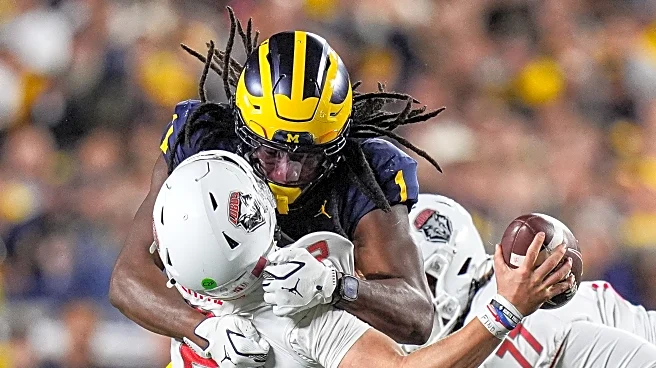
Pick 96 — Jaishawn Barham, EDGE, Michigan

Seattle reinforces the front seven with Jaishawn Barham, one of the more intriguing hybrid linebacker prospects in the class.
What makes Barham particularly appealing for Seattle is his positional flexibility. He has experience lining up as an off-ball linebacker, overhang defender, and played on the edge in the last year showing an amazing run defense.
In a defense that values simulated pressure and creative blitz designs, Barham could become a chess piece. Early in his career, he would likely rotate as a situational pass rusher and special teams contributor while refining his pass rush tech.
Pick 106 — Logan Jones, C, Iowa

The Seahawks finally turn to the offensive side of the ball with Logan Jones, a center prospect who brings toughness and experience in the trenches.
Jones started multiple seasons in college and developed a reputation as a technically sound interior lineman with strong communication skills. As the anchor of his offensive line, he handled protection calls and adjustments at the line of scrimmage.
Seattle has continued to emphasize building depth along the offensive line, and Jones fits the mold of a reliable interior option who can develop into a future starter. His strengths lie in run blocking and leverage at the point of attack, making him a good match for a run game built around zone concepts and physical downhill runs.
Pick 128 — Bud Clark, S, TCU

One of the extra picks acquired in the trade-down is used on Bud Clark, a ball-hawking defensive back with strong instincts. Clark produced consistently in college as a turnover creator, showing excellent anticipation in zone coverage and the ability to read quarterbacks’ eyes.
Seattle has long valued defensive backs who can generate takeaways, and Clark’s play style reflects that philosophy. While he may initially project as a depth safety and special teams contributor, his instincts give him developmental upside in sub-package roles.
Given Seattle’s emphasis on defensive back versatility, Clark could eventually compete for snaps in dime or rotating safety packages.
Pick 187 — Zane Durant, DT, Penn State

Seattle closes out the mock draft with Zane Durant, a defensive tackle who brings quickness and interior pass-rush potential.
Durant’s college production was built on explosiveness off the snap and interior penetration. While he may not be the biggest defensive tackle in the class, his ability to disrupt plays in the backfield makes him an intriguing developmental option.
For a Seahawks defensive line that values rotation and situational pass-rush packages, Durant could carve out an early role as an interior rusher on passing downs.
If he continues developing his strength and consistency against the run, he could eventually grow into a larger rotational role.
Final thoughts
This mock draft reflects what Seattle’s offseason strategy may be pointing toward: depth in free agency, impact in the draft.
By trading down and adding picks, the Seahawks increase their chances of landing multiple contributors across the roster. The class focuses heavily on defensive versatility and trench depth, two areas that align with the long-term vision of the coaching staff.
If Seattle’s front office approaches the real draft with a similar philosophy, expect them to prioritize volume and schematic fits rather than chasing a single splash pick.
And given the number of rotational pieces added in free agency, the expectation remains clear: the next wave of Seahawks starters will likely come from this draft class.