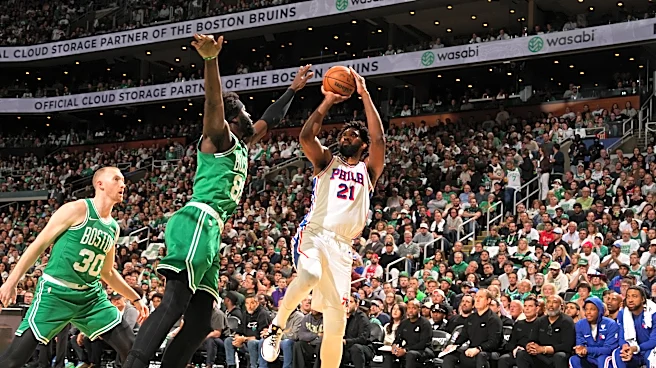

There is no such thing as a Joel Embiid stopper.
That feels like a decent place to start, because if the Celtics spend the summer trying to find one, they’ll be chasing the wrong thing. Embiid is a former
MVP for a reason. When he’s healthy, comfortable and getting to his spots, there are only so many bigs in the league who can even make the conversation around slowing him down interesting.
The Celtics don’t need a big who erases him. That player probably isn’t walking through the door, and if he is, Boston likely doesn’t have the money, trade assets or clean roster path to make it happen.
But Game 7 made something else pretty obvious: the current big man plan isn’t sturdy enough.
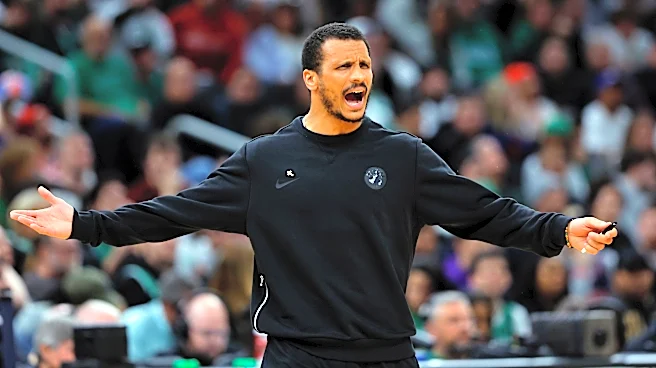
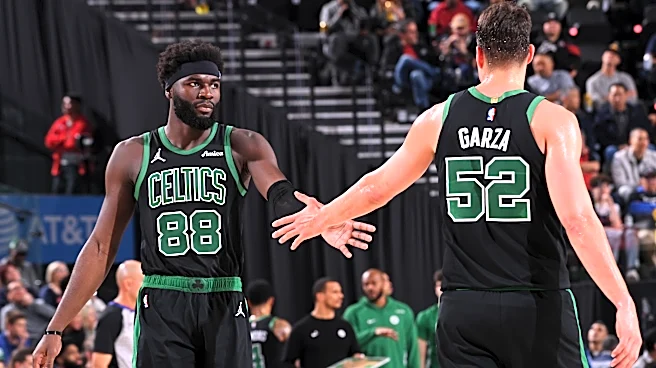
By the end of the Sixers series, the center position felt like the clearest symbol of Boston’s larger problem. The Celtics were in desperate need of a big that could last longer than a few possessions. Joe Mazzulla tried different looks from game to game. Neemias Queta gave them a real push in Game 7. Nikola Vučević, who was a regular in Joe’s lineups up until Game 7, found himself picking his nose on the bench (literally) for the final game of the season. Luka Garza started the most important game of the season after barely being part of the playoff rotation, to mixed results. He ended up playing only nine minutes in the game-that-shall-not-be-named.
That isn’t meant as an insult to any of those guys. Queta had a legitimate breakout season. Vučević is a skilled veteran who joined the team in a weird role at a weird time, and dealt with an injury just as Jayson Tatum was coming back from his own. Garza showed he can be more than useful during the regular season. And Amari Williams is absolutely still worth developing.
But if the goal is to build a team that can win four playoff rounds with Jayson Tatum and Jaylen Brown at the core (If you’re looking for commentary on JB trade avenues, you’ve come to the wrong article), the center room can’t feel this improvised again.
Queta earned a role, but that doesn’t mean the search is over
Before we go any further, Queta deserves his flowers.
He went from useful depth piece to full-time starter over the course of the season, averaged 10.2 points, 8.4 rebounds and 1.3 blocks in 25.3 minutes per game, and gave the Celtics real regular-season stability after losing Al Horford, Kristaps Porzingis and Luke Kornet last offseason. For a team that entered the year with plenty of questions about size, Queta answered more of them than anyone reasonably could have expected.
His development was undeniable, but the real question now is: how much better can he get?
His playoff numbers dipped to 9.3 points, 0.9 blocks and 21.7 minutes per game, and while those numbers don’t tell the full story, they line up with what the series felt like. Queta was energetic and had his moments. His Game 7 fourth-quarter burst helped drag the Celtics back into a game that looked gone. But he was also foul-prone, matchup-dependent and still learning how to play with control against elite size and talent.
That’s where the distinction matters. Queta can absolutely be part of the center plan, maybe even a major part of it.
He just can’t be the whole thing.
An anonymous Western Conference scout put it pretty bluntly to ESPN: “Can Queta get you through 82? Yes, but can he patchwork it through the playoffs? I think he keeps getting better, but there’s a ceiling. They have to get a higher-level center if they want to be considered serious contenders.”
That sounds harsh, but it also feels like the question Brad Stevens and the rest of the front office have to answer honestly.
Because if Queta is your second center, or one half of a more complete rotation, that can work. If he’s being asked to handle every major playoff matchup as the primary solution, that feels like a bet with too much risk attached.
Vučević only makes sense if the role and price make sense.
Vučević is the easiest decision point because he’s Boston’s only unrestricted free agent.
The idea made sense when the Celtics acquired him. They needed size, rebounding and a more established center option. In theory, his skill set should have helped smooth out some of the regular-season turbulence and give Boston another way to play.
In practice, it never really clicked for long enough.
Some of that deserves context. He joined midseason, changed roles, dealt with a broken finger and didn’t get a clean runway. It’s possible the Celtics think a full offseason and a more defined role would help.
Still, his playoff performance is hard to stomach. Vučević struggled to hold up defensively, and when the series reached Game 7, he couldn’t be trusted to touch the court.
That doesn’t mean Boston should automatically move on. But I do think the salary has to match the reality. If Vučević returns near the minimum or around the taxpayer mid-level range, maybe there’s still a case to keep him on the roster. A skilled veteran big who can rebound, pass and eat regular-season minutes? Yes please.
But if the Celtics bring him back as the main frontcourt solution, my concern levels will rise.
Because that wouldn’t feel like an adequate center plan, but rather another finger in a cracked dam.
Boston needs a type, not a name
Okay, so I’ve done a lot of talking around why the current guys can’t be the whole answer. So let’s now focus on what a competent solution might look like.
The Celtics need a center who can do several things at once, and players who do several things at once usually cost real money. I don’t think that qualifies as a Burf Bomb.
The ideal version can hold up physically against bigger matchups without fouling every other possession. He can rebound in traffic. He can set real screens without fouling (ahem, Queta), roll hard and put pressure on the rim. He has enough mobility that Boston isn’t locked into one coverage every night, while bringing an offensive feel to the game so that the ball doesn’t die when it finds him.
If he can shoot, great. If he can pass on the short roll, even better. If he can do both, congratulations, you’ve probably found someone Boston can’t afford.
That’s why the archetype matters more than the dream name.
Fans are already throwing out the splashy names as potential targets. Guys like Isaiah Hartenstein, Mitchell Robinson, Daniel Gafford, Walker Kessler, Robert Williams, Kristaps Porzingis, Nic Claxton, Jarrett Allen and everyone else who looks good in green inside the trade machine. Some of those names make real basketball sense. Others are probably unavailable. Some are too expensive. Others carry injury concerns. And some would require Boston to move salary it may not want to touch.

That doesn’t make the conversation pointless, but I do think it needs to be more realistic.
The Celtics shouldn’t be asking, “Who is the biggest name we can get?”
The right question is, “Who gives us a skill set we don’t currently have?”
That could be a rugged rebounder or a switchable defender. Maybe a vertical spacer who forces the weakside defender to think twice, or a savvy veteran who can survive a rough matchup for six minutes without the whole game tilting.
Luckily, Brad Stevens has never been one to chase the flashy options. He tends to look for players who make sense in the room, in the system and in the moments that matter most.
The money makes every answer complicated
You want some good news? I’ll give you some good news. Boston has the tools to make something happen.
The Celtics are projected around $188 million in committed salary if the expected team options are picked up, with the tax line at $201 million, the first apron at $209 million and the second apron at $222 million. They have the full mid-level exception available, but using it would hard-cap them at the first apron. They also have smaller paths, including the taxpayer mid-level amount, and several traded player exceptions, including a $27.7 million one.
That all sounds useful until you remember every tool comes with a consequence.
Use the full MLE and suddenly the hard cap comes into play. Use a TPE and the incoming salary starts to limit your flexibility. Chase a bigger trade and now you’re probably talking about real rotation players going out, whether that’s Sam Hauser, Payton Pritchard, Derrick White or some combination of them, plus salary and picks.
That’s why the “go get a center” conversation is always easier said than done.
Of course Boston should look. Brad Stevens needs to explore every path and turn over every stone if it means maximizing the prime windows of Tatum and Brown. But there’s a reason this wasn’t solved already. Good centers cost money. Great ones cost a fortune. Cheap ones usually come with the exact flaws you’re trying to avoid.
The Celtics are trying to improve the roster without undoing what still works. That’s a narrow tightrope to walk.
The Celtics need clarity before they need a splash
Boston doesn’t need to build its whole offseason around stopping Embiid. That would be an overreaction. The East has too many different problems for the Celtics to solve only one of them.
But they also can’t watch the way this season ended and pretend the center spot isn’t an issue.
Among the current group of big men, Boston has pieces. What it doesn’t have yet is a complete answer.
Maybe that comes through the mid-level, trade, or a smaller move that gives Mazzulla one more trusted option when the matchups get heavier and the possessions slow down.
However they get there, the standard should be clear.
The Celtics need a big who keeps them from spending an entire playoff series searching for someone who can survive it.
After Game 7, another half-answer next season isn’t acceptable.