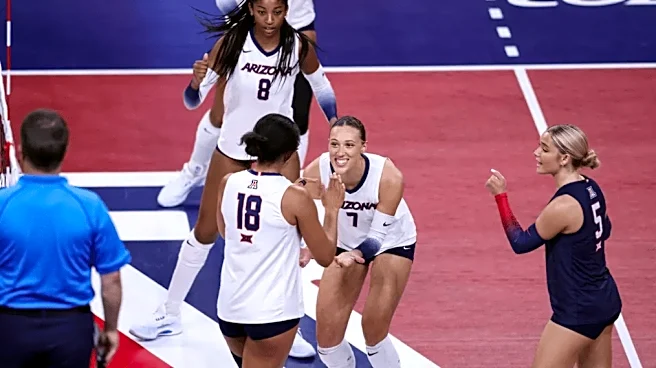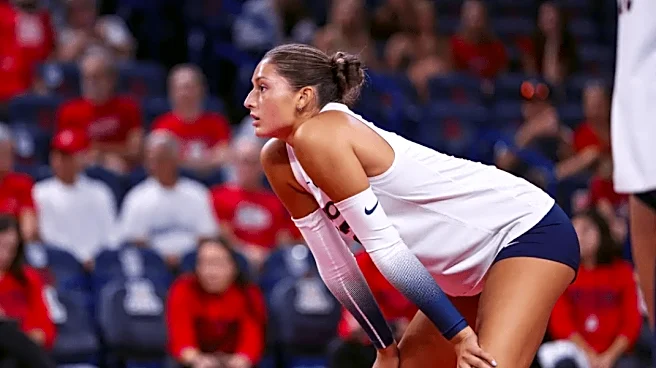





The Arizona Wildcats have taken sets off or played very competitive three-setters against teams ranked 10th, 11th, 14th, and 32nd in the RPI during Big 12 play. On Saturday, No. 40 Utah was on the schedule. Once again, it was a competitive match that ended in a 3-1 (25-18, 22-25, 25-21, 26-24) loss.
“Other than how we started off the set, the first set—I wasn’t too happy with that—I thought we did a good job of staying competitive on the floor,” Arizona head coach Rita Stubbs said. “Unfortunately,
our skills broke down in certain situations, and coachability wasn’t necessarily the best, and they took advantage of it at the right time, but the wrong time for us.”
Arizona was especially done in by Utah runs later in sets. That was even the case in the second set, which the Wildcats won.
UA went up 19-12 in the second only to have the Utes go on a five-point run to close the lead to two. The big cushion was the saving grace for the Wildcats. They were able to trade points and mini-runs with Utah down the stretch to win by three points.
Those mid- and late-set runs were their downfall in the third and fourth sets. It didn’t take a lot in sets that were so closely contested.
The difference in the third came with the teams tied at 12. Utah went on a three-point run to reach the technical timeout leading 15-12. It never trailed again.
Another three-point run later in the set gave the Utes set point at 24-19. Arizona saved two set points, but it was just one of five occasions when it scored more than one point in a row. Four of those five “runs” were of just two points and the other was three.
The fourth was a back-and-forth affair throughout as Arizona fought to stay in the match. The Wildcats took their first lead at 7-6 and had a four-point lead at the technical timeout.
As was common throughout the match, the timeout helped the team that had been struggling. Utah used a 7-2 run to take the lead at 18-17.
Stubbs called time and Arizona responded with a 4-0 run to go up 21-17. The Wildcats were so close to evening the match.
Once again, the timeout changed the teams’ fortunes. The Utes called time and followed with a 3-0 run to tie the set again.
Arizona couldn’t string points together after that. The Utes had two 2-0 mini-runs. That was enough to win the set 26-24 and close out the match.
Arizona’s outside hitters both carried the team at different times while fighting against some difficult sets. In the early part of the match, junior Carlie Cisneros was the primary scorer as the Utes picked on Destiny Ndam-Simpson in serve receive. Cisneros was aggressive, which Stubbs praised after the match.
Cisneros took more of the serve receive load on as the match progressed, but she still ended with a team-high 14 kills on .278 hitting. Ten digs gave her a double-double. A block assist and her kills tied her for the team lead with 14.5 points.
Ndam-Simpson got stronger as the match progressed. She was second on the team with 12 kills. Her hitting percentage fluctuated wildly throughout. She struggled in the first set with no kills and one hitting error, but she found her game in the second set and continued through the third.
Ndam-Simpson’s hitting percentage reached a high of .320 late in the third when she reached her 10th kill of the match. It dropped back to .156 by the end of the match after four hitting errors against just two kills in the final set.
Her serve receive also improved later in the match. She was aced four times, but half of those came in the first set. She was targeted by the Utah serve a team-high 39 times.
“Dez struggled on the first one, but got better on the second one,” Stubbs said. “And so what I told her was, whatever you’re saying to yourself on the second pass, say it on the first one. You know, you’re just trying to find different things to make them laugh or be restful because sometimes they tend to beat themselves up for the error that they make and we’re always trying to teach them was that a good error or a bad error. So the fact that she was able to self correct without us being able to tell her anything—because unless you call a time out you can’t really get it there—that’s a good sign. Earlier in the year, that would have resulted in three, four of them in a row potentially.”
Arizona got significant contributions from its middle blockers. Journey Tucker was especially strong on the offensive side in the early going. She had five kills on .333 hitting in the match, but four of those were in the first two sets. Her block picked up as the match progressed. She ended with four total blocks including one solo. Three of the four came after the first set.
It was a good weekend overall for Tucker, although her blocking numbers weren’t as big this time as they were in the last match against Utah. When the Utes came to Tucson, Tucker had nine blocks. She only had one block at BYU on Thursday, but that’s not the only job of a middle blocker.
“She was a great blocker from pin to pin [at BYU],” Stubbs said. “I don’t think she was the best in terms of blocking the middle, but she was touching balls, making the hitters do something different, which made our defense better, which is what you would want. And what I told her was, I said it’s pretty frustrating to do that and it’s not statted anywhere. That’s why being a middle blocker sometimes is hard because you only think your reward comes when you get the block, but if you’re directing it to the defender, you’ve done your job.”
Fellow middle blocker Marina Vosloo ended with seven kills, although they were paired with five hitting errors. She tied for second on the team with two total blocks. Between Vosloo and Tucker, the middles contributed 26 percent of the Wildcats’ kills and 27 percent of their total points.
The Utes were able to contain right side hitter Kennedy Osunsanmi, who has been one of Arizona’s primary offensive weapons this season with 2.09 kills per set. The opposite had three kills on a negative hitting percentage against Utah, but she contributed in other areas. She ended with a season-high six digs and had two total blocks.
In many situations, Stubbs will substitute a player out if she’s starting to struggle physically, mentally, or emotionally. It wasn’t a possibility on Saturday.
Backup opposite Renee Jones, who is fourth on the team with 1.60 kills per set, was unavailable. She had a visit to the emergency room for IV fluids on Friday due to a bout with the flu. She was not on the bench.
“When you’re Type 1 diabetic, it becomes something that you become a little bit more aware and conscious of,” Stubbs said.
On the other side of the availability story, the Wildcats got defensive specialist Brenna Ginder back this weekend. She has been out since getting elbowed in the face by a teammate against Houston on Oct. 30. She was reintroduced as a serving specialist against BYU on Thursday and appeared in all four sets against Utah.
“She went in and she mixed it up as a server,” Stubbs said. “I know she missed that one, which she beat herself up for that, but after that, she went back and she was aggressive. You know, you’re gonna lose some, win some, lose some. My goal is for us to always serve the ball out if we serve an error versus in the net, and so I was pleased with that. So I was happy. It was nice having her back.”