

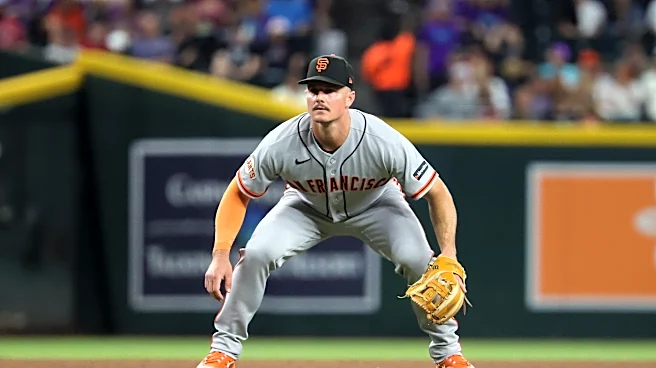
The MLB trade deadline (the only one these days, as opposed to the non-waiver deadline days) is Monday. The Diamondbacks are currently five games over .500 and hold the final wild card berth. Furthermore, they have begun the process of picking up some tie-breakers against their competition. When poised to make a playoff push, it is almost always in the best interest of a club to bolster their roster at the trade deadline. However, unlike the offseason, finding available targets is not always possible,
at least not at a reasonable cost. That’s a sec0ndary problem though. First, a team must identify what areas could most benefit from improvement. Herein are some of the areas Arizona could most likely address between now and Monday afternoon.
First Base/DH/Left-Handed Platoon Impact Bat
After years of Paul Goldschmidt, followed by a few more years of Christian Walker, Arizona fans became spoiled by just how good they had it at first base. Now, the club is in the midst of a historically abysmal season from the infield corner formerly manned by perennial all-star talent. Recently, last year’s trade deadline acquisition, Tyler Locklear, returned to service at the position. It remains to be seen if the slugging right-handed batter will be able to stick at the MLB level. Due to significant, long-term injury, the team still has not had a chance to examine his ability to make the adjustments necessary to thrive at the highest level. His defense is actually better at first than initial reports, so there is certainly some hope that the bat may still surprise as well. Unfortunately, entering Friday’s action, Locklear only has eight appearances in games, amounting to a total of 28 plate appearances. On top of that, while he is showing some signs of being a decent power bat for the middle of the order, he does bat from the right side. That doesn’t help the team’s retched performance from the left side of the plate.
In order to find a potential quick, temporary fix to that issue, the Diamondbacks turned to PED violator, Max Kepler as he came back from his suspension. The results from that move have been mixed – at best. Moreover, even if Kepler finds his best pre-suspension form again, he is ineligible for the playoff roster. So the team will still need a replacement for him if they expect to play in October.
The team need not focus exclusively on first basemen for this need, that simply is the most straight-forward solution. However, given the injury issues with Jordan Lawlar, Tommy Troy, and Lourdes Gurriel Jr. the team could also target a left-handed platoon bat for left field, hoping to get some impact that way, much like when they had Joc Peterson on the roster. Of course, there is also the pure-DH route that could be explored, but such a move is not typical for Mike Hazen, who puts appropriate value on flexibility, maximizing what the mid-market Diamondbacks can do with their roster.
Starting Pitching
Every playoff hopeful wants the best starting pitching they can assemble. Teams with strong October expectations begin to look for ways to turn a season-winning, five-man rotation into a playoff-winning three or four man rotation. Arizona is not so fortunate. Right now, they have a three-man rotation with two more slots being filled by developing prospects. With Zac Gallen and Ryne Nelson unlikely to throw another pitch this year and the questionable return timetable for Corbin Burnes (who may not come back sharp enough to be helpful), the team is left hoping that the injury to Michael Soroka is as minor as can be. Otherwise, the team is short enough pitching to stay competitive over a long spell. As such, starting pitching may well be the one area in which even a modest acquisition can represent a substantial upgrade to the forecast. But then, pitching always costs a premium at the deadline. Still, this is one area where I would expect much of the attention to be focused.
High Leverage Relief Pitching
Arizona’s bullpen has performed well -above expectations thus far this season. Even the recent demotion of Paul Sewald from the closer’s role is a testament to that. Here we are in August and the Diamondbacks’ bullpen (including Paul Sewald) has been a big part of why they are currently a playoff bound team. However, the recent demotion of Sewald has exposed Arizona’s lack of high leverage relief. The team appears to be flush with arms with the potential for mop-up innings and eating swaths of middle innings. What it appears to lack are shutdown relievers. The team entered the season with hopes that both A.J. Puk and Justin Martinez would be back in time to make meaningful contributions as the team’s back end of the bullpen. Now, at this point, it is wishful thinking to expect any meaningful contribution from either of them in 2026. While Brandyn Garcia and Jonathan Loáisiga have the sorts of arsenals one wants to see in high leverage relievers, neither has spent much time in high leverage situations this year. Expecting them to seamlessly slide into those roles now seems a bit problematic. If nothing else, the team will need more than just two high leverage arms for the sort of action they can expect to see in October.
Relievers tend to be grossly overpriced at the trade deadline. But, at the same time, there are so many of them spread across 30 clubs and 30 AAA rosters, that quality can still tend to be found for reasonable prices. Of course, it doesn’t always work out, even when all the signs point to an amazing deal having been made. Arizona fans need look no further than Mike Hazen’s acquisition of Jake Diekman in the summer of 2018. That summer, the team needed left-handed help in the bullpen. Diekman’s peripherals matched his solid track record of success and his salary was still quite reasonable. He was, quietly, one of the better left-handed relievers in the game. Yet, no sooner did he ride the bullpen cart across Chase Field to join his new team than his performance fell off a cliff. Rather than a change of scenery helping him, the change turned him from one of the better elfty relievers in the game to one of the worst overall relievers in the game. Annoyingly, after Diekman was allowed to walk after his failed stint in Arizona, he promptly returned to being a slightly above league average reliever. It would be four more years before he started to struggle again as his stuff declined. Even his lesser time from 2022-2024 was better than his stint in Arizona though. What this demonstrates is that relief pitchers are simply volatile creatures. Unless one is trading for the likes of a Mason Miller or 2010s Craig Kimbrel, a trade for relief pitching is still a risky venture.
Will Mike Hazen address all of these areas for concern? Will he address any of them? What realistic options are open to Mike Hazen and the Diamondbacks this season? We’ll eamine that tomorrow morning.