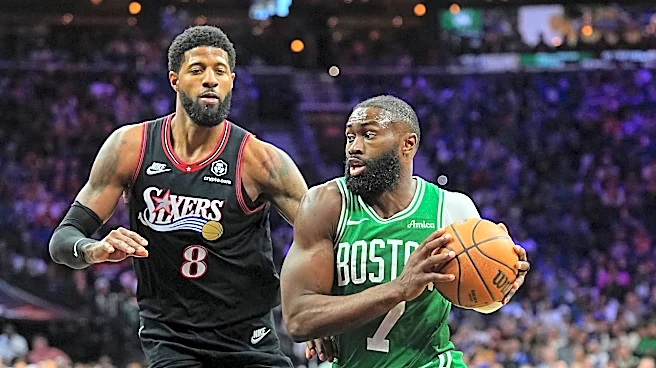




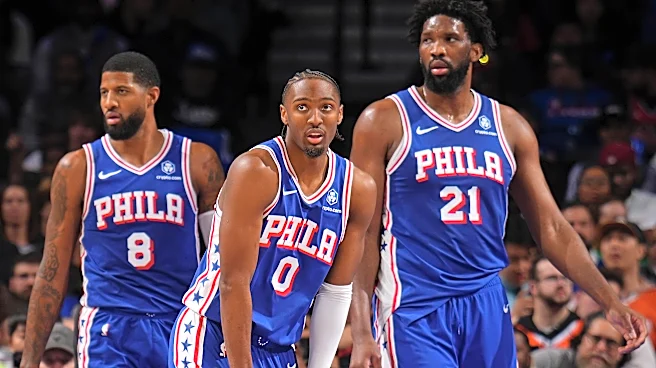


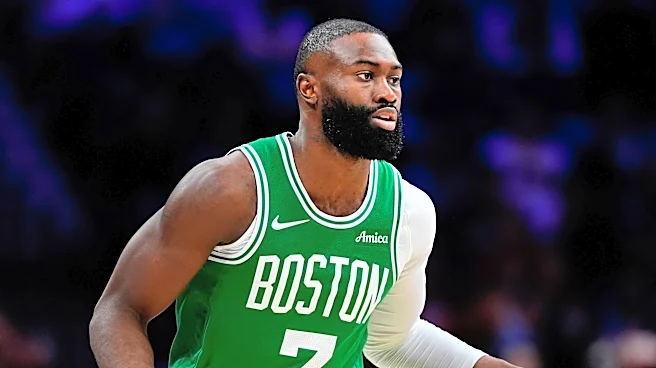
Nearly 48 hours after the Sixers agreed to trade Paul George, two first-round picks and two second-round picks to the Boston Celtics for Jaylen Brown, the consensus appears to be that the Sixers made out like bandits.
ESPN’s Zach Kram gave the Sixers an A- and the Celtics a D+ for the trade. CBS Sports’ Sam Quinn gave the Sixers an A+ and the Celtics a D-. Yahoo Sports’ Morten Stig Jensen was more generous in giving the Celtics a B, but he still gave the Sixers an A.
However, that opinion isn’t universal.
Liberty Ballers’ own Josh Grieb expressed his reservations with the deal, and to be completely honest, I also flinched when the news first hit my timeline. (Granted, that was before I realized that one of the two first-rounders they gave up was in 2028 rather than 2033.)
Chalk it up to Markelle Fultz PTSD if you must. Maybe you’re an analytics nerd who’s overly concerned about Brown’s on/off splits in recent years. That’s ignoring the context in which the Sixers made this trade, though.
Look up any recent ranking of the worst contracts in the league. George routinely appeared toward the top of the list. Even rankings that featured Brown had George ranked higher.
George has one fewer year left on his contract and will not be commanding anything close to a 35 percent max on his next deal, sure. Brown very well might be overpaid relative to his production, both now and moving forward.
But this was a risk that the Sixers had to take.
So long, Sixers apathy
As of midday Wednesday, apathy would likely be the best way to describe how most fans felt about the Sixers.
Adding Dean Wade was fine in a vacuum. Signing Ariel Hukporti to an above-minimum contract was eyebrow-raising, and not in a good way. Adding Wade and Hukporti while losing Quentin Grimes and Kelly Oubre Jr. hardly moved the needle, particularly as other Eastern Conference teams were taking huge swings by adding the likes of Giannis Antetokounmpo and Kawhi Leonard.
With Brown in tow, the Sixers can think bigger again. They dropped from +6000 to +2000 to win next year’s title after the deal, according to ESPN’s Doug Greenberg, which puts them behind only the Oklahoma City Thunder (+270), the San Antonio Spurs (+270), the reigning champion New York Knicks (+850) and, ironically, the Celtics (+1300).
It’s unclear whether the Brown trade directly contributed to the Sixers landing Anfernee Simons with what figures to be the remainder of their non-taxpayer mid-level exception, but it appears to have helped. ESPN’s Shams Charania reported that Simons chose the Sixers over other suitors because he believes “his fit is perfect with the revamped 76ers roster.”
The Sixers might not be done there, either. It’s still a long shot—particularly since they have only a minimum contract left to offer—but the Sixers have “entered the mix” for LeBron James and “are attempting to pitch him,” according to ESPN’s Anthony Slater.
Even if the Sixers don’t land LeBron, the fact that it’s even a possibility is absurd given where they were a few days ago. On The Hoop Collective podcast, ESPN’s Bobby Marks said it likely would have cost the Sixers at least one unprotected first-round pick just to dump George alone.
ESPN’s Brian Windhorst then asked him, “So, did they get Jaylen Brown for free?” Marks replied, “Essentially.”
So, why did the Celtics part ways with Brown at that price?
“It wasn’t that the league doesn’t think Jaylen Brown is a great player or an excellent player,” Windhorst said Thursday on NBA Today. “It’s that the league doesn’t value what he produces at his salary slot. At $57 million, what he produces. And that is why he was traded, and that is why he was traded for relatively so little.
“As the Celtics evaluated where they were as an organization and evaluated where they have to operate in this new world of aprons and basically hard salary caps and everything like that, they said they had to move off of a player of his production level at that salary number, and the other teams out there didn’t disagree.”
That’s a reasonable conclusion for the Celtics to reach. They already have Jayson Tatum heading into the second season of a five-year supermax contract. They’ve spent the past year tearing down their championship roster in fear of a $500 million payroll and luxury-tax bill. After losing in the first round of the playoffs (ironically to the Sixers), they might not have seen a path back toward title contention with Tatum and Brown gobbling up roughly 70 percent of the cap every year.
The Sixers didn’t have much of an alternative.
George and Joel Embiid were going to consume roughly 70 percent of their salary cap for the next two years. The Sixers could have chosen to ride those years out and preserved their assets for the eventual Tyrese Maxey and VJ Edgecombe era. But how would Maxey take to the Sixers lighting two years of his prime on fire in the hope that George and Embiid could stay healthy throughout the regular season and the playoffs?
Maxey is already heading into the third year of the five-year, $203.9 million max contract that he signed in July 2024. By the time George’s contract expired, Maxey would be going into the last year of his deal. And if today’s NBA has taught us anything, it’s that teams are almost always on the clock with their star players.
Flipping George, who played only 78 total games across the last two seasons combined, for Brown, who played 71 games last year and has yet to miss more than 20 games in a season across his 10-year NBA career, could help the Sixers in multiple ways, analytics be damned.
The Sixers shouldn’t have to play Maxey a league-high 38.0 minutes per game again this year, particularly after signing Simons in free agency and drafting Labaron Philon Jr. with the No. 22 overall pick. Ensuring that Maxey and Edgecombe don’t run out of gas in the regular season is key to the Sixers’ hopes of going on a deep playoff run.
As long as Brown continues to avoid catastrophic injuries, he should also help uplift the Sixers more than George did in the games that Embiid misses. Brown finished sixth in the MVP race this past season, while George’s production plummeted upon his arrival in Philly two years ago.
George’s scalability is what made him an attractive option when the Sixers signed him two summers ago. He could shift down into a No. 3 option alongside Embiid and Maxey—and his off-ball shooting ability made him a strong fit for that role—but he theoretically could scale up whenever Embiid or Maxey missed time. However, that didn’t come to pass.
George admitted after the season that he felt like his explosiveness “wasn’t there this year,” and he planned to spend the offseason trying to figure out how (if at all) he could get it back. That won’t be a problem with Brown, to say the least.
There are undeniably questions about how Brown will fit with this Sixers roster, and whether he can live up to both his current contract and his next deal. He might very well be miscast as a No. 1 option. Luckily, he doesn’t have to be that in Philly.
The alternative to the Brown trade was running out the clock with George—and risking Maxey starting to eye an exit from Philly in the next year or two. From that standpoint, this was absolutely a risk worth taking, no matter what the Sixers’ recent transaction history with the Celtics might suggest.
Unless otherwise noted, all stats via NBA.com, PBPStats, Cleaning the Glass or Basketball Reference. All salary information via Spotrac and salary-cap information via RealGM.
Follow Bryan on Bluesky.




![Rich Paul on Sixers: ‘How could they not have [LeBron’s] attention?’](https://glance-mob.glance-cdn.com/public/cardpress/binge-magazine-card-generation/spaces/US/en/sb-nation/images/ppid_2cf3d240-image-178308715105961826.webp)