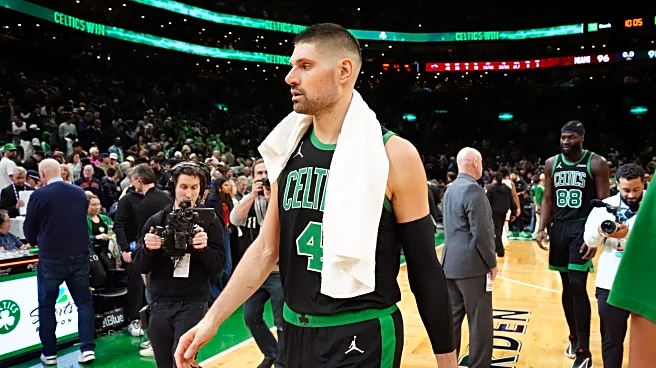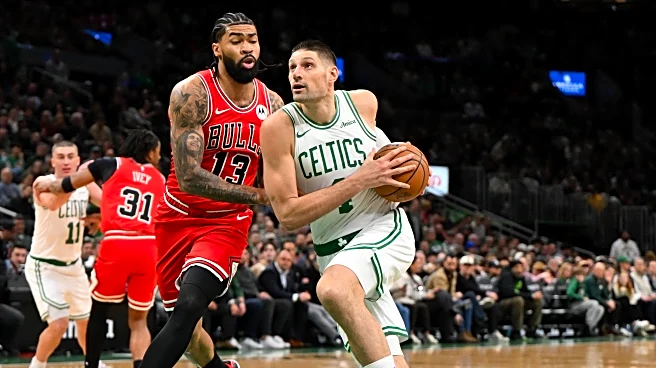

Luka Garza recently tapped into an old routine he leaned on at the University of Iowa to persist through a six-game stretch of bad games in his sophomore year. He found himself riding highs-and-lows then,
playing some of his best basketball then crashing into his worst.
He began journaling through the following offseasons — and said it changed his career.
“As a guy who works so hard, you want to go out there and perform at the level you know you’re capable of,” Garza said on Monday. “But sometimes, you put too much pressure on yourself to do that. So that moment in my career helped me out and pushed me to get past that.”
Having that and other experiences helped Garza through his month without playing time after beginning the season as the Celtics’ backup big. Boston removed him from the rotation in back-to-back games against Detroit and Minnesota late last month after a start and prominent role early in them, respectively. Then, Joe Mazzulla shifted toward a small ball lineup that helped power the team to first among NBA offenses this month. Both those units and Garza’s struggled defensively, so despite the Garza groups losing their minutes by 9 points per 100 possessions, the numbers never ruled him out. And he never felt eliminated either.
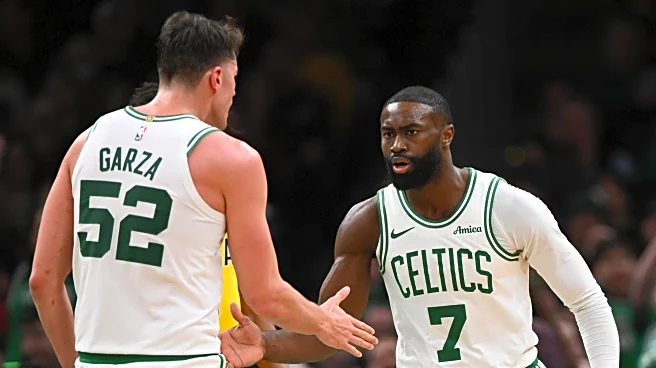
Garza understood Mazzulla’s style, willing to adjust roles and never warning players when he will. So he sat for eight straight games, appearing in two garbage time stints before Jaylen Brown missed last weekend’s game at the Raptors. Garza joined the lineup in Brown’s place early as part of a whole-sale change. He and three other bench players changed the game on a 15-0 run to close the first and Garza finished with 12 points and 10 rebounds as a +22 on 4-for-9 shooting.
“When you’re on the outside looking in, you want to get back in there,” Garza said. “There’s a huge heightened awareness, heightened urgency when you do get that chance, but I just had faith … I got a lot of good people around me to just push me, keep my mind right and I’ve said this before, but that’s the position I’ve been in most of my career, on the outside looking in, waiting for an opportunity and I think that helps me that I have so much experience with it. So it’s nothing I haven’t seen before, but the cool thing about this is I knew it was coming back.”
“It was just a matter of time. I just wanted to make sure when I got that chance that I went out there and did everything I could to help the Celtics.”
Garza and Celtics assistant D.J. MacLeay worked out through Garza’s hiatus and watched the film on the key areas where he needed to improve. He blocked a shot in each of his first two games back and hauled in nine offensive rebounds against Toronto, capitalizing on the chances he missed earlier this season. Despite setting career highs with 10.2 rebounds and 6.3 offensive boards per 36 minutes to begin this year, he seemed to lose control of the ball or come an inch short from retrieving it on numerous plays where he set himself up to do so.
Those, along with misses at the basket, starting 56.5% from the field, left him feeling like he missed opportunities. Sometimes, he said, it felt like he should’ve ended the game with 10 rebounds and left with one, if that. His fate, to some degree, came down to bounces, and how the rest of the team fared. Mazzulla talked to him occasionally as he stayed ready and conditioned for his return. The Celtics’ players have bought into picking each other up, sacrificing and stepping up when others don’t have it. Garza internalized the latter.
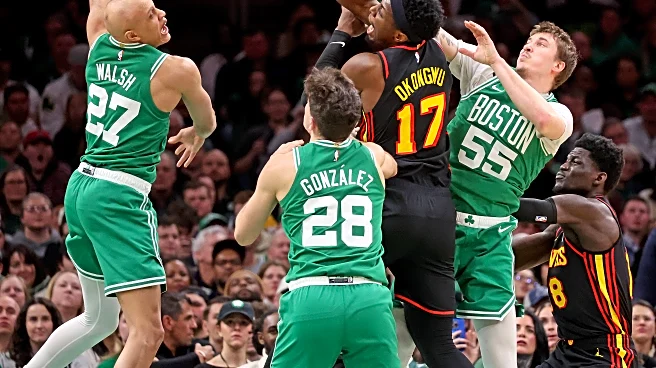
And it happened again two nights after the Celtics’ win in Toronto. Garza entered the game in the first half with Jordan Walsh out, then continued alongside four other reserves after Hugo González already replaced Josh Minott at halftime. They immediately cut a 20-point deficit in half.
“Just create havoc, junk up the game, try to put some pressure on them,” he said. “Make the little plays, effort plays. I think we had that lineup out there in Toronto, or very similar, with me Baylor, Hugo, or whoever else was out there. Ant was out there as well. Going out there and playing as hard as we can, and just trying to turn the game around. I think sometimes we jolted the game, with our energy and effort, and then everybody came in and took care of the rest. JB was unreal down the stretch. It’s a team game. Not every night is every player going to have it to start the game or whatever. It’s the NBA. There are a lot of games and so we all rely on each other … pick the other person up when they’re down, and then give them the rhythm and then we go.”
The Celtics signed Garza to a two-year contract after The Athletic noted that they liked him as he developed there through G-League stints and limited opportunities. He’s averaged 6.7 PPG, 4.0 RPG and 1.0 APG, flashing a three-point shot (12-28 3PT, 42.9%), strong screening skills and free throw shooting (34-45 FT, 75.6%) above his career average.
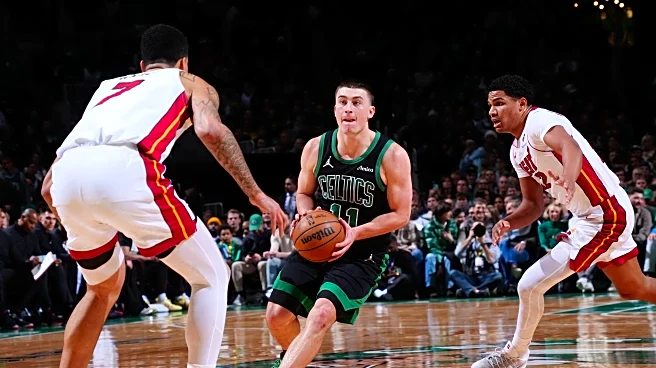
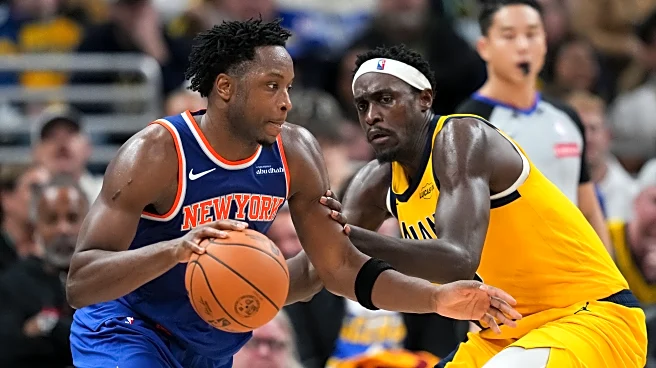
Garza’s pick-and-roll productivity helped Payton Pritchard score 29 points at Indiana on Friday, and he hit all five shots on his way to 15 points, four rebounds and two assists. Another three fell. Indiana’s 15-point lead disappeared and the Celtics won Garza’s minutes by 26 points after +22 and +13 showings on Saturday and Monday. Boston used him in a closing role across those wins, and on a team where nobody’s minutes are promised night-to-night, he led the team in minutes at center across all of them.
Only two weeks ago, he wrote and looked forward to receiving any at all.
“It’s been a journey,” Garza said. “My rookie year, it was really tough and I struggled a lot and I felt like when I was getting out there, I was trying to force too much and was losing my confidence, then I was cut and I was out of the league. I had to take an E-10 to try to make a team and get back in. That moment just gave me a whole bunch of more perspective on everything, understanding that at the end of the day, even if I’m not playing or I’m not in the rotation, I’m living my dream. I never really thought I was gonna be here … playing for the Celtics.”
“There’s so much work that’s done on the physical side of the game and people don’t talk about the work you have to put on the mental. That, for me, I’m journaling, I’m meditating, I’m doing all sorts of things to try to keep my mental right, especially in those moments, that’s where I have even more of a sense of urgency to work on that.”