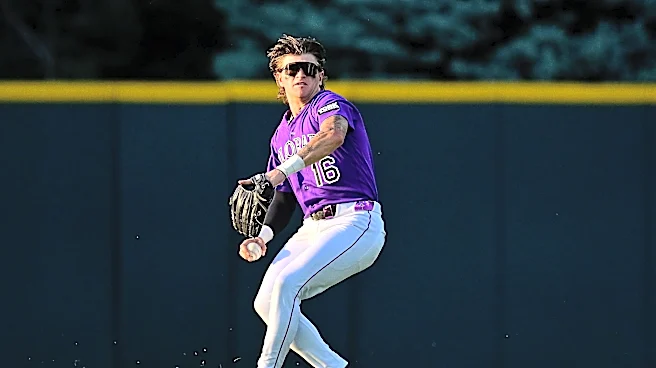




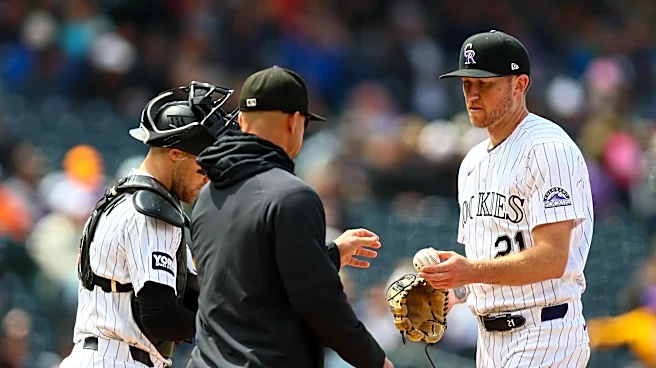


The Colorado Rockies’ bullpen has already shown several different looks in 2026.
In April, it was one of the most valuable relief groups in baseball while handling one of the league’s heaviest workloads. In May, nearly the same workload produced one of the worst ERAs in the majors. June was not much better, and this time, the underlying numbers largely agreed with the damage. Then July arrived, and the bullpen started preventing runs again.
That is not a straight line, but it is still progress.
The
improvement from 2025 has not come from a sudden surge in strikeouts. Colorado’s bullpen has reduced its walk rate from 3.94 to 3.72 per nine, cut its home-run rate from 1.41 to 1.12, and lowered its ERA from 5.18 to 4.93. That cleaner combination of fewer free baserunners, better damage prevention and slightly improved run prevention has helped move the group from minus-0.4 fWAR last season to 2.7 fWAR through July 12th.
The bullpen has provided better value than it did in 2025, but it has also remained temperamental. Its best stretches have looked sustainable enough to matter, while its worst stretches have arrived quickly and often in clusters.
The bullpen is meaningfully better than it was in 2025
The strikeout rate is almost identical. The strand rate is essentially unchanged, and the bullpen’s .318 BABIP is slightly higher than last season’s .313.
The larger changes have come through fewer walks and fewer home runs. Those gains have lowered the bullpen’s FIP by more than half a run, from 4.90 to 4.36.
The 3.1 fWAR swing is best understood as the result of those improvements, along with more useful innings from Antonio Senzatela, Brennan Bernardino, Jimmy Herget, Juan Mejía and Chase Dollander.
The expected ERA is actually slightly higher than it was in 2025, so this is not proof that every underlying problem has disappeared. Colorado still allows plenty of traffic, and its strikeout production remains below league average.
What has changed is the number of workable looks and the value created when those looks have held together.
Month-by-month bullpen performance
After 21.0 relief innings across five March games — three against the Miami Marlins and two against the Toronto Blue Jays before the calendar flipped — April established the bullpen’s ceiling.
Colorado’s relievers threw 125.1 innings during the month, the third-most in baseball, and led the majors with 1.7 fWAR. Their 3.59 ERA ranked sixth, while their 4.01 expected ERA ranked 10th.
This was not merely a bullpen protecting a few late leads. It was a group regularly covering four, five and sometimes more innings while still preventing runs.
Dollander and Senzatela were central to that structure. Dollander threw 21.0 April innings with an 11.57 K/9, 2.14 BB/9 and no home runs allowed. Senzatela added 17.0 innings with an 8.47 K/9, 2.12 BB/9 and no home runs.
Bernardino did not allow a run in 10.0 innings. Herget paired nine strikeouts per nine with a 1.13 BB/9. Mejía struck out 11.32 per nine while averaging close to 98 mph with his fastball.
For one month, the different looks fit together. The long relievers covered innings, the hard throwers missed bats, and Bernardino and Herget disrupted timing in different ways. The workload stayed enormous, but the bullpen absorbed it.
May showed how quickly that balance could unravel
The Rockies threw 123.1 relief innings, again the third-most in baseball, but their ERA climbed to 6.35, ranking 29th. The 4.78 xERA was less severe, though hardly encouraging.
The strikeout rate fell from 9.12 to 7.37 per nine. The walk rate rose from 3.38 to 3.72. The home-run rate barely changed, but the strand rate collapsed from 76.4% to 61%.
The bullpen was still allowing traffic, but it was no longer escaping it with the same consistency. Once runners reached base, innings became harder to contain.
There were useful performances buried in the month. Jaden Hill posted a 1.93 ERA, 2.20 xERA and 1.06 FIP over 9.1 innings. Tanner Gordon’s 6.06 ERA sat next to a 2.98 FIP, 9.37 K/9 and 1.10 BB/9, making his month much stranger than simply bad.
Elsewhere, the regression was more direct. Zach Agnos posted a 12.89 ERA. Mejía continued missing bats but walked 7.82 hitters per nine. Victor Vodnik walked 10.13 per nine. Herget allowed five earned runs in three innings.
Welinton Herrera (No. 17 PuRP) also received his first major-league opportunity late in the month. Herrera made three appearances and did not allow a run over 2.1 innings, including two scoreless innings against the Dodgers. His season ended almost immediately afterward when an MRI revealed a torn UCL in his left elbow. Herrera was transferred to the 60-day injured list, removing one of the organization’s more promising left-handed relief options from the 2026 picture.
June’s expected numbers offered less hope
Colorado finished the month with a 6.01 ERA, 5.78 xERA and 5.19 FIP. The strikeout rate declined again, the walk rate rose again and the home-run rate climbed to 1.39 per nine.
May had been poor with some reason to expect correction. June was poor in a way that looked earned.
The month was not one uninterrupted collapse. From June 14–21, the bullpen posted a 3.42 ERA over 23.2 innings, limited opponents to 0.76 home runs per nine and generated a 53.5% ground-ball rate. The same stretch also came with a 6.19 xERA, 6.46 K/9 and 4.94 BB/9.
The Rockies were escaping innings without consistently controlling them.
The following week produced a 4.30 ERA and 4.46 xERA, a less impressive result but a more believable level of performance. A late-month disaster then helped push the final June line back above six.
July has brought another rebound
Through twelve July games, Colorado’s bullpen ranks fourth with a 2.14 ERA and has accumulated 0.7 fWAR. The group allowed only 0.76 home runs per nine innings and stranded 80.1% of runners.
The 4.17 xERA and 4.26 xFIP advise against treating that ERA as a permanent change. The strikeout rate remained low, and the walk rate was still close to five per nine. But the 3.46 FIP and improved home-run suppression suggest the bullpen has genuinely pitched better, even if not quite as well as the scoreboard says.
Vodnik’s strikeouts returned. Agnos stopped creating as much of his own trouble. Mejía put together four cleaner appearances. Senzatela’s surface results remained uneven, but the underlying work stayed useful.
Jordan Romano also entered the late-inning mix after having his contract selected on July 4th. He recorded two saves and struck out five hitters over his first 3.2 innings, although four walks left the early look incomplete.
Better than the rotation, but not always when the game gets tight
The bullpen has been the better half of Colorado’s pitching staff.
Rockies relievers have combined for a 4.93 ERA over 409.0 innings. The rotation has a 5.90 ERA over 451.1.
The bullpen also owns the lower WHIP, 1.482 to 1.551, and the higher strikeout rate, 7.9 per nine to 6.6. That does not mean the bullpen has been consistently good. It means it has been less damaging than the rotation.
The inning splits make the distinction clearer.
The seventh inning has been a real strength. Opponents have hit .232/.304/.365, and the Rockies have posted a 3.21 ERA.
The results deteriorate from there. Colorado pitchers have allowed a 5.33 ERA in the eighth and a 6.16 ERA in the ninth, where opponents have hit .318/.384/.516.
Extra innings have been worse. Opponents have hit .355/.488/.516 with a 1.004 OPS. The automatic runner raises the difficulty, but it does not explain nine walks and only four strikeouts in 7.2 innings.
The broader leverage numbers follow the same pattern. Opponents have an .858 OPS in high-leverage plate appearances, an .842 OPS in tie games and an .855 OPS with the score within one run.
The bullpen has often helped the Rockies get near the finish, but it has been less reliable once the game has reached its most sensitive point. Romano may give Warren Schaeffer another late-inning look, though four appearances are not enough to say the ninth has been stabilized.
Agnos has carried the largest load
One of the more surprising first-half facts is that Agnos leads all Rockies relievers with 50.1 innings.
Senzatela is just behind him at 49.0, followed by Mejía at 41.2, Bernardino at 38.0 and Dollander at 30.1 before his move to the rotation.
That workload helps explain Agnos’ place in the group.
He has worked short relief, covered several innings behind struggling starters and made a five-inning start. His six-pitch mix gives him several looks to move through a lineup, but the results have remained uneven.
Agnos owns a 7.15 ERA in relief, with a 5.44 xERA and 4.71 FIP. He has struck out 5.90 hitters and walked 3.58 per nine innings.
He has repeatedly taken innings the Rockies needed covered. That is not the same thing as being the bullpen’s best pitcher, but it is still a real contribution on a staff that has needed a lot of outs after the starter leaves.
Senzatela has been the most valuable reliever
Senzatela has separated himself from the rest of the group.
He has thrown 49.0 innings with a 3.31 ERA, 3.22 FIP, 1.224 WHIP and 1.1 fWAR. He has handled multiple innings, entered at different points and occasionally finished games.

Senzatela leads the bullpen in fWAR, followed by Bernardino at 0.8. Herget and Mejía are next at 0.5, with Dollander at 0.3 and Hill at 0.2.
The conversion has involved more than asking Senzatela to throw fewer pitches.
His four-seamer now averages 97.3 mph, placing him in the 87th percentile for fastball velocity. He has also reduced its usage from 56.9% in 2025 to roughly 39% this season.
The cutter has become the center of the new mix. Senzatela throws it around 30% of the time, and it has generated six runs of value. Hitters are batting .197 and slugging .303 against it.
The bullpen version of Senzatela is not built around suddenly elite movement. Several pitches still move less than comparable offerings. The improvement has come through velocity, distribution, and sequencing.
The fastball is harder and less exposed. The cutter has become the main weapon. The sinker and curveball create additional shapes, while the weaker changeup and slider have moved toward the edges of the arsenal.
Dollander gave the Rockies another successful version of the multi-inning power look before moving to the rotation.
In 30.1 relief innings, Dollander posted a 4.15 ERA, 3.33 xERA and 3.79 FIP. He struck out 10.38 hitters per nine, walked 2.97 and produced a 51.2% ground-ball rate.
His four-seam fastball averaged 99.3 mph in relief, the highest mark on the team.
For a while, the Rockies had two pitchers capable of covering several innings with starter repertoires and premium velocity. Dollander’s move to the rotation — and the 13.2 innings he later threw across three starts before suffering a right elbow strain — left Senzatela as the primary version of that role.
The velocity is real
The Rockies have not lacked hard throwers.
Dollander averaged 99.3 mph in relief. Seth Halvorsen sits at 98.9. Vodnik is at 98.6. Mejía is at 97.4. Senzatela is at 97.3. Hill is at 97.2.

That is a substantial collection of velocity, but it has not produced a high-strikeout bullpen.
Colorado relievers have struck out 17.9% of opposing hitters, below the 21.8% league average. Their 8.4% walk rate is slightly better than the 9% league average, but the modest strikeout total leaves only a 9.5-point gap between strikeouts and walks.
The reasons look different from pitcher to pitcher.
Vodnik’s fastball has elite speed but ordinary carry. His slider has developed into his best pitch, while the changeup has lost depth and become more vulnerable to elevated contact. His recent improvement has come from finding better exits after walks, not eliminating the walks.
Hill has generated whiffs and limited barrels, but his 13.4% walk rate has kept the profile unstable. His excellent May was followed by nine earned runs and eight walks in six June innings. He has not pitched since June 20 and remains on the injured list with right shoulder tendinitis.
Halvorsen has relied on the four-seamer for nearly two-thirds of his pitches but owns a 17.7% strikeout rate and 15.6% walk rate. Velocity near 100 mph has not yet produced the missed bats or controlled counts expected from it. He is also on the injured list with right shoulder inflammation.
Mejía has been the more balanced member of the current power group. He has struck out 9.07 hitters per nine with a 3.99 FIP, although his 4.75 BB/9 and 5.40 ERA show how often traffic has complicated the innings.
His first four July appearances offered a cleaner look, with one earned run, six strikeouts and two walks over 5.2 innings. That is too small a sample to establish a turnaround, but it is closer to the profile Colorado is trying to develop.
Bernardino and Herget provide different looks
Brennan Bernardino has remained Colorado’s only established left-handed reliever for most of the season. In relief, he owns a 2.37 ERA, 3.02 FIP and 0.8 fWAR over 38.0 innings. His 6.16 K/9 is modest, but he has limited walks, home runs and overall damage.
The lack of another dependable left-hander makes his versatility more important. Bernardino cannot function only as a specialist. The Rockies need him to face both sides and work through portions of a lineup.
Colorado has received only 4.1 relief innings from left-handers other than Bernardino. Herrera accounted for 2.1 of them before his season ended, while Sammy Peralta made one two-inning appearance and is no longer in the organization.
The immediate depth behind Bernardino is also limited. Triple-A Albuquerque has several left-handed relievers, but none has established himself as an obvious major-league replacement. That leaves the Rockies with little margin if Bernardino is injured or moved before the trade deadline.
Jimmy Herget gives the Rockies another contrast. He does not depend on velocity; his value comes from a low release angle and several pitches that begin from the same window before moving into different lanes.
Herget has a 3.68 ERA, 3.42 FIP and 9.41 K/9 over 22.0 relief innings. His season included a concentrated stretch of hard contact and a shoulder injury, but the overall strikeout and walk profile has remained useful.
The most effective parts of this bullpen have not all looked alike.
Injuries and the shuttle
The Rockies have used 24 players in relief.
That total includes one-off appearances from starters Michael Lorenzen and Kyle Freeland, along with six innings from backup catcher Brett Sullivan. Sullivan has somehow managed a 4.50 ERA, although his 5.93 FIP suggests future appearances may not be quite so forgiving.
Removing those three still leaves 21 actual relievers.
Dollander moved from the bullpen to the rotation, threw 13.2 innings across three starts and eventually landed on the 60-day injured list with a right elbow strain. Herget missed more than a month with a shoulder impingement. Vodnik was out with right ulnar nerve inflammation. Herrera moved quickly from his first opportunity to the 60-day injured list. Hill, Halvorsen and Blas Castaño have since joined them.
The Rockies have responded by moving Agnos, Gordon, TJ Shook, Jeff Criswell and others between Colorado and Albuquerque.
The transaction count can make the depth look broader than it is. Shook is the only current Triple-A reliever on the 40-man roster, so promoting most of the remaining Albuquerque group would require another roster move.
Some transactions have provided longer developmental looks. Others have simply supplied a fresh pitcher capable of recording the next several outs.
The trade deadline could change the look again
The bullpen that opens the second half may not be the one Colorado carries through August.
Senzatela, Bernardino and Herget offer different kinds of potential trade value. Senzatela provides length and a successful role conversion. Bernardino is an established left-hander. Herget brings deception, strike-throwing and another season of control.
Vodnik and Mejía are already receiving regular major-league opportunities, which gives the Rockies some flexibility. Both are young power relievers with upside who could carry trade value, but Colorado could also keep them and move them into higher-leverage roles if more established relievers are dealt.
If the Rockies move one or both, larger opportunities could open for Hill, Halvorsen or Criswell. If Vodnik and Mejía stay, they could move into the higher-leverage innings currently handled by pitchers such as Senzatela and Herget, while the next group receives more regular work behind them.
The left-handed side is thinner, and trading Bernardino would remove a look the Rockies do not currently have an obvious way to replace. Herrera remains injured, and no other left-hander has established a lasting role.
That does not mean Bernardino cannot be moved. It means the roster impact would be different from trading one of the right-handers.
An improved bullpen still being defined
The 2026 bullpen has shown more useful looks than the version before it.
Senzatela has succeeded in multiple roles. Dollander brought premium velocity and strikeouts before moving into the rotation. Bernardino has kept a mostly one-lefty construction workable. Herget supplies a release and movement profile no one else replicates. Vodnik, Mejía, Hill and Halvorsen have shown different versions of the power-reliever look.
The group has also produced declining strikeout rates through the first three months, persistent command problems among several of its hardest throwers, and poor results in the ninth inning and extras.
July has provided another encouraging stretch. The trade deadline may change the personnel before there is enough time to know how much of that improvement will hold.
The Rockies are getting a clearer look at which bullpen traits may work: starter repertoires in shorter outings, premium velocity supported by a real secondary pitch, left-handers capable of handling both sides and deceptive releases that create uncomfortable angles.
They are also seeing that velocity without strikeouts has limited value, one reliable left-hander leaves little margin for injury, and a bullpen can be clearly better than the rotation without consistently finishing games.
That is where the position stands at the midpoint: better value, more useful looks and still temperamental.
Join the conversation!
Sign up for a user account and get:
- Fewer ads
- Create community posts
- Comment on articles, community posts
- Rec comments, community posts
- New, improved notifications system!
Please keep in mind our Purple Row Community Guidelines when you’re commenting. Thanks!