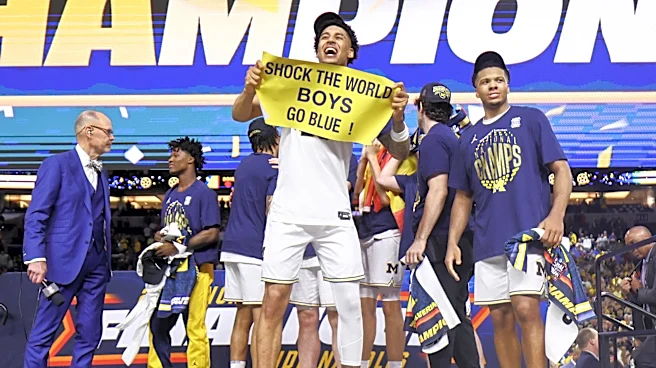









Seeing the confetti fall in Indianapolis was the culmination of a magical season for the Michigan Wolverines, providing a massive sigh of relief for multiple generations. Certainly those who came of age during this century never expected the NIT-riddled program to ever reach the top of the mountain, and it felt like the 2013 National Championship Game was the once chance that slipped away, even with the surprise in 2018.
Obviously, winning a title is an amazing feat that many programs never experience.
Even getting to the Final Four is an accomplishment in itself, as often that ends up being the peak for programs as they experience a particular chapter of their history. Michigan fans cannot be greedy now that the banner is in the rafters, and should be willing to accept a step back, not just because of NBA departures, but because the math is just so harsh.
Returning to the Final Four is hard!
Four teams take the national stage the final weekend of the season, with three of them hungry to get back the following year. While maybe it is no surprise to hear that making consecutive Final Fours is unlikely, one might assume that the top teams in one season would also have a good shot in the next — well, not so fast, my friend!
Since the 2000 NCAA Tournament, just 15 teams have made it to back-to-back Final Fours, representing a 15% success rate. Narrow that window to the past 10 (non-covid) postseasons and that number falls all the way down to two instances: 2017 North Carolina successfully overcame its heartbreak in the 2016 final, and UConn, of course, won back-to-back tournaments in 2023 and 2024.
Why has this already limited possibility dropped to just 5% over the past decade? The transfer portal and NIL only cover some of this range, so while they play a factor, they cannot explain it all. I think the answer might be the obvious one: it is just really hard to build a team that is good enough to make the Final Four. Doing so once probably requires a little luck, and those who are qualified enough to do so based on merit are going to lose talent to the NBA and the portal.
Reigning champions fare little better
Enough about those non-champions LOSERS, what about those who actually won it all? Unfortunately, the math is not any more helpful. Of those 15 teams to return to the Final Four, just three of them were reigning champions: 2001 Michigan State, 2007 Florida (who repeated), and the aforementioned UConn. That means that just 12% of title winners this century end up making it back to the last weekend, with the Huskies the only program to do so since 2007.
That feels pretty consistent with the hypothesis above — winning a national championship is more about the realization of a journey, not necessarily the start of an era. 2022 Baylor, 2023 Kansas, 2025 UConn, and 2026 Florida all lost in the Round of 32, which is a far more likely outcome than making back-to-back Final Fours. It is not just making a second consecutive trip that is hard; simply surviving the first weekend is a challenge for most previous winners.
The fact that the two champions that most recently did return to the Final Four actually went back to win the whole things speaks to the perfect storm it takes for the previous season’s winners. Those who get that far do not do so on accident. Maybe there is some reason for hope, as Michigan enters the 2026-27 campaign as legitimate title contenders, but history does suggest that a shorter NCAA Tournament run is likely to follow.
Various other trends from the data…
- 1999-01 Michigan State and 2006-08 UCLA are the only teams this century with three consecutive Final Fours (the Bruins fell short each time)
- While reigning champions struggled, six different times a team returned to the Final Four after not winning the prior title and ended up cutting down the nets (2000 Michigan State, 2002 Maryland, 2009 North Carolina, 2012 Kentucky, 2013 Louisville*, 2017 North Carolina)
- In addition to UCLA, 2002-03 Kansas, 2009-10 Michigan State, 2010-11 Butler, 2014-15 Wisconsin, and 2014-15 Kentucky all made consecutive empty trips — impressive, but painful