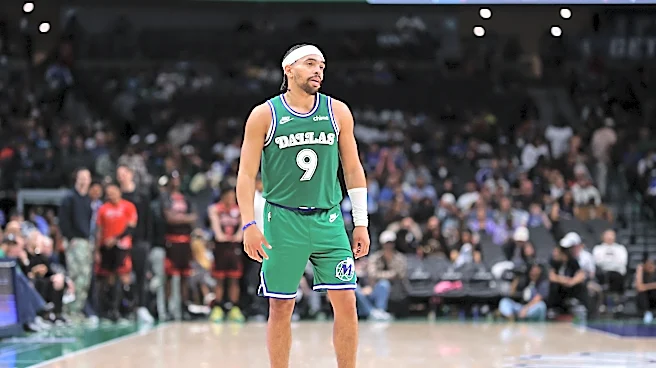






When I previewed Ryan Nembhard back in October, the framing was modest by design. Pass-first guard. Two-way deal. Floor general in the margins. Best case: define his lane so clearly that the Mavericks couldn’t justify cycling him out of the roster. Worst case: blend into the background.
Six months later, he set the franchise’s rookie record for assists in a game with 23 against the Bulls in the season finale, breaking a mark his own head coach set in 1995. So we can dispense with the question of whether
the season was a success. It was. The harder question, the one that lingers under the highlight reel, is what kind of NBA player he gets to be from here. Let’s walk through what actually happened.
Season Retrospective
Nembhard barely played in October. Two minutes here, ten there, sixteen against San Antonio in the opener. He was the fifth or sixth option in a backcourt rotation that included D’Angelo Russell, Brandon Williams, Dante Exum, and, for the first stretch of games as Jason Kidd performed what he believes was an unlocking maneuver, Cooper Flagg as the starting point guard.
The door cracked open on November 28 in Los Angeles. Nembhard scored 17 points on 7-of-11 shooting in 23 minutes against the Lakers. Three nights later in Denver, he became the first undrafted rookie since Stephon Marbury in 1996 to record 25 points and 10 assists with zero turnovers in a game: 28 points, 10 assists, 12-of-14 from the floor, 4-of-5 from deep. It was a coming-out party for the undrafted player.
The next month was the best stretch of his rookie year. Across thirteen December games he averaged 9.2 points and 6.8 assists on 48 percent shooting. He had 13 assists against Miami, 11 against Utah in an overtime loss, 7 in a one-point win over Denver before Christmas. The Mavericks went from a historically poor offensive team to something resembling functional, and the math wasn’t subtle: when Nembhard ran the show, the ball moved, the spacing made sense, and the finishers Dallas had stockpiled actually got clean looks.
Then the roster’s limits caught up to him.
Dallas was hard-capped at the second apron, which meant the front office couldn’t convert his two-way deal until January 6 at the earliest. Then the calendar started working against them anyway. Two-way players are limited to 50 NBA appearances, and Nembhard was burning through his allotment. By early February, the math was unmistakable: keep playing him and he’d hit the cap; sit him and let the conversion happen on the back end. Dallas chose patience. His last NBA appearance before the conversion was February 5 against the Spurs.
The conversion finally came on February 28. Tyus Jones, acquired in the Anthony Davis trade as point guard depth, was waived to clear the roster spot. Nembhard signed a two-year deal with a team option for 2026-27. The early Brandon Williams parallel from my preseason write-up, undrafted two-way guy plays his way onto a permanent contract, wasn’t aspirational anymore. It happened for Nembhard much the same way.
What happened next was murkier.
March was a rollercoaster. Williams had emerged as a real backup option. Flagg was getting more reps initiating the offense. Nembhard’s minutes contracted. There were four-minute appearances and five-minute appearances and outright DNP-CDs, including one against the Lakers. Facing a roster of Lakers wings none shorter than 6-foot-5, Kidd opted not to put him on the floor at all. The implication wasn’t subtle. Against certain matchups, his size becomes a problem the coaching staff can’t scheme around.
He still flashed: 12 assists with zero turnovers against Atlanta on March 18, 9 dimes against the Clippers on March 21 in overtime. But the role had narrowed, and the eye test started raising questions the December breakout had quieted.
April rebooted the workload. With Dallas closed out of any meaningful seeding race and the rotation fully thinned, Nembhard started every game and averaged 30 minutes. The finale against Chicago was a perfect storm. Flagg out after ten minutes with the ankle, the Bulls offering essentially zero defensive resistance, and Nembhard given the keys for a full 38 minutes against a defense that looked actively allergic to closeouts. He finished with 15 points, 23 assists, and 9 rebounds. Take the perfect storm out of it and the closing kick is still real. In his last three games before the Bulls, he posted 21 assists against just one turnover in 86 minutes.
For the season: 60 games, 27 starts, 6.6 points, 5.3 assists, 2.2 rebounds. Led all NBA rookies in assists per game. 316 total assists against 85 turnovers, a 3.7-to-1 ratio that would be impressive for a veteran and is borderline absurd for an undrafted rookie. He belongs in the league. Kidd said as much in his postgame after the finale, unprompted: “He belongs in this league.”
Outlook
So what is he, going forward?
The honest answer requires distinguishing between three different jobs. Can Ryan Nembhard be the entrenched long-term starting point guard for a team trying to win? Very unlikely. Not because of what he showed this year, but because of what the league has become. There were once a few smaller lead guards starting on serious teams. Now there’s basically one, and Trae Young (6’2) is now on the rebuilt Wizards, looking to contend. Young is carried by an offensive ceiling that Nembhard is unlikely to match. The size question doesn’t go away with development. Elite on-ball defenders look at a 5’11” point guard the way a pitcher looks at a hitter who can’t catch up to a fastball. They’ll keep throwing it until you prove you can.
Can he be a fifteen-minute-a-night contributor on a winning team? Maybe. The passing translates anywhere. The decision-making is real. The shot, 35.6% from three on the year and 44.4% in his starts, is functional enough that defenses can’t just sag off him. In the right ecosystem, with the right teammates around him, that’s a useful nightly piece.
Can he be a third point guard, on a standard contract instead of a two-way, on a team trying to compete? Almost certainly yes. That’s the floor, and it’s a floor most undrafted rookies never reach. Brandon Williams found that floor last year and turned it into a real role. Nembhard’s already cleared that bar.
The question of which version Dallas gets, or whether the answer is “none of them, here,” isn’t really one he controls. The Mavericks are about to hand the keys of the front office to someone new. That person inherits an audition tape. The Marbury game in Denver, the Mavericks rookie assist record, the absurd assist-to-turnover ratio, and also the DNPs against length-heavy lineups, the March stretches where the role evaporated, and the size question that won’t ever fully answer itself. Whoever’s reading that tape will decide whether Nembhard is a piece of what comes next or an asset that helps build it.
That’s just the cruel calculus of an undrafted guard who exceeded every modest expectation set for him and now has to clear a much higher bar to stick where he made his name.
What I’m certain of is this: on a Mavericks roster with very few feel-good stories this season, Ryan Nembhard was one. He showed up on uncertain nights and gave the team something it didn’t have anywhere else. He earned the contract. He earned the record. He earned the conversation.
Whatever the next chapter looks like, and wherever it gets written, the floor he established is real. The ceiling is the league’s to determine. And the guy in the middle of it, the 5’11” undrafted Canadian who led every rookie in the NBA in assists per game and broke his coach’s franchise record on the last night of the season, has earned the right to be evaluated honestly, not generously.
He belongs in the league. Now we find out what the next Mavericks GM does with that.