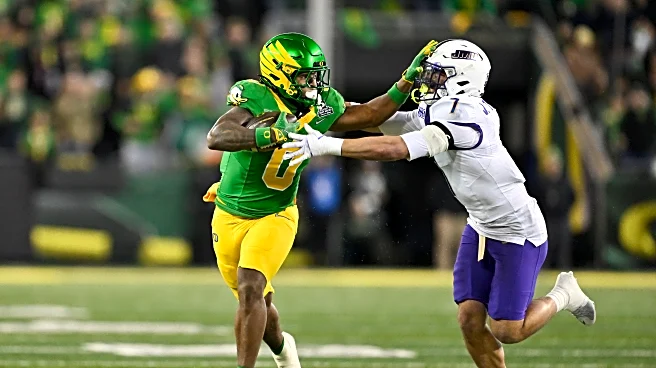

Oregon’s approach in this first playoff game was as aggressive, if not more so, than during their non-conference schedule. As hythloday’s guests had suggested on the podcast, James Madison stayed with their base single high safety defensive alignment early in the game. It was a big gamble to try and generate negative plays against an offense with a noticeable speed advantage and the Ducks made them pay for it. Oregon’s first five offensive possessions all ended in touchdowns after taking only 5 plays or fewer,
and each drive included a play that went 30+ yards. The JMU Dukes mixed in a bit more zone coverage as the game progressed, but it didn’t make much a difference and they never went away from their base defense completely.
By contrast, James Madison’s offense only had a single super-explosive play in the first half (a trick double-pass), and only managed six points even after getting a late turnover. Long, time consuming offensive possessions is a classic asymmetrical strategic approach for teams with speed deficits (e.g., the service academies with the triple option), but can only work if those possessions are paid off with touchdowns and Dukes didn’t do that. JMU extended competitive play when they finally scored a super explosive touchdown to open the second half. Once Oregon answered and JMU proceeded to go three-and-out, representative play ceased as JMU didn’t have enough time on the clock to make up a four-touchdown deficit.
From an analytical perspective everything after JMU gave up a sack with 9:28 left in the third quarter is garbage time. Much has been made of the Dukes narrowing the deficit as the game went on even though Oregon left their starters in (though they were mixed in with backups after this). Analyzing the team’s “killer instinct,” effort, or ability to stay focused during non-representative play is beyond the scope of a film study like this one, which is concerned only with replicable performance during competitive play.
Offense
The gap in athleticism between JMU and Oregon was at its most apparent when the Ducks had the ball. Oregon ran only 29 plays before garbage time, but that’s only because they had to kick the ball away after scoring. As such I didn’t have a large enough sample size to separate out runs and passes, but the overall numbers speak for themselves: 79.31% success rate, 44.83% explosive plays, and 15.35 adjusted yards per play. The Ducks were a mismatch for the Dukes and the Oregon staff put together a very aggressive game plan to take advantage of this and bury their opponent early. For all intents and purposes, the Ducks could call whatever they wanted and the only thing that ever stopped them was themselves.
JMU’s defense is designed to play against Sun Belt offenses that emphasize the ground game and utilize the QB as runner. They were very effective against teams with comparable athleticism in the regular season but had no answer to the size and speed Oregon had on offense. Quarterback #5 Dante Moore did have one carry for a touchdown, but besides that the threat of his legs wasn’t needed. The offensive line had an overall 15% error rate in the run game (decent but still not yet at the historical Oregon standard), but unless multiple blocks were missed the Ducks ball carriers were getting significant yardage. Below is a sample of successful rushing plays.
(Reminder – you can use the button in the lower right corner to control playback speed)
- :00 – Both true freshman backs are to either side of QB #5 Dante Moore as TE #18 Sadiq motions across the formation into the boundary. If the unblocked DE on the offense’s left had crashed down immediately on RB #0 Davison, Moore would keep the ball and have the option to toss to RB #23 Hill or keep it himself. When the end stays wide to defend the keep Davison gets the ball. Notice the entire offensive taking a kick step to their right to obtain proper leverage on the defenders. Davison has a clean hole to the second level where a block from WR #1 Dak. Moore helps get him inside the 10-yard line.
- :15 – Hill had a number of big gains using his speed on the edge. This play is an under center variation of the outside zone toss we saw so frequently from Stein’s Oregon offenses in years past. The corner gets pulled inside when WR #2 Bryant goes in motion. That same defender is forced to the sideline by OT #76 World pulling around Sadiq who pins the DE inside. Davison takes care of the boundary safety and Hill is free to practice his 50 yard sprint.
- :39 – Davison leads the way for Hill again, but this time straight up the middle. The blocking is excellent besides RG #74 Iuli releasing to the linebacker. He makes enough contact for a successful run, but the defender squeezes the hole so the safety can fill it. Hill’s speed and strength still nets him ten yards and a new set of downs.
- :47 – Another two-back look, but this is a bit different as veteran RB #6 Whittington is to Moore’s left with TE Sadiq to his right. Sadiq cuts in front to block for Moore if he keeps it, but given the end’s leverage the correct decision is to hand off. The blocking at the point of attack is a bit of a mess, OT #71 Harkey is supposed to release to the boundary safety but has to stay and help Iuli handle the 3-tech. Whittington becomes his own blocker and drags the defender downfield behind him.
Oregon only had two failed rushing plays during meaningful play, based on the down and distance. As such I picked out two clips with the starters involved during garbage time to fill in the compilation below.
- :00- The Dukes are in an unusual 3 down alignment here so Moore’s backside read is the LB JMU #56. When that defender stays wide the line has 5 against 5 as they kick step to their left. Neither double team neutralizes the first level defender and Whittington can only push the pile forward for 3 yards.
- :08 – Hill goes in motion to occupy the nickel defender and give the offense numbers to execute a split-flow inside zone run. Sadiq gets wrong-armed by the defensive end, OG #75 Pregnon lunges and loses control his man, which contributes to a poor angle from C #72 Laloulu. Davison muscles forward but was given a very unfavorable spot, so it goes down as only a two yard gain.
- :15 – We’re already into garbage time less than halfway through the 3rd quarter before I could find another good clip of a failed rushing play. Veteran transfer RB #22 Jay Harris is in the game, possibly as a reward during his last game at Autzen. The orbit motion from Hill occupies one defender while the backside DE is held in place by the threat of Moore keeping the ball. Harkey and Iuli both fail to gain outside leverage and Harris waits too long to try to cut back down field bewteen Laloulu and Pregnon.
- :23 – It’s after the blocked punt now and essentially all over but the confetti. Davison is lined up behind center with Moore behind him in the pistol while Hill is to his left and RB #27 Jayden Limar (back from injury) is to his right. The Dukes are expecting a run so the field side defenders react quickly. Davison makes the correct read of the DE (and Pregnon’s failed block) to hand off. On the edge WR #17 Cooper loses outside leverage on the nickel and the linebacker makes an form tackle against Hill with help on the way.
Oregon fans got very good news in the lead up to the game as WRs #7 Evan Stewart, #2 Gary Bryant Jr., and #1 Dakorien Moore were cleared to practice. Stewart has been out all season recovering from a major knee injury suffered this time last year and didn’t see the field. Dak. Moore and Bryant were both in the game at various points, though only Dak was targeted while getting a single catch outside of garbage time. Mostly Oregon went with the 12 and 21 sets that they have used the latter part of the season and they were extremely effective. Below is a sample of successful passing plays.
- :00 – Possibly trying to rattle Moore, JMU drops eight defenders into a 3-deep zone coverage. It’s the best possible situation for the defense as Laloulu and Iuli are allowing pressure right up the middle despite only three rushers. Moore sees the field side corner bailing deep and knows he’ll have WR #11 McClellan open on a comeback route. He stands tall in the pocket and delivers an accurate throw just before being taken to the ground.
- :09 – Oregon has reached the red zone and the Dukes are in a more typical alignment for them; man coverage with a single high safety. Expecting this, Moore’s first look is to McClellan on his left running to the pylon where the corner has no help. The receiver gets downfield position and the defender resorts to interference trying to prevent a touchdown. In this case, such resistance is futile. Moore never has to come off his first read so the pressure coming from the inside twist and green dog blitz from the linebacker has no chance to affect the play.
- :44 – In prior games hyth and I had been critical of the Oregon staff not taking advantage of second and short situations to throw deep. Against JMU the offense was willing to take those shots and it paid off most of the night. The Dukes are crowding the line leaving WR #4 Benson one-on-one against the field corner. The blitzer’s coming from the perimeter are causing a problem even with only two receivers in the pattern, but Moore trusts his man to win against single coverage and throws before pressure arrives. Benson has cooked the defender and it’s time to strike up the band.
- 1:28 – Oregon has a similar look in second and short here, but with an already comfortable lead the call is an RPO to simply extend the drive. The corner is, understandably, giving Benson plenty of cushion so Moore has an easy throw that his receiver turns into a big gain with so much room to run.
As with the rushing offense, the passing game was so efficient I had to dip into garbage time to find a full set of usable clips of failed passing plays with the starters. Examples are shown below.
- :00 – The offensive line line a 10% overall error rate in pass protection against JMU, not terrible but not as well as they had done late in the regular season. On this play I think that Harkey and Laloulu are supposed to be pulling to the offense’s left to bait the defense into reacting as if this is counter with the ball going to Davison. The Dukes are blitzing aggressively and concentrating on pressuring the quarterback, so the line is now out of position and Sadiq gets beaten around the edge to boot. Moore still has a chance to loft a high throw to Perry when the nickel bails deep at the snap, but the receiver slips. Both teams struggled with traction on the turf during this game, in the cold environment.
- :15 – The Dukes show a six man pressure, and with five in protection Moore is responsible for getting the ball out before the rusher coming around the offense’s right side can get to him. Anticipating the hot route being run into the boundary, it is actually a simulated pressure as the linebacker follows Hill into the flat and earns a PBU. Credit to the JMU defensive staff for a great call.
- :21 – Late in the second quarter the Ducks have a chance to get a clean kill before halftime if they find the end zone in a two minute drill. Before the snap JMU looks like they are sending the house and using straight man coverage. If the rush comes he’ll have the slant to Benson wide open, but if a defender bails into the throwing lane he can swing it out to Whittington. The linebackers drop into coverage, but Moore sees the defender moving to the flat and thinks he can still find Benson with a side arm throw. He has the ability to do this, but the decision backfires when Benson can’t keep his feet through incidental contact and a lucky bounce results in an interception. The safe decision was the screen pass to Whittington, but Benson also needs to see the linebacker coming and try to dodge around him.
- 1:02 – The game is already well in hand at this point in the third quarter. The offense has occasionally asked Hill to be more involved in the passing game than the other backs, and this is one of the most difficult routes I’ve seen him be asked to run. Moore seems to expect him too continue further to sideline before heading downfield, but instead he makes his second cut early and gets tangled up with the defender as the ball sails over his head.
Defense
James Madison’s first possession was well scripted by their offensive coaches, marching 63 yards in 15 plays, though they needed two fourth down conversions to do it. Despite getting explosive runs of 24 and 14 yards, the Dukes needed two fourth down conversions to maintain possession and had to settle for a field goal. They did get a super-explosive 50 yard gain on a trick play in their second drive, but didn’t score and were held to another field goal attempt, which was blocked. Their remaining points during representative play came on short field at the end of the first half allowing another field goal, and a super explosive touchdown pass that came down to a missed tackle (see below). All of this aligned with the trends for JMU’s offense indicated in hythloday’s preview.
The Dukes did well running the ball on their first scripted drive as Oregon adjusted to dealing with RB JMU #3 Knight and QB JMU #14 Barnett at full game speed. After this point James Madison could pick up short yardage but didn’t have any explosive runs except on a fake punt. The size and athleticism of Oregon’s defensive line put the Dukes behind the chains often enough they could not grind out long drives on the ground later in the game. Here is a sample of successful rush defense.
- :00 – JMU used a lot of different blocking schemes and backfield alignments to keep Oregon off guard in their first drive. Even close to the low red zone, they aren’t out of new ideas as QB JMU #14 Barnett makes a midline read while the backs move in the opposite direction of the pulling guard and tackle in an effort to confuse the defenders crowding the line of scrimmage. The quarterback keeps the ball when ILB #54 Mixon takes outside leverage on the running back. There is nowhere to go in the middle as DT #52 Washington gets off a block and gets his hands on the QB before ILB #28 Boettcher arrives to clean up.
- :08 – The Ducks are playing with two high safeties to guard against explosive plays, and with two tight ends (one split out to the offense’s right) and receivers tight to the formation there are enough blockers that Barnett doesn’t need to read a defender. Boettcher comes on a blitz and does an excellent job to gain inside leverage. This forces RB JMU #3 Knight to bounce outside where S #21 Flowers runs the alley to bring him down.
- :16 – The Dukes are now in standard 11-personnel, and Oregon is in the alignment they used most often this game with two high safeties and S #31 Thieneman closer to the line of scrimmage in the middle of the field. Mixon is split out in coverage so the offense has a numbers advantage in the box. This is countered by DT #50 Gray (at 1-tech) splitting the double team. Both DT #99 Green and OLB #44 Tuioti turn their blockers inside to create a wall of bodies with no gaps to run through. The QB can’t keep because DE #10 Uiagalelei keeps backside contain and CB #4 Finney has come on a blitz from the boundary, leaving the runner with no escape.
- : 24 – Keep your eye on Washington playing 3-tech to the offense’s left. He pushes guard back at first, but doesn’t keep his feet moving to maintain proper weight distribution so is then pushed back. This opens a hole for the running back, but Mixon has come down from coverage to spill the play toward the sideline. By this time STAR safety #0 Austin has come down in run support. He doesn’t wrap up properly but does buy time for Washington and Uiagalelei track down the ball carrier in pursuit.
Oregon’s efficiency defending the run was exactly average with as many successes as failures. While the Ducks were very good at limiting explosive runs, short yardage continued to be a weakness. This appeared to be part of a deliberate strategy: the defense never oversold to stop the run in short yardage situations. While this did lead to extended drives by the Dukes, it also kept them out of the end zone if they couldn’t generate super-explosive plays prior to garbage time. Examples of failed rushing defense follow.
- :00 – Very early on the Dukes had success getting leverage on Oregon’s defenders. I doubt the QB read was live here because none of the defenders on the line of scrimmage are left unblocked. In the middle it’s a mess thanks to DT #1 Alexander, but the receivers execute an excellent double team to seal STAR #22 Canady and Thieneman inside while Mixon gets caught in the wash. The quarterback then knocks Finney on his butt and it’s up to Flowers as the single high safety to save a touchdown.
- :22 – James Madison came into the game prepared to risk going for it frequently on 4th and short. Barnett is in the backfield, but notice it is Knight raising his leg to signal the guard to begin the silent count, indicating he will take the snap. With only a half yard to go the running back can then directly at the gap that is temporarily vacated as Green twists over Washington in the middle and fall forward for the needed half yard. The safeties playing off the line of scrimmage shows the Ducks were willing to give JMU a fresh set of downs to avoid the chance of a giving up a touchdown to a play action pass.
- :34 – Here is the complement to Knight in the run game as Barnett executes a midline read. Boettcher is aiming for the A-gap as part of the rush plan if this had been a pass, so Mixon needs to scrape over the top of him to guard the B-gap on the offense’s left as Tuioti sets the edge. Once Mixon steps inside there enough space for Barnett to put a move on him. Thieneman does well to minimize the gain from his single high safety position.
- :50 – Later in the game it appears Oregon is trying out using a scrape exchange with Tuioti crashing on the running back while Alexander loops around outside him. The plan backfires when the offensive tackle gets leverage against Alexander to give Barnett a clean hole before Thieneman has time to properly diagnose the play.
The Ducks were confident they could contain JMU’s receivers one-on-one down the field and spent most of the night in man coverage. There was also a far more blitz intensive plan to generate pressure on Barnett, bringing 5 or more rushers on more than a third of the Duke’s drop backs. The tactic paid off as batted balls and off target throws were frequent. JMU was no more efficient throwing the ball than they had been all season, and far less explosive. Here is a sample of successful defended passing plays.
- :00 – Though it is compressed in the low red zone here, this three safety look with Thieneman in the middle of the field was the most common alignment for the secondary throughout the game. As shown here, it was also frequently paired with a fire blitz from the linebacker. The quarterback sees his tight end gain inside position on CB #7 Obidegwu quickly enough to throw before Boettcher gets to him. The T/E stunt by Alexander and Tuioti puts the latter in position to knock the ball down, one of several instances I have noted on my tally sheet.
- :12 – On this play Oregon is in the same defensive alignment, this time against a bunch formation from JMU. Mixon blitzes this time from the offenses right. The quarterback’s first read is a slant run into the boundary, but Boettcher steps into the throwing lane. By now pressure coming so the QB has to check down to his tight end who made a delayed release into the flat. Thieneman needs to do a better job of wrapping up on the tackle, but Mixon arrives in time to hold the play to a minimal gain.
- :22 – On third and very long Oregon only sends a four man rush and keeps seven players back in coverage. With the back assisting in protection the pocket holds up quite well. The Dukes are getting close to desperate down 17 in the 2nd quarter and call three vertical routes. Fortunately the Ducks are playing a three deep zone and nobody is open.
- :32 – JMU is threatening to cut into Oregon’s lead before the end of the half so the defense sends not only Boettcher but also Flowers after the quarterback through the A-gaps in 2nd and 10. Barnett knows the protection won’t hold for long and he has to get rid of the ball quickly, so he takes a shot against Obidegwu in single coverage. The corners answers the challenge, keeping proper position and turning to play the ball so he can break up the pass.
Astute readers knew that WR JMU #13 Ellis had the ability to beat one-on-one coverage (to the point where I worry JMU will lose him to the portal), but outside of him the vast majority of completions were for short gains. The Duke’s other receivers do have some impressive run after catch ability, but with one notable exception Oregon kept them contained. Below are examples of unsuccessfully defended passing plays.
- :00 – This bubble screen to the TE is essentially a glorified hand off to force the defense to guard the entire width of the field. The blocks by the receivers aren’t perfect but are enough for a 5 yard gain on 1st and 10.
- :07 – Before the snap Barnett see’s his best receiver, WR JMU #13 Ellis, is matched up in press man coverage against true freshman CB #14 Offord. Pass rush specialist OLB #32 Wyatt has a chance to hurry the pass, but he slips on the turf (something both teams were prone to). Offord isn’t in bad position, but there is no defense against an accurate back shoulder throw to a receiver with Ellis’ reach.
- :15 – Mixon is showing pressure, but backs out into zone coverage at the snap. I’m not sure why he takes a step toward the passer rather than continuing to widen with Ellis though.
- :23 – In the third quarter the Dukes finally got the super-explosive play they had been searching for. Once the quarterback sees Obidegwu blitzing from the boundary throwing the hitch is a guaranteed first down. Flowers loses his footing as he spins down from his safety position, but WR JMU #11 DeGenarro shows off some fancy footwork to stay in bounds and it is off to the races. Canady also seems to be a victim of poor traction trying to save a touchdown.