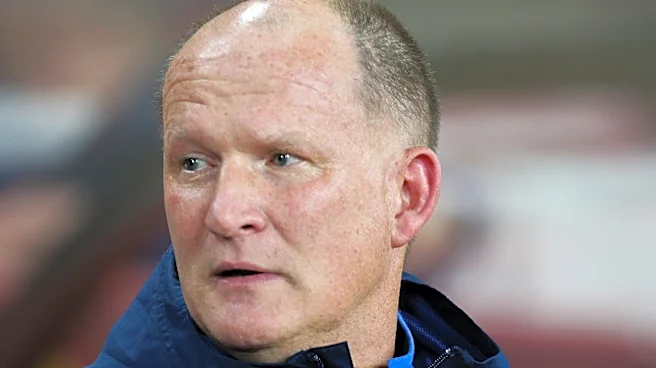



In hindsight, you couldn’t have made it up now that we have the luxury of looking back from what could potentially be one of the club’s most exciting periods, yet Simon Grayson was sacked on Halloween in 2017.
What a horror show that whole episode was.
In fact whilst doing some background reading about Simon (Larry) Grayson, it made me sit back and wonder at how far we’ve come in a few short years. Say Grayson’s name to most Sunderland fans in a game of ‘word association’, and they’d say “flip chart”
in response, following his disastrous appearance on the Netflix series.
Of course, we now know (according to Grayson himself) that it was all a set up and that he quickly had to cobble something together for the cameras, but that explanation aside, he didn’t do anything to enhance his reputation whilst at the Stadium of Light.

Born in Ripon in 1969, the outwardly tough-talking, no-nonsense Yorkshireman was given the nod following the departure of David Moyes, after relegation from the Premier League in 2016/2017.
Sunderland fans were looking for the club to regroup and bounce straight back up from the Sky Bet Championship, and on paper, perhaps there was an element of common sense about his appointment — after all, he’d guided all of his previous three clubs (Leeds United, Huddersfield and Preston North End) to promotion out of League One into the Championship.
Maybe if he’d been given the manager’s job when we were in that league, he may have helped us. We’ll never know, but he certainly couldn’t stop us from beginning the plunge out of the Championship and into League One— two relegations in two years.
Like I say, there may have been an argument that it was a sensible and pragmatic appointment but for me, his whole demeanour was uninspiring and he was a bad fit from the get go.
The debacle on Netflix (set up or not) seemed to fit perfectly with the impression that a lot of fans had of him anyway. He lasted barely four months, with his final record in first class competitions with the club reading:
Played 18. W3, D7, L8. Goals for: 23. Goals against: 34.
The final straw came after the final whistle in a home game against bottom-of-the-table Bolton Wanderers (yes, them again!).
The club seemed to have pulled off a giant “get out of jail free” card by appointing former Wales manager Chris Coleman as his replacement. He tried hard but the rest, as we say, is history. A history that I never want to see repeated in my lifetime.
After his dismissal, Chief Executive Martin Bain stated:
While we hoped Simon’s experience in the Football League would help us to have a successful season, results have not been good enough for a club of this stature
For us to improve on our current position, a fundamental change is necessary.
Despite Grayson claiming “to be the best man for the job”, a few days later, he was gone.

The Sunderland job knocked Grayson’s confidence if the rest of his career tells any sort of tale.
He went on to manage Bradford, made a return trip to Blackpool and then to Fleetwood Town, not lasting more than a season at any of the three clubs. He then found a modicum of success by chancing his arm abroad at Bengalaru in India, whom he took to a cup final, and Lalitpur City in the Nepal Super League (which sounds like an oxymoron!) with whom he won the league title.
However, as if to prove the level he was now working at, his next appointment back in England was with Hartlepool United — and yet again, he hardly lasted four months before being sacked.
Reading this might place a dark cloud over your mood, whenremembering such dismal days.
On the flipside, however, it’s also uplifting to see where we are now: back in the Premier League, with a league cup quarter-final to come and a second home Europa League game next week. Unfortunately, Grayson’s part in that story was one of several hard rocks we banged our heads against on our steep fall.