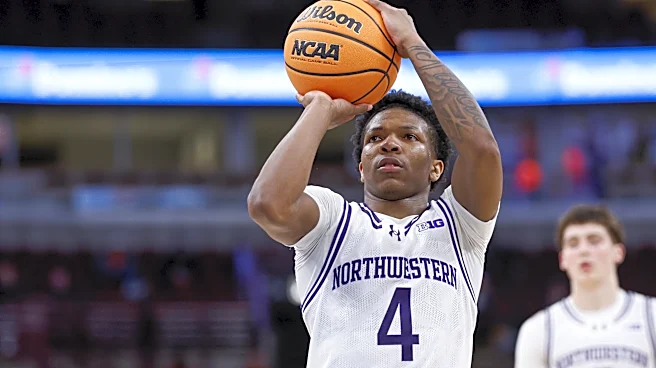






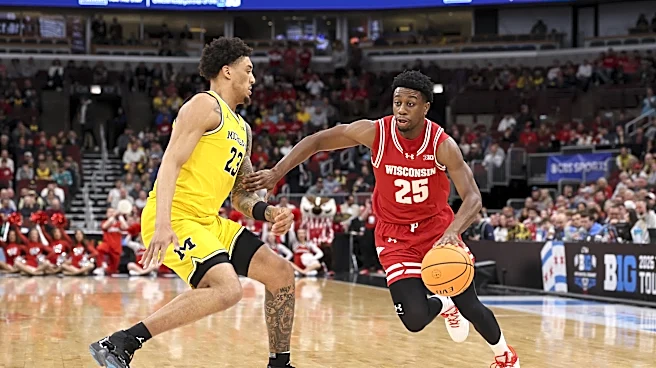
As we move forward with more men’s basketball player reviews, it’s now time to analyze the season of Jayden Reid, the 5-foot-10 junior guard from Westbury, New York.
The Good
‘Cats fans were immediately excited about the offensive stability Jayden Reid would provide when he committed to Northwestern via the transfer portal in April of last year. Reid was one of the best scoring guards in the American Athletic Conference in the 2024-25 season, averaging 12.6 points per game on 35.8% 3-point shooting, including
four games with 20 or more points.
Un Evanston, Reid immediately established himself as a floor general. Starting at point guard from the jump, Reid was the central operator of pick-and-rolls, and was successful as a passer finding ways to creatively feed Arrinten Page inside:
As a floor general, the junior’s best game of the season came in his final time rocking the purple threads on the hardwood, as he posted nine assists in Northwestern’s season-ending loss to Purdue in the Big Ten Tournament. Just two days earlier against Penn State, Reid also had nine assists, a mark that tied Northwestern’s single-game Big Ten Tournament assist record.
Reid’s best scoring output of the year came back in mid-January against Illinois. Coming off the bench, the guard dropped 28 points on 9-of-15 shooting from the field and 3-of-6 from deep, adding four assists and three rebounds. Reid’s 28 was a career-high and now stands as the most points scored off the bench by an NU player since Derek Pardon in 2015.
Propelled by these big performances, Reid finished the year as a solid starter for NU, with final averages of 10.1 points and 5.0 assists per game — which led the ‘Cats. On the offensive end, Reid was one of Northwestern’s most impactful players, finishing with a 2.92 offensive Bayesian player rating (per EvanMiya.com) that was second to Nick Martinelli and 57th in the Big Ten.
The Bad
Despite being regarded as a talented scorer, Reid’s transfer commitment to Northwestern was highlighted by two major concerns: limited size and inefficiency. At the end of his time in Evanston, both these factors continued to affect his play as a Wildcat.
Reid struggled on the defensive end in the more physical Big Ten due to his size. Though Reid was never regarded as an elite defender, Collins was forced to remove him from the lineup at points throughout the season because of his lackluster defensive play, likely influenced by his undersized 5-foot-10, 160-pound stature. Reid finished with a DBPR of 0.18 that was dead last on Northwestern.
In terms of inefficiency, in the 2024-25 season the Westbury native led South Florida in turnovers per game (2.6), while also having one of the team’s worst shooting percentages (39.2%). At Northwestern, Reid continued to struggle in both of these statistical categories. Reid’s 1.9 turnovers per game led the ‘Cats while his 39.0% shooting percentage dipped lower than it had been in Tampa.
Moreover, Reid’s three-point shooting struggled during his time in Evanston. The guard shot it from deep at a 31.7% clip, four percentage points below his mark at South Florida.
As a result, the jubilation of Reid’s big games was marred by the bitterness of poor performances. Two games after Reid dropped 20 against Michigan, he went 5-of-20 with nine turnovers in a three-game stretch versus Nebraska, Maryland and Indiana. Inconsistent play like this was a hallmark of the junior’s season.
The Bottom Line
Reid’s season at Northwestern was a mix of clear strengths and lingering flaws. He proved himself as a capable floor general and playmaker, leading the team in assists and delivering several standout scoring performances. However, his size created defensive issues, and his inefficiency — particularly as a shooter and decision-maker — led to frustrating inconsistency throughout the year.
Following the season, Reid announced his transfer to the Memphis Tigers on April 15, sending him back to the AAC for his senior campaign.
To make the most of his final season, Reid will need to become a more consistent and efficient player, limiting turnovers and improving his shooting percentage to match the flashes of talent he’s always shown.