

With the 2025 Texas Rangers season having come to an end, we shall be, over the course of the offseason, taking a look at every player who appeared in a major league game for the Texas Rangers in 2025.
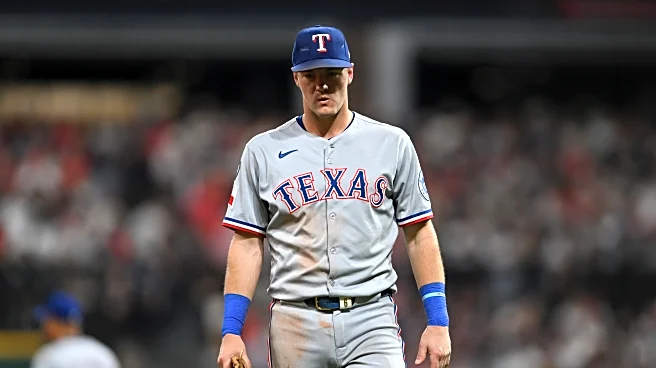
Today we are looking at Josh Jung.
There is a level of irony in the fact that the book on Josh Jung coming out of college was that he was a guy with a strong hit tool and good strike zone awareness but concerns about how much power he’d hit for. The fear was that he would be a guy who would hit for average
but not have the power necessarily to be a first division regular at third base, assuming he was able to stick there defensively and not have to move to first base. He has become a guy who hits for middling average, doesn’t walk, strikes out a ton, and whose value depends on his power production.
The 2019 MLB Draft was a weird one. Jung went 8th overall, higher than he was generally ranked on the various boards, though his profile fit the new approach the Rangers were taking in draft and in their talent acquisition, prioritizing skills — particularly hit tools and ability to make hard contact with their position players — over tools, as well as a track record of success against high-level competition. It took almost two decades, but Grady Fuson’s talent acquisition philosophy ended up getting adopted after all.
Such a checkered group of first rounders in 2019, with the career arcs of the college draftees being particularly odd. Adley Rutschman, who went first overall, appeared to be a superstar in the making his first year or two in the league, but his offensive performance has dropped each year, to the point he was really a glove-first catcher in 2025. Andrew Vaughn and J.J. Bleday, the third and fourth overall picks, have been busts. Hunter Bishop, the 10th overall pick out of Arizona State, hasn’t even made the majors; neither has Kody Hoese, taken 25th overall out of Tulane by the Dodgers. University of West Virginia pitcher Alek Manoah, taken by the Blue Jays three picks after Jung, caused a good deal of angst and regret when he got Rookie of the Year votes in 2021 and finished third in the Cy Young balloting in 2022, but since 2022 has struggled been hurt, spent all of 2025 in the minors, got waived, and then got non-tendered. Will Wilson, taken 15th overall out of NC State by the Angels, was sent to San Francisco six months after he was drafted to get the Giants to take Zack Cozart’s awful contract, never panned out for the Giants, and ended up a Rule 5 pick of Cleveland last winter. Jackson Rutledge, drafted 17th overall out of San Jacinto College, had his first full season in the majors in 2025 as a bad reliever for the Nationals.
The high schoolers in 2019 have fared better, it seems. Bobby Witt Jr., who went second overall, is one of the best players in baseball. Riley Greene and CJ Abrams went 5th and 6th, and have become above-average regulars. Corbin Carroll, taken 16th by the D-Backs, ended up being the guy we kick ourselves over passing, as he’s become a star.
I do find myself wondering to what extent this may have been a result of the pandemic. Guys who were 22 years old and starting their professional careers ended up losing a full season. Yeah, they would have been part of the summer camps when things cranked back up in late June, would have worked out with the taxi squad that was around in that abbreviated season,* but that’s not the same as a full professional season in A ball or AA, dealing with the travel and competition and the day-to-day grind.
* I couldn’t remember
A lost year for a 22 year old, it would seem, is more of a loss from a development standpoint than a lost year for a 19 year old, I’d think. A 19 year old would potentially be in college, playing a shortened schedule, perhaps not even getting regular playing time just yet. For the 19 year olds who have gone pro, there’s a good chance they are going to be in the complex league anyway, with a controlled environment and short schedule and limited travel. 2020 would have been different from what they normally would have experienced, but not as dramatic a deviation.
All these guys, all the 2019 college draftees, lost a full season of development at what feels like would be a crucial time. Those are reps that can’t ever be replaced.
And of course, the lost reps situation with Josh Jung is made that much worse by the fact that he has not been able to stay healthy as a professional. Jung was drafted six and a half years ago, and yet has barely twice as many plate appearances as a professional (2066) as he did in three years at Texas Tech (907).
Let’s just recap Josh Jung’s injuries and physical issues as a pro:
Stress fracture in his foot in March, 2021, necessitating surgery and costing him the first couple of months of the season
Trip to the COVID i.l. in late 2021
Torn labrum in his shoulder in February, 2022, requiring surgery and costing him most of 2022
Fractured thumb in August, 2023
Calf strain in spring training, 2024
Fractured wrist in April, 2024
Wrist tendinitis in September, 2024
Neck spasms in April, 2025
Calf soreness in July, 2025
For a long time we said, well, if Josh Jung can just stay healthy, he’d be really good. Jung wasn’t entirely healthy in 2025, but he was healthy enough to play 141 games between the majors and minors, and he was disappointing — so disappointing he was optioned to AAA for a week mid-season to try to get him going.
Jung finished the season with a .251/.294/.390 slash line, good for a 100 OPS+ and a 91 wRC+. He struck out a lot, didn’t walk much, swung and missed a lot, and chased a lot — but then, he’s done that throughout his career, including in 2023, when he was an All Star.
Jung’s issue was quality of contact. When he made contact in 2023, he hit the ball hard and in the air — he had a .453 xwOBA on contact, a very good mark. He had a 91.8 mph average exit velocity, and an 11.9% barrel rate, both in the upper quarter of the league. He swung and missed a lot, but when he made contact, he was hitting the ball hard and doing damage.
That wasn’t the case in his lost 2024 season, or in 2025. In 2025, his xwOBA on contact was just .378. He hit the ball on the ground more often, popped the ball up more often, had fewer hard hit balls in the air. His xwOBA against fastballs improved from 2024 (.295 to .332), but his actual wOBA actually dropped, from .338 to .317. In a very weird quirk, he only had one home run against breaking balls in 2025, after homering 9 times against them in 2023.
Not surprisingly for a guy who relies on hard hit balls in the air for his offense, Jung was especially bad at the Shed in 2025, slashing .239/.281/.337 there, compared to .264/.307/.449 on the road. His road performance was equivalent to a 112 OPS+ and a 109 wRC+.
For a long time, Josh Jung was seen as a key part of the future of the Texas Rangers, a guy who would be a good young load-bearing part of a quality lineup, at least through 2028, his final year before being eligible for free agency.
Now? Now, coming off a disappointing 2025 season, Jung is playing for his job in 2026, trying to show he should still be the Rangers’ third baseman, at least of the mid-term future, trying to show that he can stay on the field and hit enough to be counted on going forward.
Previously: