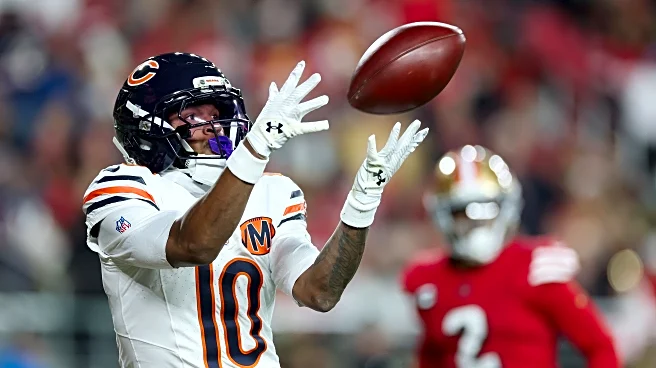

The stage is set for a high-stakes divisional battle as the Chicago Bears and the Green Bay Packers clash for the third time this season in a pivotal Wild Card playoff match-up on Saturday night at Soldier
Field in Chicago. This will be the third time the two teams have met in the postseason, the last time being in 2010 (Packers won 21-14) and the first time coming in 1941 (Bears won 33-14).
While the season series stands tied at 1-1, a deeper look at the tape reveals that the Packers held a distinct advantage in both contests, which we’ve covered here. The Bears’ sole victory came under duress, secured only in overtime back in Week 16.
The Bears under Ben Johnson have a unique passing attack that takes advantage of Caleb Williams’ arm talent and athleticism. Today, we’ll look at how one of their downfield passing concepts takes advantage of that.
In Week 16, the Bears offense aligns in a one-by-three formation, placing three eligible receivers to one side of the field, with quarterback Williams operating out of the shotgun.
The defense counters with a common pass defense shell: a cover-3 zone shell, characterized by three deep defenders and four underneath defenders.
The offense’s play call is a classic, high-leverage route combination known as the dagger concept. This is an intermediate-to-vertical passing play designed to create a void in the intermediate zone of the defense.
It features two deep routes—typically a post or go route—run to push the deep coverage (the corners and free safety) upfield, and a crucial dig route (a route that breaks toward the middle of the field at 10-15 yards) run into the newly created space.
The play works because of the route distribution. Tight end Colston Loveland runs a shallow crossing route on the backside of the formation. The primary function of this route is not to catch a pass, but to serve as a decoy, keeping the underneath linebackers and flat defenders occupied.
This route distribution prevents them from dropping into the throwing lane intended for the dig route. As the two primary deep routes successfully push the deep coverage back, the underneath safety—forced to honor Loveland’s movement—is drawn away from the center of the field.
This creates a void for the dig route run by wide receiver Moore into the deep middle of the field. With the defense’s attention and spacing compromised, Williams, showcasing his exceptional arm talent, delivers a powerful, accurate throw, even while facing immediate pressure in the pocket. The result is a significant gain, exploiting a fundamental weakness in the cover-3 zone defense.
The 2×2 version of this dagger route is also good against quarters as well.
The short drag route from the right side holds the underneath coverage low to the route, while the dagger comes in downfield behind it into the open void.
The creativity of the Bears’ offensive staff was on display in Week 17 when they executed a similar concept for an explosive passing touchdown against the formidable San Francisco 49ers defense.
In this instance, the offense once again lined up in a one-by-three formation with Williams in the shotgun, but the defensive look was significantly different: a two-shell defense (either Cover 2 or Cover 4), characterized by two deep safeties.
The offense ran a different take on the dagger concept, modified to attack the two-high structure. Here, the role of tight end Loveland shifted. Instead of a shallow cross to hold underneath defenders, Loveland’s movement was designed to mess with the backside safety, preventing that defender from rotating toward the frontside throwing window.
The frontside routes involved Burden running a vertical route and Moore running the dig route. However, the lynchpin of the play was Loveland’s deliberate action: he steps up past the linebacker, threatening the middle of the field.
With the 49ers in 3×1 “poach” quarters (weak side safety has vertical of #3), this forces the backside safety to stay put, ensuring he cannot effectively get involved in defending the throw on the frontside. This maintains the essential spacing and geometry of the route combination.
Because of the backside safety’s commitment to Loveland, the defense’s attention is momentarily misdirected. This subtle shift unexpectedly elevates the vertical route run by Burden, which is not typically the primary target in this specific design. It suddenly becomes the optimal option.
Williams executes a remarkable flat-footed throw—a difficult throw requiring both strength and precision—capitalizing on the defender’s positioning. For a quarterback with Williams’s rare arm strength and confidence, transforming a secondary route into the primary target based on defensive reaction is a shrewd and highly effective play call.
This 3×1 version is also a good call against the cover-2 side of the Vikings cover-8 defense here. Cover-8 is the inverse of cover-6, with cover-2/halves played to the passing strength, with the nickel aligned as the vertical curl player to the trips and quarters backside on the weak side.
The short hook route occupies the flat corner and middle hook player, while the seam route pulls the vertical curl player out of the void for the dagger underneath it. Williams throws another dart as pressure is pushed into him in the pocket.
With the Packers being a heavy two-deep shell team, it will be interesting to see how the Bears throw this concept, if at all, at the defense in the wild card game tonight.