




The defense has been nothing short of spectacular so far.
Two games into 2026, Virginia has allowed 11 points. That is the fewest the program has given up through two games since 1952, and it has the Cavaliers fourth nationally in scoring defense at 5.5 points per game.
The advanced numbers agree. ESPN’s FPI rates Virginia’s defense fifth in the country at 93.8, behind only LSU, Texas A&M, Alabama and Notre Dame, and first in the ACC — ahead of the Miami defense that produced last season’s ACC Defensive
Player of the Year en route to a national championship appearance and now sits 16th. So far this season, it has been the best unit on this team. FPI has Virginia 18th overall and 39th on offense.
However, those numbers must be taken with a grain of salt. Last week, Virginia got to tee off on Norfolk State, an FCS opponent that simply doesn’t have the same caliber of athlete. In Week 0, Virginia had one of their best performances in the Tony Elliott era, holding a much-anticipated NC State offense led by preseason Heisman dark horse CJ Bailey to eight points and 168 total yards. While it is right to question how good NC State is after that performance, they did pass their next test with flying colors, putting a 73-0 beatdown on FCS Richmond and setting multiple program records in the process.
But the trajectory is not new. John Rudzinski’s defense finished last season second in the ACC in scoring at 19.6 points per game and second in the entire country on third down, holding opponents to 27.98%. The improvement within that season was dramatic. Through the first six games, Virginia allowed 23.8 points and 358.5 yards a game. After the October bye, across the final eight, those numbers dropped to 16.4 and 272.8 — a scoring defense that would have ranked roughly 58th nationally before the bye and ninth after it, and a total defense that would have ranked seventh. Add the first two games of this season and that is a 10-game sample, nearly a full regular season, of top-10 defense.
So, the defense is real, and it has been operating at an ACC championship level for about a year now. So why write this article?
As I noted in my takeaways article for the Norfolk State game, I had questions about the defensive line, especially the pass rush.
Against the run so far, Virginia has been excellent, giving up 3.2 and 1.8 yards per carry in the two games — 2.38 overall, on 55 carries for 131 yards. But the Cavaliers managed just two sacks against an overmatched Norfolk State offensive line, and on several snaps the rush got home late or over pursued, letting the quarterback step up and find openings downfield.
However, during his press conference this week coach Tony Elliott delivered some sobering news: starting defensive tackle Jason Hammond will undergo elbow surgery that is likely to end his season, after an injury sustained against Norfolk State.
“I’m really heartbroken for Jason, because I know how hard he worked to get back, and he missed some time in the past,” Tony Elliott said. “Nobody wants to have to, just as you’re getting going, have to fix something to get yourself back ready to roll.”
Hammond started the first four games of 2024 before an injury ended that season, came back to start all 14 games in 2025, and made Phil Steele’s fourth-team preseason All-ACC list this summer. This is the second time in three years an injury has taken a season from him. Last fall he put up 32 tackles, three tackles for loss and 2.5 sacks, including a strip-sack at Louisville, despite only averaging about 17 snaps a game.
Virginia has plenty of depth on the defensive line, but a dearth of defensive tackles.
During the offseason, Tony Elliott and staff made building from the trenches a point of emphasis. This has been widely publicized in regard to UVA’s experienced, returning offensive line, but UVA boasts good depth on the defensive line as well.
Start on the edge, where the Cavaliers are four and five deep. Fisher Camac is the lone returning starter and the anchor, a 6-foot-7 fifth-year who put up 45 tackles, 6.5 tackles for loss and 4.5 sacks last season and has led the front in snaps both weeks. Matthew Fobbs-White, the Baylor transfer who was one of UVA’s highest-rated additions alongside Brandyn Hillman, opened at bandit and has played the second-most snaps on the line. Nnanna Anyanwu came from UTSA with seven tackles for loss and five sacks, and already has one here. Devon Baxter, who arrived from Michigan alongside Hillman, is 6-foot-6, and Billy Koudelka is 6-foot-8. Jewett Hayes played his way into first-team bandit reps during camp while Fobbs-White was banged up. Ezekiel Larry and Justin Townsend, the two Ivy League transfers, are still working into the rotation. Cazeem Moore, who had three sacks for Virginia last season, is back after a court ruling restored a year of eligibility, and made his season debut against Norfolk State. That is a deep room, and it lets defensive coordinator John Rudzinski implement his preferred high-rotation style on the defensive line to keep his pass rushers fresh for the fourth quarter.
Now look inside. Jason Hammond was the starting three technique. Anthony Britton is the nose. Behind them: Darrion Henry-Young, Kervins Choute, Sichan John and Jonathan Allen.
Six players took snaps at defensive tackle against Norfolk State, per PFF’s charting — Britton (24), Choute (17), John (16), Allen (14), Hammond (11) and Townsend (11).
UVA was already thinner inside than outside. With Hammond out, that depth gets tested further.
Looking back at Virginia’s offseason
With an experienced roster in 2025, turnover was inevitable. Sticking to their philosophy, Virginia pursued a multitude of players on the defensive line.
On the edge, Virginia brought in a combined 24 sacks through the portal. Larry led the Ivy League with 10.5 at Yale. Townsend was second in the league with 8.5 at Columbia, where he also led the Ivy with 14 tackles for loss and finished as the program’s all-time sacks leader at 23. Anyanwu had five sacks and seven tackles for loss at UTSA. Fobbs-White had four sacks and a 91.3 PFF pass-rush grade at Tulane in 2024 before transferring to Baylor where he forced the second most QB pressures on the team. Larry and Townsend are just getting up to speed, but this promises to be a talented and deep edge rushing room.
That said, UVA had also tried to bring in Jamond Mathis, a 250-pound Kent State edge with six sacks and second-team All-MAC honors, who committed to Virginia in the winter before flipping to Texas Tech.
On the interior, add up the 2025 sack production of the additions and you get two. Jonathan Allen had 34 tackles, three tackles for loss and two sacks across 390 snaps at UAB. Choute, now in his seventh year, has 17 tackles and half a tackle for loss across two seasons at UConn. Henry-Young, also in his seventh year and at his fourth school, had eight tackles and 1.5 tackles for loss at Coastal Carolina last fall.
But that number is missing two caveats, because Virginia made two attempts to secure the interior that did not go its way.
Zion Wilson was another of their highest graded transfer portal gets. The East Carolina transfer was the highest-rated defensive lineman in the Virginia class, a 300-plus-pound interior anchor coming off 42 tackles and seven sacks. The NCAA denied his sixth-year waiver. He signed with the Philadelphia Eagles instead and never took a snap for Virginia.
Additionally, alongside Cazeem Moore, Virginia has also tried to bring back Jacob Holmes, the 6-foot-2, 290-pound defensive tackle who played all 14 games for them last year and put up 33 tackles, six tackles for loss and three sacks. Like many stories from around college football, this was an eligibility case and both players had begun practicing with the team. This indicated that Virginia still believed it could use extra depth on the line, however, while Moore was cleared to play and appeared in the game against Norfolk State, Holmes was not.
That means two key interior linemen Virginia wanted — Wilson, its highest-rated defensive line addition, and Holmes, a proven returning body — are both off the roster on eligibility grounds. Compounded with Hammond’s injury, the interior of the line begins to look thinner than I’m sure the coaching staff would like.
So who plays defensive tackle on Saturday?
The expectation around the program is that Henry-Young starts alongside Britton, with Allen and Moore among the players asked to absorb more, and essentially everyone inside taking a larger share.
Anthony Britton is the critical piece. The fourth-year, 308-pound Norfolk native was already playing the most interior snaps on the team, 27 against NC State and 24 against Norfolk State, and that number is going up. He is the only defensive tackle on the roster with a real body of Virginia snaps behind him.
Darrion Henry-Young is 6-4, 295 and further along than his production suggests. The seventh-year transfer has actually played more snaps this season than Hammond did, 42 to 34, and he has been Virginia’s third-down speed-package piece — PFF charted him with the ends against Norfolk State despite his listing as the backup nose. Expect him to be one of the primary replacements for Hammond.
Sichan John is a bigger unknown. The second-year, 6-3, 312-pounder is listed directly behind Hammond on this week’s depth chart and has recorded one tackle so far across 30 snaps.
Jonathan Allen has the most recent tape of the group after transferring up a level. Three hundred ninety snaps at UAB last season is not nothing, and he has worked up from seven snaps in the opener to 14 against Norfolk State. Expect him to see an expanded role against West Virginia.
Kervins Choute is another veteran, 306 pounds and 30 snaps already this year. His career numbers are thin, but rotation math alone pushes him into a larger role.
Worth noting: Virginia is built around constant rotation on the defensive line rather than the standard starter-and-backup arrangement most teams use.
“We don’t have starters. Everyone is a starter,” Elliott said after Norfolk State. “When you can play 12 guys, it gives you versatility and flexibility.”
Six players were splitting interior snaps in something close to a committee, most of them landing in that same 15-to-20 range.
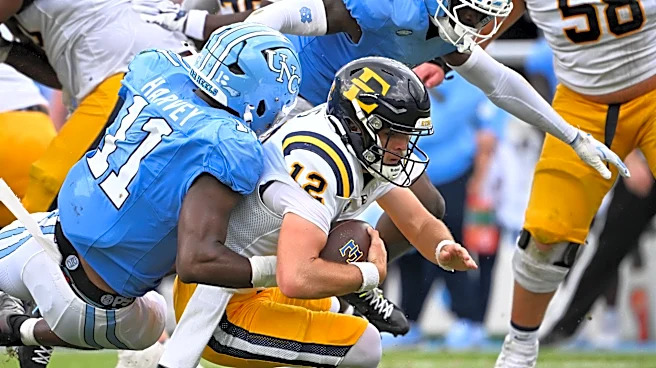
The payoff is fresh legs in the fourth quarter, and this strategy paid massive dividends in 2025, when Virginia kept pulling out games late. The clearest example came at North Carolina, where the Cavaliers won 17-16 in overtime after Bill Belichick went for two and Virginia stopped Ben Hall short of the pylon on the final play — one of three overtime wins they took that season.
So, it is not as simple as asking one player to replace Hammond. It is asking everyone in that room to take on more than the staff likely envisioned.
Virginia’s answer might not be another defensive tackle
This is the part I find most interesting, in part because of the excellent depth and skill Virginia has in the rest of the defense.
Virginia already has a package for this. On third downs and obvious passing situations, the Cavaliers deploy a speed grouping that moves a defensive end inside to the interior — Camac has taken snaps there, and it is a look this staff has been building for a while. Henry-Young came into the rotation through that package. Moore, who is listed as a defensive end, can play inside as well.
One answer, especially against the more pass-heavy offenses later in the year, is to go smaller and faster in the middle and make opposing offensive lines block quicker people.
Justin Townsend is a name to watch in that arrangement. The sixth-year Columbia transfer has played 12 snaps as a Cavalier and has excelled in his limited playing time. His 89.8 PFF grade against Norfolk State, with 1.5 tackles for loss on 11 snaps, is the highest any Virginia lineman has posted this season. He is listed at 265 pounds, which is light for a three technique and heavy for an edge, and PFF charted him among the defensive tackles against Norfolk State even though Virginia’s own release grouped him with the ends. He is already being used both ways. Elliott compared his motor to Daniel Rickert’s during camp and called him someone in the conversation for rotational snaps.
Ezekiel Larry is the other former Ivy League standout that could prove important. The Yale transfer put up 48 tackles and 10.5 sacks on his way to first-team All-Ivy honors and was described in August as Virginia’s designated pass rusher, the role Rickert held a year ago. Then he got hurt, missed the opener, and has three snaps to show for the season. He is healthy now, and he moved from defensive end to bandit on this week’s depth chart. A healthy Larry playing real volume could prove big for the Virginia defensive line.
Rudzinski’s defense has never required the interior of line to generate everything either. All four of Virginia’s sacks this season have come from the edge or the back seven: Caleb Hardy and safety Jaylen Jones against NC State, Anyanwu and Fobbs-White against Norfolk State. The linebacker room, especially with Kam Robinson back and depth pieces like Myles Brown emerging, could be a big factor both in run defense and in pressuring the quarterback.
But there is a tradeoff: if Virginia has to manufacture more pressure from the second and third levels, that is more bodies committed to the rush and fewer sitting in coverage or filling run gaps. Against West Virginia, an offense that would prefer to run it anyway, it might not be the end of the world, but against the kind of offenses Virginia will have to face if they want to reach their ultimate goals, this is something to watch for.
West Virginia is going to test the defensive line
The Mountaineers are 2-0, having beaten Coastal Carolina 31-24 and buried UT Martin 52-7, and they rank ninth nationally in rushing offense at 298.5 yards per game. They rank 111th in passing at 170.5. Through two games they have run the ball 112 times and thrown it 26 (81% frequency) for 597 yards at 5.3 a carry with seven rushing touchdowns. They are converting 56.7% on third down, 14th in the country, and they have not missed on fourth.
Over the offseason Rich Rodriguez invested heavily in the offense, particularly at quarterback and running back, building what he hopes will be an overpowering ground game.
Like Beau Pribula, West Virginia quarterback Michael Hawkins Jr. likes to run the ball. This season he has 26 carries for 199 yards — 7.7 a pop — and three rushing touchdowns, including a 71-yard score against UT Martin. He is an Oklahoma transfer, and he is efficient when he throws, going 11-of-14 for 132 yards and a touchdown against Coastal Carolina. He just does not throw much.
Cam Cook, a Jacksonville State transfer, who led the nation in running yards during the regular season a year ago, has 40 carries for 194 yards and three touchdowns. Unlike the UVA offense, which has split carries among five backs, West Virginia has shown early that it plans to ride Cook. His debut against Coastal Carolina was a massive workload: 30 carries, 142 yards, two touchdowns and a 72-yard run. Between them, Cook and Hawkins accounted for 245 of West Virginia’s 281 rushing yards in that game, about 87% of the ground production. Amari Latimer has added 11 carries for 65 yards as the change-up.
This is a high-octane running game that will test Virginia’s ability to defend the run without their best defensive tackle. For what it is worth, Virginia’s two worst run-defense performances of last season came against high-volume rushing attacks: 216 rushing yards at 6.2 a carry with four rushing touchdowns at NC State, and 256 rushing yards at 5.3 a carry in a 514-yard afternoon for Florida State. Both came before the bye, before the defense became what it eventually became, but it is a cautionary note that this front has been stressed before.
Saturday night in Charlotte is where we find out whether Virginia has those answers, and whether a defense built on depth still plays like one when a relentless running game attacks the spot where depth is starting to run thin.