
A year ago, one of the most cited benefits of hiring Bill Belichick was the premise that elite coaches and players would flock to work and play for the man. Belichick, after all, comes with the label Greatest
Of All Time (GOAT) for the NFL. His eight Super Bowl rings, six as head coach, will probably never be matched. Who, the thinking went, would not want to learn from such an all-time great?
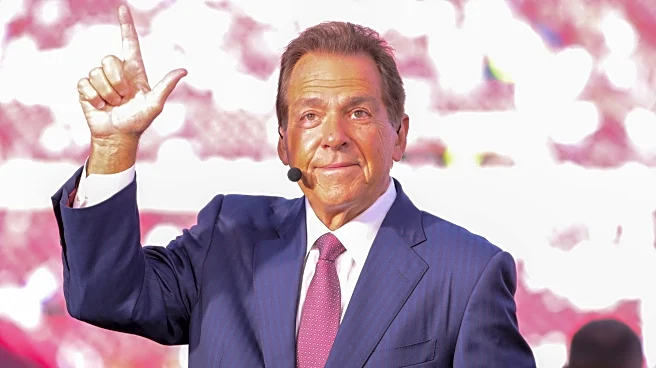
Nick Saban is also a GOAT, and that title comes from his well-known accomplishments in college football. Coaches working under Saban have gone on to tremendous success. Two of them won three national titles themselves. Five of the 12 playoff teams this year have (or had; hey Lane) head coaches who worked in Saban’s operation at Alabama at one time or another. Working for Saban helped a lot of coaches reach the top of their profession and make a lot of money. Conventional wisdom would suggest that if anyone could have his pick of elite coaches to work with, it would be Nick Saban.
Except…. While the retirement of many high profile college coaches recently can be attributed to the sea changes wrought by NIL and the transfer portal, Saban dismisses those causes entirely. In the following two videos, Saban clearly states that his reason for retiring was his difficulty attracting the kind of staff he knew he needed to operate at the top of the college football.
Check out this video from ESPN. The video is five minutes long in its entirety, but the most relevant portion can be found in the first two minutes:
“…my age started to become a little bit of an issue. People wanted assurances that I would be here for three years, five years, whatever, and it got harder and harder for me…”
Saban dominated college football for almost two decades by recruiting the game’s best staffing and players and then getting them to work productively together. His program hadn’t diminished in any appreciable way. His 2020 team went 13-0 against an entirely P5 schedule. 2021 played for the title. 2023 reached the playoffs. Yet, Saban’s age, at least in Saban’s view, made it increasingly difficult to sustain his record of attracting the game’s best to Tuscaloosa. Saban and Belichick are the same age.
The next video outlines his concerns even more clearly.
Saban in 2023 had Tommy Rees as his offensive coordinator, Kevin Steele as his defensive coordinator, Holmon Wiggins at wide receivers, and Robert Gillespie (who coached Michael Carter and Javonte Williams here) at running backs. On the surface, those are some quality names. On the other hand, Reese was 31. Steele was talked out of retirement to coach the defense for another year. Wiggins departed at the end of the season for Texas A&M, and Saban said his decision to retire happened during a phone interview for a replacement candidate.
Running a college football program that aims for the top requires a large and talented staff, with a head coach capable of harmonizing their efforts and identifying areas their efforts might be coming up short. In these videos, Saban seems to be speaking to the ways his staffing was starting to suffer due to his age. In turn, his effort to mitigate those shortcomings, in his words, “was going to kill me.”
Now, let’s take a look at Belichick’s staffing last season:
General Manager: Mike Lombardi, personal friend
Defensive Coordinator: Steve Lombardi, son
Defensive Backs: Brian Belichick, son
Offensive Coordinator: Freddie Kitchens, left over from Mack’s staff
Quarterback Coach: Matt Lombardi, son
Offensive Line Coach: Will Friend, friend of Kitchens
UNC allocated over $16 million for staffing, in part to pay the elite staffing Belichick was thought to be able to attract. None of those names in critical positions are elite. Reportedly, UNC spent somewhere between $12 million and $13 million on coaches, support staff, strength and conditioning, and other football related personnel. On the one hand, that’s a savings to the university. On the other, it’s an opportunity cost. If the money is there to pay top coaching talent, then something else must be discouraging top talent from coming. That absence seems to be leaving gaps to be filled by friends, family, and former UNC players, almost all of them stepping into roles of higher responsibility than they occupied prior to their positions here. That can work at Missouri State. It’s not what UNC envisioned when it broke the bank for Bill Belichick.
Long story short: we don’t have an elite staff or anything remotely resembling it. Worse, one isn’t coming.
Perhaps a Bobby Petrino or Chip Kelly ups the star power of that assemblage. However, no one’s accusing Steve Belichick of being an elite defensive coordinator. Worse, even if an elite defensive coordinator wanted to come work for Belichick, how does Belichick dismiss his own son from the position? We run into the same problem with Matt and Brian. Once family fills these positions, the evaluation of them ceases to be as objective as a professional football operation needs to be.
Again, the central premise of the Belichick hire was to jump start UNC football into the worlds of professional football and elite football simultaneously. That’s what all this money was for. Instead, we’re staffing like a family business, except the family’s spending UNC’s money. We’ve got what appears to be a lack of great position coaches and coordinators beating down Belichick’s door to work for him. Saban speaks to what could be a significant factor in that. As a result, UNC’s spending SEC money for coaches that no SEC school would have, at least in similar roles.
Final note: a lot was made of the whirlwind nature of Belichick’s hiring and the pressing issues related to recruiting and portal calendars. “The staff wasn’t elite because it was rushed.“ Well, UNC’s season wrapped a month ago. Belichick and Lombardi opted to stand pat outside the offensive coordinator and special teams coordinator roles. Neither has been filled, while quality candidates have been landing at other programs for weeks now. Whatever concerns Belichick and Lombardi might have from a 4-8 record against one of the easiest P4 schedules, significantly upgrading on-field staff doesn’t appear to be one of them. This is your reminder that the UNC offense finished 109th and the defense 100th (FEI) nationally.
Does any of this feel like a 33rd NFL team to you?