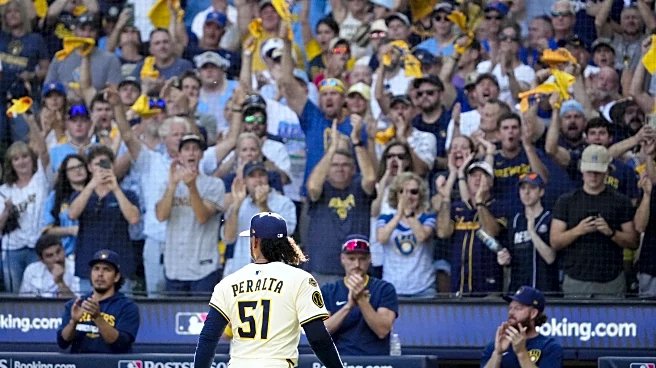

On Wednesday, we got news many of us have expected all offseason: after eight years in Milwaukee, Freddy Peralta has been traded. I am not here to analyze that trade (Jason both reported on the trade and
looked at what the return , Brandon Sproat and Jett Williams, will offer the 2026 Brewers, and we’ll have more coming). Instead, I’m here to look back and appreciate Peralta’s career as a Milwaukee Brewer.
Peralta’s career did not start in Milwaukee. He signed as an amateur free agent out of the Dominican Republic with the Seattle Mariners way back in 2013, when he was 17 years old, and spent his first three years as a pro pitching in Seattle’s system. In December 2015, Peralta was one of three minor leaguers the Brewers acquired from the Mariners in exchange for first baseman Adam Lind, who was coming off a solid season as Milwaukee’s first baseman. Neither of the other two players acquired in that trade—Carlos Herrera and Daniel Missaki—ever made the majors.
Once he was in the Milwaukee system, Peralta started to assert himself a bit. in 2016, he started the season by going 4-1 with a 2.85 ERA in 60 innings (16 games, eight starts) at Class-A Wisconsin, where he struck out 11.6 batters per nine innings. In 2017, the 21-year-old Peralta started at High-A Carolina and earned a midseason promotion to Double-A Biloxi, where he allowed just 16 earned runs in 63 2/3 innings (a 2.26 ERA). Over the full 2017 minor league season, Peralta struck out almost 13 batters per nine innings. When he looked nearly as good after getting promoted to the offense-friendly Pacific Coast League in 2018, Peralta was on his way to the majors.
Peralta’s debut came on Mother’s Day, May 13th, 2018, and it was a day to remember. On the mound at home versus the Colorado Rockies (who were good in 2018—remember, that’s the team Milwaukee played in the divisional round of the playoffs), Freddy baffled the Colorado lineup. Throwing almost exclusively his fastball, he struck out five of the first six batters he faced, didn’t allow a baserunner until an error allowed a man to reach in the third, and didn’t allow a hit until the sixth inning, when David Dahl singled to center. Peralta struck out one more batter after Dahl’s single and was taken out of the game after 98 pitches and 5 2/3 innings: he allowed just the one hit, walked two, and struck out an astounding 13 batters, one more than the previous franchise record in a debut, held by Steve Woodard.
In that start, 90 of the 98 pitches that Peralta threw were fastballs, which set the tone for his whole rookie season, during which he earned the nickname Fastball Freddy. While the rest of that season didn’t go quite as well as his debut, Peralta made 14 starts and two relief appearances in the 2018 regular season and pitched to a 4.25 ERA while striking out 11 batters per nine innings, a massive total for a starting pitcher. He didn’t pitch much in that postseason, but he did throw three scoreless innings in game four of the NLCS after Gio Gonzalez was chased after just one inning; Milwaukee lost in extras.
After the encouraging start to his career, Peralta hit some bumps in 2019, when he made eight starts and 31 relief appearances and pitched to a 5.29 ERA. But he was still striking out a ton of batters—12.2 per nine innings—and the Brewers were clearly still encouraged, especially when he made arguably the best start of his career in his second start of the season on April 3rd: Peralta pitched eight shutout innings with 11 strikeouts, no walks, and just two hits allowed in a 1-0 victory. He wasn’t bad in 2020 and struck out everybody (14.4 per nine), but it was such a strange season that it was difficult to judge his progress. It turned out that Peralta was on the verge of a breakout.
In 2021, Peralta functioned as the third starter in the best top-three in baseball, behind Corbin Burnes and Brandon Woodruff (who finished first and fifth, respectively, in NL Cy Young voting). Peralta wasn’t in the Cy Young conversation like his teammates, but he was excellent: in 144 1/3 innings, Peralta pitched to a 2.81 ERA (147 ERA+) and 3.12 FIP, struck out 12.2 batters per nine, and made his first All-Star team.
Over the next three seasons, Peralta was one of the steadiest pitchers in baseball. While he struggled to regain the form that got him on the 2021 All-Star team, Peralta was almost always healthy (he missed some time in 2022 but made 30 starts in 2023 and 32 in 2024) and turned in consecutive seasons with a 113, 112, and 113 ERA+. There was some fluctuation in his underlying metrics—his strikeouts were a little up and down, he allowed a bunch of homers in 2023 and 2024 which hadn’t previously been a problem. But he was an extremely steady presence, and he struck out 210 batters in 2023 and 200 in 2024.
For most of his career, Peralta had operated somewhat out of the spotlight behind his star teammates, but Burnes was traded after the 2023 season and Woodruff was injured that same year, so in 2024, Peralta became the de facto ace of Milwaukee’s staff. 2024 was viewed as somewhat disappointing: Peralta was by no means bad, but he had the worst FIP of his career (aside from 2019, when he was almost a rookie and pitching out of the bullpen) and it just felt like things weren’t quite coming together. Peralta had also developed a frustrating habit where it felt like he’d get ahead of every batter 0-2 and then miss badly with three straight pitches until it was a full count; whether he got the batter out or not, Peralta’s pitch counts suffered, and he rarely worked deep into games.
Things changed in 2025. As the team coalesced around Peralta, Milwaukee enjoyed a remarkable run through the summer that earned them the best record in baseball. The Brewer ace was the constant, the thing that all the young players around him knew they could rely on. In a career-high 33 starts and 176 2/3 innings, Peralta led the National League with 17 wins, finished fourth in the league with a 2.70 ERA, and finished sixth with 204 strikeouts, the third straight season in which he’d struck out at least 200 batters.
For the first time, Peralta earned Cy Young votes, as he finished fifth in National League voting for that award, and he added his second All-Star selection. But Brewer fans knew that time with Peralta was running out. Before the 2020 season, Peralta had signed what turned out to be a very team friendly extension with Milwaukee, a five-year deal that bought out his arbitration years for just $15.5 million, which included club options for the 2025 and 2026 seasons at just $8 million each. With just one of those option years remaining before free agency, the Brewers made the decision to move him for controllable assets this week.
Peralta now relinquishes his status as the third-longest-tenured Brewer, as only Christian Yelich and Brandon Woodruff had been on the major league team longer—Yelich by just over a month, since his debut came on Opening Day during the 2018 season, and Woodruff by about three months, as he’d debuted near the end of the 2017 season. Had he returned for his ninth season as a Brewer in 2026, Peralta would’ve set a major franchise record, had he stayed healthy—as is, he leaves the club third in their history in strikeouts with 1,153, 73 behind Yovani Gallardo’s record. Among Brewers with at least 500 innings pitched, Peralta is first in franchise history in hits per nine (6.7) and strikeouts per nine (11.1).
Now, the soon-to-be 30-year-old pitcher will ply his trade for a team other than the Brewers for the first time in the major leagues. It will be tough to see him pitch for the Mets, a team who has become something of a rival over the past couple of seasons, a deep-pocketed team that is desperate to become as good—and as unlikable—as the Dodgers. But there is some poetry in that move: the Mets’ president of baseball operations, David Stearns, was the brand new general manager of the Brewers in 2015 when he made the trade for Peralta, just his third trade as the boss.
Trades like this certainly bring mixed emotions, one of which could certainly be angst. Peralta, from everything we can tell as fans, is a humble, friendly, happy guy, a leader who others in the clubhouse looked up to, exactly the type of dude that it’s fun to root for. (He is one of my favorite Brewers of all time.) He’s also a very good pitcher. To lose those things is a drag. Those sad feelings are also mixed in with the excitement of the two new players, both with tantalizing potential, that the Brewers welcome into their system this week.
But it is safe to say that Peralta will always be a hero to fans of the Milwaukee Brewers. He is, at worst, one of the ten best pitchers in franchise history, and it is exceedingly rare for players to stick with a single team for as long as Peralta did—eight years—in the modern game. Now that he’s moved on, do you know who the third-longest-tenured Brewer is, after Woodruff and Yelich? That would be Aaron Ashby, who debuted in 2021 and still hasn’t made 100 MLB appearances.
So, thank you, Freddy Peralta. You had a fastball that didn’t make sense, you were the reason that many of us Brewers fans learned what “extension” was, and you had great rapport with Sophia Minnaert (I’m having trouble tracking it down, but Minnaert traveled with Peralta to his home in the Dominican Republic for a special that aired on Brewers television a few years ago, which is worth checking out). You frustrated us, you delighted us, and you turned yourself into one of the best pitchers in team history. Good luck in the future (unless of course you’re playing the Brewers).