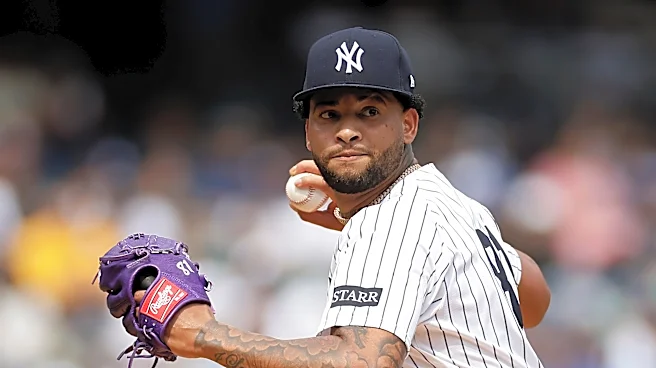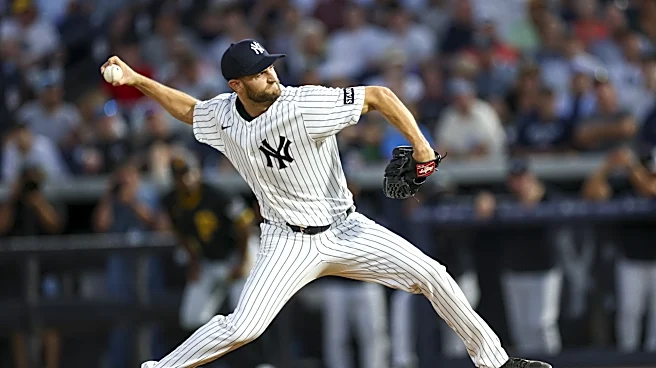

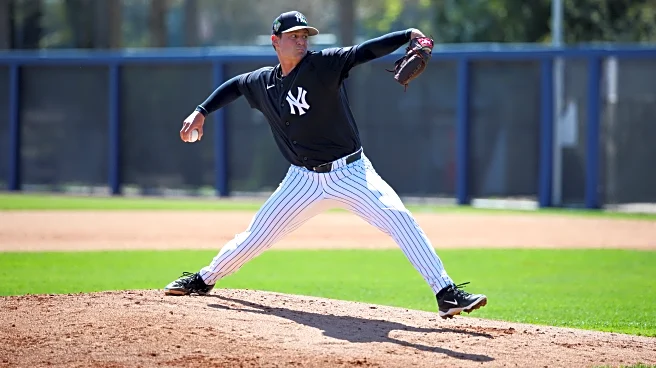
Last year, the Yankees dealt two legitimately interesting prospects, Roc Riggio and Ben Shields, to get reliever Jake Bird from the Colorado Rockies at the Trade Deadline. Their experiment wasn’t successful, at least in 2025, as he posted a 27.00 ERA in a couple of innings with the team before being optioned to Triple-A, where he also struggled to the tune of a 6.32 ERA in 15.2 frames.
It was an ugly initial showing for Bird, but the bright side was that the Yankees knew they had three years of team
control remaining on the righty, whose tantalizing pitches helped him fan 62 batters in 54.1 innings for Colorado prior to the trade. This offseason, Bird effectively hit the reset button as he turned 30, worked on his stuff, and resurfaced with New York in February, ready to turn the page and make his mark on a new year with his new team. He had no guarantee to make the team, but he earned his Opening Day spot in the 2026 bullpen.
After a fine spring that included a 2.70 ERA and 16 strikeouts in 10 innings, Bird has pitched 3.1 scoreless frames to open the campaign, with three punchouts, no walks, and just one hit allowed. The sample is still, of course, quite tiny, but it’s plain to see that he looks confident and in control on the mound. Last year, let’s just say that wasn’t the case.
What’s behind Bird’s early success? Why is he looking so much better this year than last? Well, he made some key adjustments in his repertoire and pitch mix, and they are paying off.
In 2025, Bird’s most frequently used offering was the sweeper, which he threw 40.5 percent of the time. The sinker, at 33.6 percent, was his second most frequently used pitch, and the curveball checked in at third with 22.7 percent. He also threw a cutter (2.5 percent of the time) and a four-seamer (0.6 percent) to complement his arsenal.
Again, it’s still too soon to conclude that the pitch mix he has used in 2026 will stick, because he has only faced 11 hitters, but Bird and the Yankees completely overhauled the way he uses his pitches.
This time around, Bird is prioritizing the sinker, throwing it 56.4 percent of the time. He is also getting amazing results with it: a .119 xwOBA and 30-percent whiff rate from 22 offerings, amazing for the pitch type in question, but almost certainly unsustainable once the sample grows. Nonetheless, the progress is quite apparent.
The four-seamer, which is up a tick in comparison to last season (95.2 mph this year vs. 94.2 mph in 2025), is now second in his arsenal after barely being used in 2025. In fact, he’s already thrown it more times this year than all of last year, 9-6. The only hit he’s surrendered, a ground-ball single from Heliot Ramos that snuck by Ryan McMahon and José Caballero, came off a four-seamer, but it certainly wasn’t well-struck.
Bird’s third pitch thus far is his familiar sweeper, which he’s thrown eight times. Although four missed the zone (as sweepers are wont to do), he got called strikes on two of them, induced a groundout from Casey Schmitt, and struck out Willy Adames. Not bad at all. It’s fair to say that this is closer to the pitcher the Yankees thought they were acquiring last year.
So what has changed besides the pitch mix? Well, a couple of things.
Last year, Bird’s sinker averaged 11.3 inches of horizontal movement, and when he came to the Bronx, his command of the pitch was not good. In 2026, the pitch is averaging 16.5 inches of horizontal movement. That, coming in at an average speed of 94.8 mph while also being wary of the filthy sweeper, is just not easy to hit.
Now, he can use that sinker to get grounders:
Or even as a swing and miss pitch due to its incredible arm-side movement:
Last year, it quickly became evident that the command of the pitch just wasn’t there, as can be seen in this short clip of Kyle Stowers’ grand slam on a middle-middle sinker with little movement:
That was the meatball of all meatballs in a nightmare of an introduction. In the small sample that this year has given us, Bird has mostly avoided the fat part of the zone with his sinker.
Additionally, his sweeper can do this:
When Bird gets ahead of the count against a righty, the probability of him getting a strikeout on a sweeper away and out of the zone is quite high.
Bird’s 63.6 percent first-pitch strike rate would be a career-high, but it’s still far too early to declare him fully back until we see it for a much longer period. It wasn’t right for fans to declare him toast after just three games in pinstripes last year, and it wouldn’t be right to declare him the next great setup man after just three games this year. All the same, the early signs of a breakout are there, and the Yankees will hopefully reap the benefits of their patience and the pitcher’s hard work.