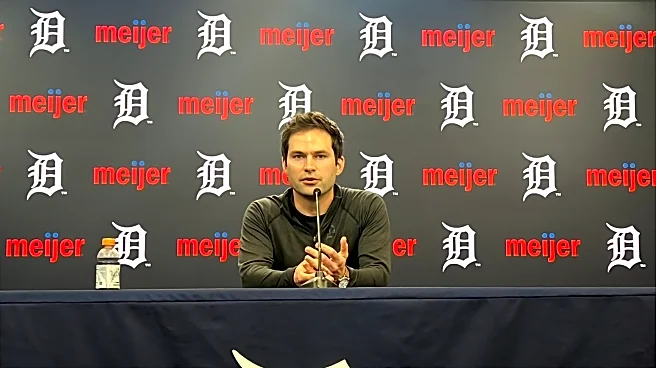

At his end of the season press conference back in October, Tigers president of baseball operations, Scott Harris, spent a lot of time talking about his players. Certainly the collapse of offensive production for several players, most notably star left fielder Riley Greene, played a major role as the club staggered through September, barely hanging onto a Wild Card spot after posting one of the best first half records in baseball. However, the one person in the Tigers organization who needs a big
bounceback season the most is probably Scott Harris himself.
Harris has done several things well since taking over from Al Avila at the end of the 2022 season. However, little of that work has shown up in Comerica Park yet. It’s largely revolved around his work in continuing the overhaul in scouting, analytics, and player development that was already underway.
In three drafts, with a handful of trades for young talent mixed in, Harris has rebuilt the farm system into one of the game’s best, despite only picking in the top ten of the draft one time over the last three years. Young talent like top prospect Kevin McGonigle, outfielder Max Clark, shortstop Bryce Rainer, slugging first baseman/catcher Josue Briceño, and more give the Tigers a really nice foundation of young position player talent with which to sustain their push to be one of the game’s consistent contenders over the next half decade or more.
Of course, as good as the farm looks right now, the idea that it’s going to produce more talent than the 2018-2019 drafts did is pretty far-fetched. They’ll be fortunate to do as well as Al Avila did, even if his first few seasons and overall miserable record on player development undercut most of his draft successes when he had the luxury of top picks every year.
Where we really hoped they’d be better is in acquiring major league talent. On that score, the first three years of this front office have been something of a disappointment. Not a disaster, but just pretty pedestrian work overall. As the Winter Meetings get underway in Orlando, Florida today, with Scott Harris and GM Jeff Greenberg facing some major decisions regarding Tarik Skubal, Riley Greene, the current free agent class, and a roster of young players who are starting to get more expensive, it’s a good time to take a look through this front office’s successes and failures through three years running the team.
Let’s take a trip down recent memory lane and just go through this year by year.
2023 season
Among Harris’ first significant roster moves after taking over in October of 2022 were the decisions to release third baseman Jeimer Candelario and utiltyman Willi Castro. Harris presumably wanted to bring in his own guys to fill those roles, but rather than view the duo as potentially tradable assets, if they could put together bounce back seasons after poor performances in 2022, he simply cut them loose.
Tigers fans then watched as Candelario hit .251/.336/.471 for a 118 wRC+ and posted a 3.2 fWAR season for the Washington Nationals in his final year before free agency. Willi Castro ended up with divisional rivals the Minnesota Twins, where he hit .257/.339/.411 for a 107 wRC+, doubling his walk rate, stealing 38 bases, and putting up 2.5 fWAR. That’s 5.7 WAR just given away, with Castro just entering arbitration, and Candelario in his final season prior to free agency.
There’s no guarantee they would have played that well with the Tigers, and it’s worth noting that there wasn’t a while lot of angst about releasing the duo. Of course, this is a results business. Candelario, at least, was a decent bet to have a pretty good bounce back season in his final year before free agency. Castro was certainly a complete wild card at that point. I don’t beat the front office up over these two moves. However, their attempts to replace them didn’t go terribly well either.
In their place were Matt Vierling and Nick Maton, the fruits of Harris’ trade of Gregory Soto. As the now 30-year-old southpaw reliever reaches free agency for the first time, his three years in Philadelphia featured steady production, but Soto has never been able to cure the bouts of wildness to remain a consistently good setup man. Harris made the right decision to deal him away and pretty close to peak value.
On the Tigers’ side, Maton quickly burned out and was released in August after a brutal season at the plate. Vierling though, was worth 4 fWAR combined in 2023-2024, though still a fringe average outfielder who dabbled some at third base. He missed most of the 2025 season due to shoulder and then oblique injuries, and struggled badly in the 31 games he was even in the lineup.
Overall, you’d call that trade a solid win for Scott Harris. It’s easier to find a fringe average outfielder who is a good clubhouse guy than it is a triple-digit lefty with a good strikeout and home run rate, but Soto’s tendency to give away baserunners through walks that become runs continues unabated by anything the Phillies have tried. And while Vierling missed the whole 2025 season, the Tigers do still have him for three more seasons of team control, while Soto is hitting free agency.
The other really notable trade made in the early days of Harris’ tenure was the Joe Jimeñez deal. The big right-handed gave the Atlanta Braves a good season and then a borderline great one in 2024. He then missed all of 2025 to a cartilage injury in his left knee. Jimeñez will look to get back on track in 2026 with free agency looming this time next year.
The Tigers acquired Justyn-Henry Malloy in that trade, but unfortunately the soon-to-be 26-year-old Malloy has been unable to establish himself as a major leaguer. Both his big league looks the past two seasons have shown flashes of the very dangerous hitter he can be, but Malloy just cannot handle major league breaking stuff yet. Combine that crucial issue with the fact that he doesn’t really have a position and is probably best served by a move to first base.
Even if Malloy becomes a decent bench piece for a while, the Tigers would’ve been better off with Jimeñez. Still, that deal remains open-ended and it’s not impossible that Malloy finally puts it together more in 2026.
From that point on, things went reasonably well.
Michael Lorenzen had a nice first half in the Tigers’ rotation and netted them a solid infield prospect in Hao-Yu Lee, who is only going to turn 23 years old in February and is probably getting overlooked after a modest first season at the Triple-A level. Matthew Boyd was mediocre and then got injured, but Harris found Tyler Holton, Zach McKinstry, and Andy Ibáñez all on the cheap in a nice bit of depth building and role player development.
Late in the season there was one more slick move when Harris released Eric Haase to pick up catcher Carson Kelly after the Diamondbacks released him. The Tigers then picked up Kelly’s club option for 2024, helped him improve his defense, and were able to trade him at the 2024 trade deadline. That was pretty good work, though one could certainly argue that they would have been better off trying to extend Kelly instead. Either way that’s a 2024 issue. In 2023, picking up Kelly was a very good move with Dillon Dingler still struggling to break out of the upper minors.
There was one more crucial mistake when Harris let the clock run down at the trade deadline in trade talks for Eduardo Rodriguez, only to be caught without a backup plan when the left-hander refused to waive his no-trade clause. Whatever they would have gotten for him, which was a matter complicated by the fact that Rodriguez held an opt-out clause as well as a five-team no-trade list, they needed to get him off the books. That was much more important than anything they were going to get in return, but the left-hander certainly had a good deal of trade value at that point, and the Tigers extracted none of it. They were very fortunate that Rodriguez finished the season healthy and ultimately did decide to opt-out of his deal.
It’s possible that Rodriguez and representatives misled the Tigers into thinking he’d waive the no-trade clause to LA, but the fact that the Dodgers were one of the teams he chose to put on it in the first place tells you from the start that it was an issue. One way or another, the Tigers came away with nothing and even that was a bit of a relief just to move on from the left-hander.
For the Detroit Tigers as a whole, the 2023 season was a good one. Harris and his scouting chiefs did a pretty great job in their first crack at the draft. Tarik Skubal was suggested a seam-shifted changeup grip by the front office’s analysts and looked like the best pitcher in baseball after the All-Star break. They should have pursued an extension at season’s end, but there’s no guarantee that was even a possibility with Scott Boras as his agent. Riley Greene and Spencer Torkelson were both trending in the right direction, and Reese Olson emerged from the farm system as a solid mid-rotation starting pitcher with the potential for more.
In terms of signings, trades, and other player decisions, it was a decent start for the new front office as well. Matt Vierling ultimately made trading Soto worth it, and Tyler Holton and especially Zach McKinstry have been pretty crucial cogs at times over the last three seasons. Picking up Carson Kelly was smart, and over the next year the Tigers improved his framing and made him a more valuable player overall. Michael Lorenzen worked out well, Matt Boyd got injured. Nothing flashy, but a good enough start to Harris’ tenure with the Tigers.
2024 season
The 2023-2024 offseason went a little better. It largely came down to an excellent one-year signing of Jack Flaherty and his and other player development successes.
In September of 2023, the Tigers hired Harris’ friend and former fellow Chicago Cubs assistant GM, Jeff Greenberg. At that time, Greenberg was coming off two seasons in the hockey world after the Chicago Blackhawks hired him to develop an analytics department. With Greenberg installed as GM under Harris as president of baseball operations, the front office reached its fully formed state.
With Spencer Torkelson still trying to establish himself as a major leaguer, Harris and Greenberg picked up first baseman and part-time corner outfielder Mark Canha to provide some support. That was as solid decision as the veteran put up league average numbers at the plate and provided some veteran leadership to a young lineup.
The move that went very badly was the two-year, $24 million given to veteran right-hander Kenta Maeda. The former mid-rotation stalwart for the Los Angeles Dodgers and Minnesota Twins had nothing left, producing zero fWAR and clogging up the pitching staff with bad performance. Unwilling to eat the money, the Tigers tried him in the bullpen and brought him back for 2025 before they finally admitted it was over.
On a smaller scale, the pickup of Gio Urshela was just a cheap experiment to fill a hole in the roster that didn’t work out, but cost next to nothing. Shelby Miller was worse than replacement level as a reliever. Andrew Chafin was a good pickup and was flipped at the deadline for a pair of project arms in Chase Lee and Joseph Montalvo. Lee gave the Tigers a bit of decent work in 2025, while Montalvo stalled out at the Double-A level during an injury plagued 2025 season. He’ll be 24 in the spring, so things aren’t looking good for him in terms of developing into a big leaguer right now.
Harris sold off just about everyone without long-term team control at the deadline. Catching prospect Thayron Liranzo and shortstop Trey Sweeney were the main acquisitions. Sweeney helped the Tigers reach the postseason in the absence of Javier Báez, while Liranzo quickly advanced to Double-A as a 20-year-0ld, though he’s stalled out there so far through 2025. He is still quite young, so some of the panicky downgrades of his future value this offseason are a bit over the top, but he’s certainly a fairly high risk, high reward type of prospect as a switch-hitting catcher with huge raw power, but still raw both as a hitter and a catcher.
Meanwhile, Carson Kelly was flipped for a catching prospect in Liam Hicks that the Tigers ultimately let go in the Rule 5 draft a year ago. He spent the year with the Marlins where he was roughly a league average hitter and a bit below average defensively as a catcher, producing 1.0 fWAR. That whole sequence was a bit of a botch and they would’ve been better off trying to extend Kelly instead.
Reliever Tyler Owens was also acquired from the Rangers in that trade, but struggled with injury in 2025 as his command went to pieces. He may yet prove a decent setup level reliever if he can get healthy for 2026.
Beyond acquisitions, Harris was the initial architect of the “pitching chaos” concept. He and A.J. Hinch schemed up ways to use the quality Triple-A pitching depth that the Al Avila era had bequeathed to them. Keider Montero, Brant Hurter, and Ty Madden all played a key role in that, as did Tyler Holton. That creativity between front office and coaching staff led to a miraculous run to their first postseason appearance in a decade.
Jack Flaherty’s 2024 campaign remains the real standout win on Harris’ resume to this point in terms of 40-man roster level moves. For $14 million, the Tigers had one of the three best pitchers in baseball for four months, and cashed him in for prospects at the right time. While he wasn’t on the roster from August through October, the Tigers never would’ve even had the chance to go on that run without Flaherty backing Skubal atop the rotation through the first four months of the season.
After decent 2023 season, the 2024 campaign saw some struggles in terms of missing on players but it was all redeemed by the Flaherty signing. That was the only standout move, but it was a good one with no risk, and may ultimately keep paying dividends through catching prospect Thayron Liranzo. Adding Canha as protection for Spencer Torkelson turned out to be a solid decision in the first half. Unfortunately, the good moves were counterbalanced somewhat by Maeda’s deal and another batch of small misses.
2025 season
After a pretty stunning run to the postseason in the second half of 2024, the Tigers finally appeared to be on the verge of breaking out into an annual contender and the leading force in the AL Central division. Many Tigers fans expected some big moves and a real push in free agency with only two years left before Tarik Skubal’s free agency. Mike Ilitch isn’t around to push the front office any more, but Chris Ilitch had repeatedly reassured fans through the long rebuilding process that the team would be aggressive and spend when the time was right. Instead, the club stayed pretty modest in their pursuit of talent all year long and burned some goodwill in the process.
When Jack Flaherty and Gleyber Torres didn’t find the interest they hoped for in free agency, Harris and Greenberg were able to land them without any long-term contract required. Torres signed for one year and $15 million, which turned out to be a steal, and while Flaherty regressed from his 2024 campaign, he was more than worth the $20 million with a player option for $25 million in 2026 that the Tigers offered him. Those were smart moves. They just didn’t do that much to improve the roster over the 2024 edition.
A whole lot went wrong as well.
The Tigers pursued Alex Bregman all offseason only to balk at Scott Boras’ counteroffers, losing out to the Boston Red Sox. They blew $15 million on Alex Cobb. Kenta Maeda was still terrible and had to be released as the Tigers got nothing out of the $24 million they spent on him. They paid $7.75 million to Tommy Kahnle, who was worse than replacement level. John Brebbia only cost $2.25 million, but that was money down the drain as well.
The Tigers struggled all year to put together the bullpen. Several players they had and then cut bait with, from Andrew Chafin, to Matt Gage, to Dietrich Enns, all went on to better success with other teams. In fairness, none of them exactly tore it up either, but it just highlighted a chaotic and ineffective search to patch up the bullpen on the cheap.
The icing on the cake was giving up a good teenage catching prospect in Enrique Jimenez, along with an interesting relief prospect in Micah Ashman, for Chris Paddack and Charlie Morton at the deadline. Both were abysmal. The collapse of Riley Greene and a few other hitters in September provably did the most to cost the Tigers the division, but Paddack and Morton couldn’t even keep them in games most of the time. Despite leading the division , Harris and Greenberg didn’t show much urgency and their attempts to spackle around the edges of the roster enough to get through the regular season and hold on to their big AL Central lead went very poorly.
Harris and Greenberg may ultimately be proven right if their better prospects work out, and maybe at that point nothing was going to win the Tigers a World Series, but it’s just a hard sell when the front office makes bad deadline deals when they’re in the pole position and the club crumbles down the stretch like that.
From the Tigers’ perspective, there just wasn’t available in terms of starting pitching, and they were more focused on just getting to the playoffs, knowing they’d lean heavily on their 5-6 best arms in October. As Harris said after the season, they didn’t really have Paddack or Morton fitting into their postseason planning in the first place. Either way, the duo ended up hurting the team more than helping it.
“When Reese went down, that changed our need but not the market,” Harris said. “Only one starter moved at the deadline who posted a sub-4 ERA afterward. I think our evaluations were right. Do I wish we’d added more productive innings to our rotation? Absolutely. That’s on me. But it also reflects the actual markets that existed, and I’m proud of the effort our staff put in.”
Of course they kept it on the small side in terms of the bullpen as well. They avoided dealing their top prospects for the top relief arms available, but to their credit they did find an inexpensive gem in Kyle Finnegan. That turned out to be one of the slicker moves made at the deadline, but it wasn’t nearly enough to hold the pitching staff together down the stretch, and an offense that everyone knew was overperforming somewhat got no help and crashed to Earth in August and September. The emergence of Troy Melton was the thing that saved them on the pitching side, leading to a pretty impressive performance by the staff in beating the Guardians in the Wild Card round, and then doing an outstanding job smothering the hottest offense in the game in the Mariners during the ALCS.
In the end, the team finished the year in the same place it was a year earlier, and a third of the payroll was spent on players who didn’t even give them replacement level performance. Not good, folks.
Three years without much definition
A simpler way to sum this all up is that there just hasn’t really been a major trade or signing of any kind. There are no defining moves from this front office. They’ve played it very close to the vest, avoiding the big mistake, but in the process they haven’t made that much of an impact either. That should finally change one way in 2026, as their prospects will start hitting the major leagues, but they haven’t shown that much in terms of adding talent by other means.
Certainly on a cost-per-win basis they’ve done a mediocre job with their signings. They’ve hit on a couple of players, but they’ve also spent an awful lot of money in terms of percentage of payroll on depth starters and role players that provided little to nothing to the team. It’s hard to pull off a huge win at that level of free agency in the first place, but they would have been better served throwing it all at one or two really good players, because it just hasn’t worked out. For every Flaherty or Torres, who haven’t provided a ton of surplus value but were both good, solid signings, they’ve spent a lot of money piecemeal on depth that went right down the drain.
Yes, they’ve made the postseason twice after a decade of failure and slow rebuilding efforts. The front office just really hasn’t had that much to do with it in terms of talent acquisition. It’s just a little odd to think that three years on, they haven’t made a single lasting mark on the roster yet.
On the plus side, they haven’t made any big mistakes either. They’ve all been on the small side in the grand scheme of things. But the initial mission statement from Harris that they would come in and stack good small scale decisions one on top of another, adding good talent opportunistically, until they’d built a World Series championship roster has been undercut by the difficulty of hitting on many of those smaller moves.
They continue to pull out a gem here and there, like signing Jahmai Jones when it looked like his brief major league career was about over, or plucking Kyle Finnegan from the Nationals for a relatively low cost in prospects. McKinstry, one of Harris’ first moves, has been instrumental as a Swiss Army knife who continues to give them some effective production off the bench. Moves like those continue to give me at least some confidence in the front office.
Ultimately, Harris and company didn’t show much urgency in trying to take advantage of a young, fairly inexpensive and talented roster in 2024 and 2025, and now that group is bound to get more expensive, while Tarik Skubal enters his final year before free agency. The long-term future of the club looks to be in solid shape with Kevin McGonigle, Max Clark, and Josue Briceño bearing down on the major leagues, but there’s a cycle in terms of Skubal and still having Riley Greene, Kerry Carpenter, Spencer Torkelson, and Casey Mize on the cheap that is about to come to an end. It’s difficult to see how they’re going to be any better one or two years down the road without a serious influx of talent beyond what the farm system can offer.
So far they’ve shown little interest and no ability to go make a big move and have it work out. It can’t wait forever. It they’re going to somehow sustain their success and get beyond the ALDS and challenge for a World Series in the next few years, it’s going to take a lot bolder work than we’ve seen thus far. Certainly some decisions are just going to come to a head no matter what they do, starting with Tarik Skubal’s future.
So, fear that this era of Tigers baseball has already hit the high water mark is rampant. When Harris and Greenberg looked back on the 2025 season, pointing out this player and that player who struggled down the stretch, or to the injuries, or how hard it is to acquire talent at the deadline without getting robbed, an awful lot of fans were rolling their eyes. Hopefully the duo is taking a long hard look at themselves at the Winter Meetings. If anyone in the Tigers organization needs to put together a good bounce back season and do some bold things in 2026, it’s the front office.