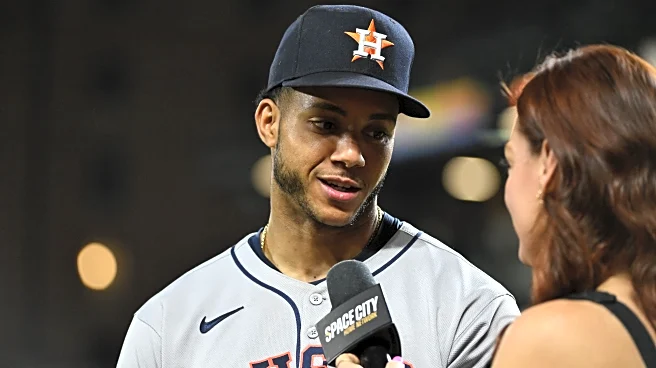

In this edition, we are going to play agent for Jeremy Pena. There is no drama over whether Pena will be the shortstop for the Astros in 2026. He is arguably the most valuable position player on the team
according to wins above replacement. Obviously, a healthy and productive Yordan Alvarez may challenge him on that, but no one adds the offensive and fielding value he adds together.
This is the fifth of this series and if you have not read the first several then I invite you to go back and take a look at what BPO is all about. Essentially, we are adding total bases, walks, hit by pitches, and stolen bases and dividing it by total outs. Some other statisticians have used similar formulas. Some could theoretically take steals away while others could include sacrifices. The end results end up being fairly similar.
We looked at mostly regular players at every position. That included 34 shortstops with more than 300 plate appearances. We are taking the median at shortstop and overall at each position. The actual league average would be different because we did not include players with fewer than 200 plate appearances. The median big leaguer had a .678 BPO while the median shortstop had a .683 BPO. Let’s start by taking a look at how Astros shortstops did last season.
I profiled 310 different players for BPO. Nick Allen ranked 310th in BPO. He had 17 outs above average last season as the Braves regular shortstop. Obviously, he did not start the season as the team’s regular shortstop. He gives the Astros some insurance as a guy that could at least field the position as good as any shortstop in the business. If he gets more than 150 plate appearances next season there has either been a rash of injuries or Joe Espada has had a stroke.
Pena led the Astros in BPO and that is particularly true when you consider that Alvarez did not qualify for BPO since he had fewer than 200 plate appearances. This is where magical thinking can overcome us. It is too tempting to assume Pena will be just as good all while other Astros will be better offensively. Yordan will likely be healthier. Cam Smith, Christian Walker, and Yainer Diaz may all improve. Expecting the likes of Jake Meyers and Pena to be just as good as they were last season might be a bit of wishful thinking.
The good news is that they same is true for his agent. Negotiating a long-term deal now on the heels of last season is likely not in the cards, but they would certainly like it to be if they are smart. If we take Pena’s BPO numbers over the last four seasons combined and throw in the WAR numbers for baseball-reference.com and fangraphs.com then we will get a pretty good list of who he is similar to.
Fangraphs has a value they have for each player based on a specified value per win. That value is theoretical and some believe it is accurate, but I choose to look at actual contracts and if I am Pena’s agent I am going to base my asking price on players I think are similar. I would assume that Pena will not perform as well as he did this past season, but he will perform better than he did in his first three seasons. That would probably put him in the territory of these four shortstops.
Now, if I am a good agent, I am looking at the length of the contract and the total value of the contract as well. The problem above is that these numbers are what these players have done over the past four seasons. Bo Bichette’s contract numbers below are where is projected to go this offseason. The other three signed at least one year ago if not more. So, their contracts were based on performance before the contract, but the numbers above include seasons they have put up since the contract.
We could get bogged down in whether one player is actually better than another. That depends largely on when they signed the deal and whether you as an analyst believe in WAR, BPO, OPS+, wRC+, and whether you subscribe to defensive runs saved, outs above average, and fielding run value. I am calling them similar and chalking up the rest of that to noise. Remember, I am playing agent and I don’t want to get bogged down in semantics. Pena is similar to these four shortstops and we will leave it at that.
So, let’s give Jeremy Pena a seven year and 195 million dollar deal and call it a day. Not so fast my friend. You aren’t getting off that easy. If everyone has been paying attention, there is a thing called inflation. For much of the last five years it has been hovering around three percent. You will owe my client that inflationary rate. So, what we can do is convert these contracts in 2026 dollars by applying a three percent per season inflation rate to convert these into 2026 dollars. Remember, Bo Bichette’s are set there because it is an estimated contract, so we will have to apply the multiplier to the other three
So, we are getting pretty close to 30 million per season as the starting point. That would obviously be a 7/210 contract for Pena. As we know, Jim Crane has never given longer than six years to any player on the roster and that include Jose Altuve. I’d imagine that he would authorize a six year offer for Pena, but that is only a guess on my part. Would Pena take six years and 180 million? That’a a calculated gamble for both sides.
The current Fangraphs model has each win being in the neighborhood of eight million dollars. He is averaging between 3.5 and 4,0 FWAR per season so far. So, if we were to go according to Fangraphs then 30 million AAV would also be pretty close to accurate. So, the question for both sides is this: what is likely to happen in 2026? If Pena puts up another four wins then he essentially has the same profile going into next season that he has this season. However, the amount you see above would need to be adjusted for another year of inflation.
The gamble for Pena is that he could put up another five or six win season and vault himself into a different tier of shortstop. That would be the Francisco Lindor, Corey Seager, Bobby Witt, and Trea Turner neighborhood. That might end up being 35 to 40 million per season. Of course, he could go the other direction and see the long-term offer decreased. For both sides, it is a question of how confident they feel in his ability to continue to produce around four wins a season. It’s an interesting dilemma.