


ST. LOUIS — It happened again.
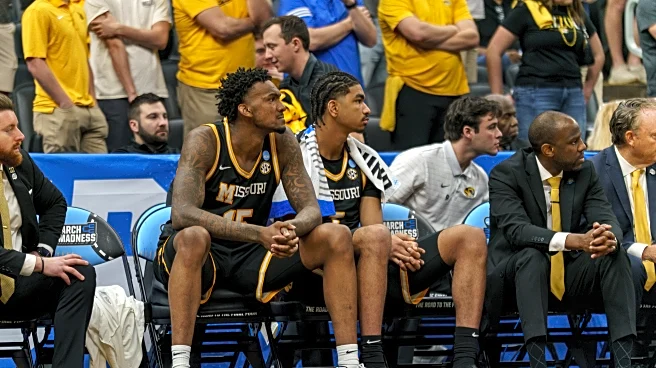
Mizzou basketball was invited to the Big Dance, but once more, it only made a brief appearance before leaving, falling to No. 7 Miami (Fla.) 80-66 in the Round of 64.
Since 2010, the Tigers have made the NCAA Tournament nine times. They have two wins to show for it, and both came in the Round of 64. But MU exiting the NCAA Tournament early once more wasn’t the only thing that made the sting worse.
The way Mizzou lost was the way Mizzou has been losing for decades.
Historically
speaking, many Mizzou teams — namely football and men’s basketball — have a knack for teasing meteoric success. They’ll appear distant from it, only to reel fans in with spurts of greatness. But then, they’ll fall just short of the mountaintop, turning hope into heartbreak and dreams into nightmares.
Mizzou fans live in an ocean wave: they get sucked into the current, only to be washed ashore covered in disappointment. This process has repeated for many generations.
“I think we have one of the most resilient teams in the country,” Nicholas Randall said after Friday’s game. “Anytime anything happens to us, we always respond in the right way … We lose a game, we’ll go on a two-game win streak. Something happens to us, and we’ll turn around and get back in the game out of nowhere.”
For most of this season, Mizzou has tossed fans back and forth. After a lackluster performance in non-conference play, which was punctuated by that 43-point loss to Illinois on Dec. 22, Mizzou beat Florida and Kentucky in consecutive games to open SEC play. The Tigers then dropped three of four games and were heading for a loss against Oklahoma until Trent Pierce and Mark Mitchell stole a win with a double dose of buzzer-beaters. After getting blown out by Texas on Valentine’s Day — a loss that put Mizzou back on the wrong end of the NCAA Tournament bubble — the Tigers tallied three wins in four games, two of which were over ranked teams.
“People wrote us off. Our guys didn’t write each other off during the difficult times,” Dennis Gates said. “They held onto their commitments that they made when they first met each other.”
Friday was the same story. In the first half, Mizzou had little juice on offense. The Tigers shot just 4-of-15 from beyond the arc, and they didn’t shoot a free throw until there were just under three minutes left in the first half. Mark Mitchell was getting enveloped by multiple Hurricanes seemingly every time he touched the ball, and he entered halftime with just four points on 0-of-3 shooting from the field.
“Every time we could get him the ball, they were in his gaps,” T.O. Barrett said. “So it would just be hard for him to drive.”
“They built a wall that made it hard for me most of the game,” Mitchell said. “Kudos to them.”
The Tigers were also getting dominated on the glass, as they entered halftime with 11 fewer rebounds than the Hurricanes, who also scored 12 second-chance points (Mizzou had none). It was reminiscent of Mizzou’s previous game in Enterprise Center (a 43-point loss to Illinois on Dec. 22) when the Illini outrebounded the Tigers by 19 and scored 29 second-chance points.
“At the end of the day, their second-chance points, their offensive rebounds gave them a lot of energy,” Trent Pierce said.
And yet, the Tigers only trailed by one after the first 20 minutes, with Anthony Robinson II catalyzing a 9-0 run at the end of the first half with aggressive dribble-drives and a nifty stepback 3-pointer.
Mizzou continued reeling the neutral-site home crowd back into the game. Even as Miami kept scoring, Jayden Stone would respond with a layup, while Shawn Phillips Jr. would elevate for a massive block or throw down a thunderous two-handed dunk. A pair of free throws from Pierce gave Mizzou its first lead of the game with 9:15 left in the second half. Less than two minutes later, after Tre Donaldson buried a 3-pointer, Mitchell sunk a triple of his own to put Mizzou back in front.
More notably, the black and gold faithful drenched the court with a shower of cheers. In that moment, no three-letter combinations became more powerful than M-I-Z and Z-O-U. The Mizzou fans at Enterprise Center were desperately attempting to lift their team to a prolonged scoring run.
“The crowd was great,” Mitchell said. “It was rocking. It felt like a home game. Wish we could’ve done better for ‘em.”
It didn’t take long for that energy to evaporate.
With Mizzou trailing by two, Mitchell spun into the lane and appeared to get hit on the arm. No foul was called, and moments later, Malik Reneau canned a 3-pointer to put Miami ahead 59-54.
“That definitely hurt a lot,” Jevon Porter said of the no-call. “He almost always gets that call, that little swipe through. The dude definitely hit his arm.”
“It was a big turning point,” Randall said, “but you just got to keep your head in the game and have a not-blink mentality. When stuff happens, you can’t get in your feelings and let it deter you from the game. You just have to turn around and make something happen.”
The NCAA Tournament is kind to those who finish strong. For the second year in a row, Mizzou fell apart when the stakes were the highest.
Over the final seven-and-a-half minutes of regulation, Miami outscored Mizzou 26-14. Another Donaldson 3-pointer with 97 seconds left proved to be the dagger, as it put the Hurricanes ahead by 12. When the final buzzer sounded, the vibes were wildly different than the thrilling contest between Santa Clara and Kentucky from earlier in the day.
Mizzou’s supporting cast, which had struggled in recent games entering Friday, was largely ineffective once again. Barrett and Jacob Crews were scoreless in a combined 35 minutes of action, while Pierce and Phillips Jr. combined for just 13 points.
The only other effective player on offense for Mizzou besides Mitchell and Robinson II was Stone, who finished with a team-high 21 points in his first NCAA Tournament game.
From a 30,000-foot view, Gates & Co. deserve credit for bouncing back in SEC play after dropping numerous games in alarming fashion at points in November and December (plus, Stone and Pierce missed time with injuries early in the season).
That made the end more palatable for Gates, but still difficult to stomach.
“How I will remember this season? I’m pretty difficult on myself. I’m hard on myself when it comes down to coaching,” Gates said. “I don’t think any coach could have brought the team to this place based off of where we were, dealing with the injuries that we dealt with. So I pat myself on the back at the same time.
But there was still sort of a goal in mind. I want to win a national championship, and I didn’t. So for me, that’s a failure. It’s just that simple.”
This failure was a magnum opus of Mizzou’s past seeping into the present. They’ll have to wait until at least next year for another shot at creating a new future.