

North Dakota State football has been winning for more than a decade.
To the surprise to most of the world-at-large, yes, the jump from FCS to the FBS level was a surprise.
But being who and what the Bisons are and have been, the remainder of the world was saying, “It’s about time to rise up for more.”
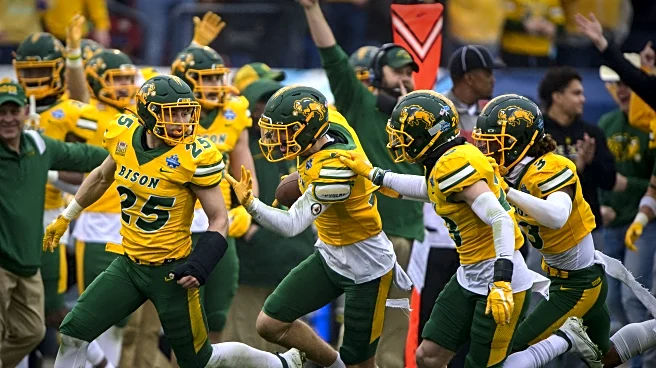
The Bison’s arrival as a football-only member of the Mountain West in 2026 is less a leap of faith and more the natural next chapter of their sustained dominance. With ten national titles since 2012 and a staggering
long-term record, it has made Fargo feel like the center of the FCS universe.
Still, dominance at one level does not automatically translate to certainty at another.
Where the realistic expectations begin
There are programs that win and then there are programs that quietly reshape the expectations of what winning is supposed to feel like.
North Dakota State has existed in that rarified space, where sustained excellence becomes routine and national championships blur into a standard rather than a celebration. So, when the Bison officially step into the Mountain West in 2026, the conversation predictably splits in two directions.
On one side: curiosity, respect, and cautious intrigue.
On the other: the familiar chorus of skepticism that tends to greet any FCS power daring to climb the ladder.
The truth, as it often does in college football, lives somewhere in between.
Canceling out the noise
The loudest doubts are easy to list:
- Speed of the FBS game
- Week-to-week depth
- Scholarship limits
- Travel grind
- NIL
- Transfer portal
All fair. All real. But, all incomplete.
What critics often miss is that North Dakota State is not a typical transition story built on one magical season or a fleeting recruiting class. This is about infrastructure. Culture. And…continuity. The kind of long-term competitive muscle memory that doesn’t just disappear.
Head coach Tim Polasek inherits and continues to shape a machine designed for stability. Line play that travels. Quarterback development that rarely panics. Defenses comfortable winning games in the low twenties when everything tightens in November. Those are not FCS traits. Those are football truths.
Polasek going into year three led a 14-2 in his first season and a 12-1 his following season. To quickly sum up Polasek’s FBS experience, Polasek was an offensive line coach with Iowa (Big Ten) for four years and was a Craig Bohl protege from 2021 – 2023 as an offensive coordinate and quarterbacks coach.
And in a Mountain West historically defined by physicality and developmental toughness, the stylistic translation may be smoother than outsiders expect.
Non-tangibles that matter more than metrics
But realism isn’t only about roster charts or depth projections. It’s also about environments. Identity. Feel.
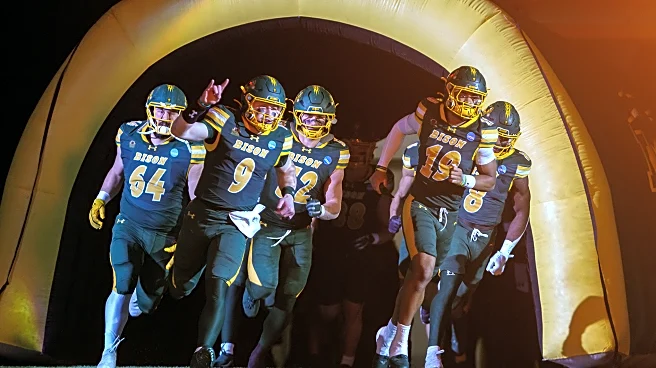
Few places in college football, at any level, match the emotional density of the FargoDome, affectionately and accurately nicknamed the Thunderdome. It is not merely loud. It is compressed intensity. A space where momentum swings feel amplified and visiting teams sense early that comfort will be in short supply.
For the Mountain West, this isn’t just another addition on a map.
It is a new kind of road trip — cold-weather, indoor, relentlessly intimate football that fits the league’s blue-collar personality better than many might assume.
Those experiences matter.
They shape close games.
And close games shape seasons.
It’s indeed a new look-and-feel addition to the conference.
Year one: honesty over hype
Realistic expectations for 2026 should resist both extremes.
North Dakota State is unlikely to walk into immediate conference contention. Depth across a full FBS schedule is learned, not assumed. There will be physical Saturdays that feel different than anything experienced in the Missouri Valley.
But collapse? That feels equally unlikely.
A more believable outcome sits in the middle tier of the standings; competitive most weeks, dangerous in the wrong weather, capable of unsettling established programs who suddenly realize the “FCS newcomer” label doesn’t quite match the trench play in front of them.
And because postseason eligibility arrives later, early success may be measured less in trophies and more in tone:
- Are games tight in the fourth quarter?
- Do opponents leave relieved rather than dominant?
- Does Fargo begin to feel like a problem on future schedules?
These are the first realistic benchmarks.
The longer arc
Expansion moves are rarely judged correctly in year one.
They are decade-long stories pretending to be single seasons.
By the time bowl eligibility and championship access arrive later in the cycle, the more meaningful question may no longer be whether North Dakota State can compete, but whether the competitive center of the Mountain West has subtly shifted to include them.
Programs built on patience tend to age well; programs built on culture travel farther than projections;
and programs accustomed to winning rarely forget how.
So, cancel out the noise. Ignore the extremes.
What remains is something simpler, and more compelling; not a fairy tale arrival and not an overmatched experiment.
NDSU is a proven football identity stepping onto a bigger stage, bringing with it the echo of the Thunderdome and the quiet confidence of a program that has spent years turning doubt into routine.
In 2026, North Dakota State doesn’t need to shock the Mountain West to matter. It only needs to be exactly what it has always been.