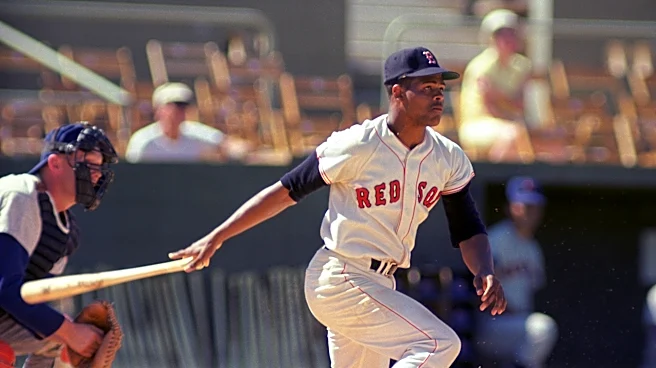


A few weeks ago, I wrote about seeing Jesse Cole, owner of the Savannah Bananas, give an inspirational speech. One of the pivotal moments of Cole’s life was his relationship with former player Reggie Smith, when Smith was a star for the Red Sox and Cole was a shy and withdrawn youth. The 20 minutes Smith spent with Cole changed his life. Smith, who enjoyed a terrific 17-year career, is often described as “the other Reggie.”
There’s no disrespect in that. Reggie Jackson drew a lot of attention from
the media. Reggie Smith just quietly went about having excellent season after excellent season.
Much has been written lately about players who have been overlooked by the Hall of Fame. You know the names: Luis Tiant. Bobby Grich. Lou Whitaker. Dwight Evans. Tommy John.
At the top of that list should also be Reggie Smith.
Smith, like many young men of the 1960s, was a multi-sport standout in high school, excelling in football and baseball. His father, Lonnie, played one season in the Negro American League. As a teenager, Smith played for a Los Angeles team coached by former Negro League star Chet Brewer. Being a ballplayer was his destiny.
Smith signed a free-agent contract with the Minnesota Twins shortly after graduation. After a strong start for the Twins’ Rookie League team, they inexplicably left him unprotected in the minor league Rule 5 draft and lost him to the Boston Red Sox. Smith blasted his way through the Red Sox minor league system, posting an excellent 1964 season at Class A Waterloo. He spent the summer of 1965 at Double-A Pittsfield, then, in 1966, at the age of 21, won the International League batting title with a .320 mark for the Triple-A Toronto Maple Leafs.
This earned him a six-game cup of coffee with the Red Sox. He collected the first three hits of his career on September 24 at Yankee Stadium. He never played another game in the minors.
Manager Dick Williams installed Smith as his starting center fielder in 1967, and the rookie helped lead the Sox to the pennant, the Impossible Dream season. Smith played in his first World Series and finished second in the Rookie of the Year vote behind Rod Carew.
Smith spent eight seasons in Boston, where he developed into a star, making two All-Star appearances, winning a Gold Glove and earning MVP votes in four seasons. I only saw Smith play once in person, coincidentally in the very first game I ever attended. He went 1 for 3 with a walk while facing Steve Busby. Busby was one of the top pitchers in the game at the time and only gave up five hits that game, a 3-2 KC win.
Smith’s time in Boston ended after the 1973 season with his trade to St. Louis. The move represented a fresh start for Smith, who suffered under the racial strains of Boston. The Red Sox were the last baseball team to integrate when they added Pumpsie Green in, get this, 1959. It seems almost inconceivable today that a team would wait almost 12 full seasons before integrating. Smith called Boston out for being a racist city, a charge that was also made by other prominent Black athletes such as Satch Sanders and Bill Russell. It got so bad for Smith that he began wearing a batting helmet in the field at Fenway Park to protect himself from coins, batteries and other hard objects thrown by his home crowd!
The city of St. Louis had a much more relaxed racial atmosphere, plus the Cardinals had two strong Black superstars in Lou Brock and Bob Gibson, which took a lot of pressure off Smith. On paper, it was the perfect landing spot for him.
He only played 2½ seasons in St. Louis but was generally excellent, both at the plate and in the field. He developed into a leader and mentor for younger players and always set a great example by staying in excellent physical condition. He moved to right field while playing with the Cardinals, making room in center for the up-and-coming Bake McBride. Smith was widely recognized for having one of the strongest arms in the game, so strong that the Red Sox briefly considered trying to turn him into a pitcher while he was in their minor league system.
In June of 1976, the Cards made one of their worst trades of the decade, and they had a few, when they sent Smith home to Los Angeles in exchange for Joe Ferguson and a couple of throw-ins. Smith had a career rebirth in LA, spending eight years with the Dodgers, where he played in two more World Series.
In 1977, Smith clubbed a career-high 32 home runs, led the league in OBP at .427 and posted the best OPS+ of his career with a 168 mark. The Dodgers met the Yankees in both the 1977 and 1978 World Series and lost both times. Smith hit .273 with three home runs in the 1977 classic but was overshadowed by the other Reggie and his titanic three home runs in three at-bat game.
Smith joined the San Francisco Giants for the 1982 season, but at the age of 37, the end was near. He still hit a very respectable .288 with 18 home runs in almost 400 plate appearances.
Not finding any suitors in the States, he played for two seasons in Japan with the Yomiuri Giants before finally retiring at the age of 39.
What a career. Over 2,000 hits, 314 home runs, over 1,000 RBI, over 1,100 runs scored and a career slash of .287/.366/.489 with a career OPS+ of 137 worth almost 65 WAR. Add in his seven All-Star appearances, the Gold Glove, the four World Series appearances (he played on the Dodgers’ 1981 winner), and his Hall of Fame case looks strong. He ended his career as one of the best switch-hitters ever. Here’s another crazy tidbit: The teams that Reggie Smith played a full season for never had a losing record. The guy was a hell of a player, and people forget just how good he was.
In retirement, Smith stayed close to the game, serving in various capacities for USA Baseball (Pan Am Games, Olympics, World Baseball Classic). He also runs a baseball clinic in Encino, California. Smith was always one of the more cerebral players of his era. He plays seven different musical instruments and found time to get his pilot’s license. Smith was in Kansas City last week for his induction into the Negro Leagues Baseball Museum Hall of Fame. Here’s hoping the National Baseball Hall of Fame takes another look at his case while he’s still alive.