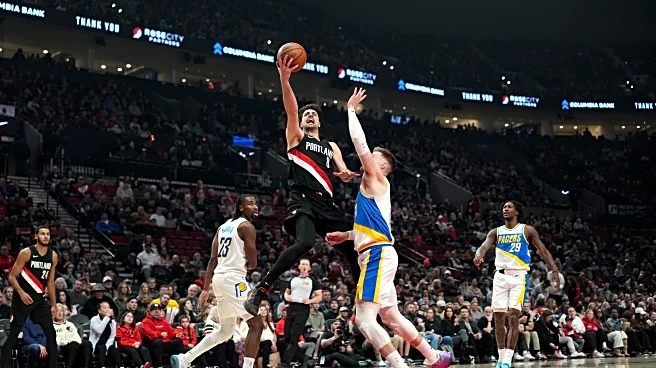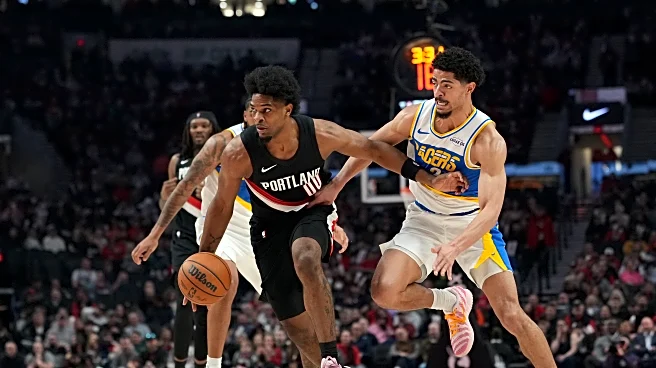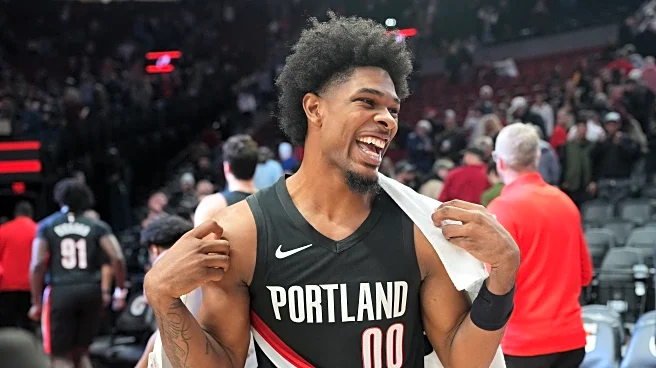
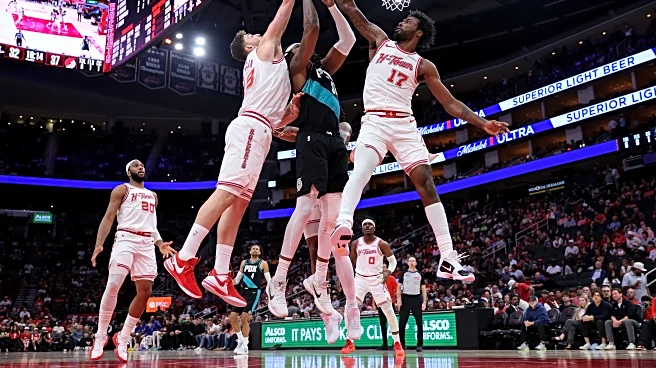
Nothing in the orbit of the Portland Trail Blazers is as exciting, or devastating, right now as a Shaedon Sharpe dunk. Stretching beyond mortal limits, the fourth-year guard manages to thrill and tantalize in equal measure. He reminds Blazers fans of his lofty ceiling, at the same time showing how far the distance back to the floor.
Since he entered the NBA, Sharpe has been trying to build a bridge over that gap. His growth curve and struggles through it comprise the heart of today’s Blazer’s Edge
Mailbag question.
Dave,
We’ve seen Deni get allstar status this year but what about Shae? You don’t mention him as much but he’s just as important to our growth imo. What do you see coming next for him? Will he be an allstar soon too?
James
The short answer is, “I don’t know.”
Since that’s dissatisfying, I’ll explain.
Shaedon Sharpe has proven he’s a scorer. There’s little doubt about that anymore and it’s a good thing for his career.
Sharpe’s 21.4 ppg average may look slightly meek, especially when compared to teammate Deni Avdija, who is averaging a robust 24.3. But Avdija’s fantastic season shouldn’t obscure the fact that Sharpe is having a good one. Carrying a neon-green light, facing little competition for shots outside of Avdija himself, Sharpe has made scoring a cottage industry. He ranks 20th in the NBA in points per minute, just outside of the Top 20 in points per possession. He’s in the neighborhood of several high-profile players, including Cade Cunningham, James Harden, and LaMelo Ball. That’s not bad for a guy who was searching for a role and consistent playing time a season and a half ago.
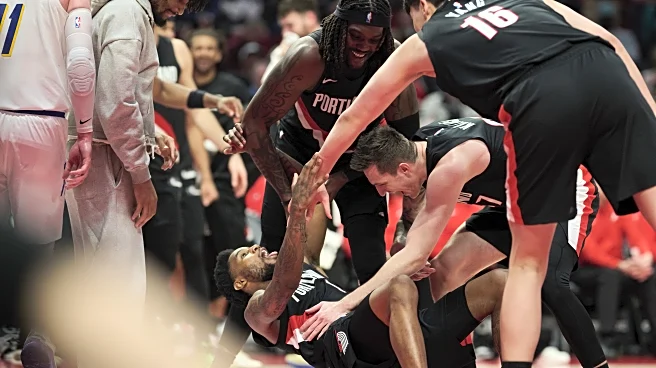
When Sharpe went down a month ago, Portland’s offensive attack began to suffer. They’ve put up big scoring totals without him, but aside from a 122-point performance against the Philadelphia 76ers back on February 9th and a 121-point effort against the Minnesota Timberwolves on February 24th, their largest offensive numbers have come against teams that are, frankly, horrible. As soon as they began facing teams with even a modicum of defense without Sharpe, the Blazers scored in the 100’s, sometimes even 90’s. The caveat is that for many of those games, Avdija was gone too, but that doesn’t diminish Sharpe’s critical production role for this year’s team.
Beyond those broad scoring strokes, though, it’s still hard to pin down exactly how Sharpe fits in.
The major difference between him and Avdija, Ball, Harden, and Cunningham is obvious. They’re all point guards—or close enough—initiating the offense with ball in hand. They’re capable of getting by defenders, making passes to further the play when covered closely.
There’s little evidence that Sharpe will ever be a regular ball-in-hand player. He’s the endpoint of the offense, not its source. That’s a perfectly valid role, except for a couple of issues.
First, the absolute hallmark of a play-finishing guard in the modern era is three-point shooting. Sharpe doesn’t have it. His 34.0% conversion rate beyond the arc is adequate, but no more. This isn’t a slump. It’s a skill he’s never possessed. His highest career mark is 36.0%. That came three seasons ago, in his rookie year, taking comparatively few shots from distance.
Three-point shooting is critical for more reasons than just bald point production, which Sharpe appears to have covered anyway. Threatening from long-range causes defenses to chase. They either have to close hard when the ball rotates to prevent an immediate shot or they have to get in front and stay tight if the shooter holds the ball. Either way, this keeps the initial defender on the edges of the court. That makes dribbling past them into space simpler. This causes the rest of the defense to shift over to stop the now-threatening drive. At that point the ball-handler can score or find an open passing lane for another, even wider-open, shot.
Defenders don’t have to do this against Sharpe. They can play back farther, cut corners as they rotate to him. With opponents impeding his route to the bucket, waiting on the ball to hit the court for his first dribble, little defensive movement is necessary and no rotation. An endpoint-scorer is supposed to create cracks through which he can convert or at least break down the defense enough that somebody else can score when opponents overcommit. Instead, with Sharpe, the ball often stalls.
Perhaps as a result, Sharpe has a fairly terrible ratio of 2.6 assists to 3.0 turnovers per game. Avdija commits more TO’s (3.8), but he also generates more assists (6.7). Their roles are fundamentally different. Miscues are common among play-initiators. Play-enders aren’t supposed to give up the ball like that. The whole offense is geared to get them that opportunity. Giving it away after all that work is bad. A guy who catches fish in the river can be forgiven when a few get away. The guy he tosses them towards to put in the cooler is not supposed to fumble them back into the water.
Nor does Sharpe convert better than Avdija, who is known as more of a speedster and volume-possession guy than a true skill-master or marksman. Deni shoots 46.1% from the field, Shaedon 45.6%. Avdija is at 33.7% beyond the arc, Sharpe the aforementioned 34.0%. Those numbers aren’t horrible, but they’re not great either.
In short, it seems like Sharpe has all the drawbacks (and risks) of a play-initiating guard without the actual benefits of same. If Sharpe were Deni, Part 2 as a fantastic floor reader, quick-strike attacker, and secondary passer—or even if he weren’t any of those things but was a 39% three-point shooter—the Blazers would be ecstatic. At this point, he’s just not.
All of this could be overlooked if Sharpe were also a prominent defender. To his credit, he has improved since he came into the league. He’s still not making a huge difference on the defensive end, though. Sharpe seems to blend in with Portland’s overall defense, not hurting it as he once did, but not helping in obvious ways either. Aside from the occasional magnificent close-out—and Sharpe IS a part of Portland’s generally-excellent three-point defense—as the Blazers go, so goes he.
Let’s put this all together.
Is Shaedon Sharpe a player you’d want on your team? Absolutely yes. His scoring prowess is significant. That would recommend him even if nothing else did.
Is Shaedon Sharpe a player you have to have on your team? Probably not. The league features lots of scorers. Sharpe is among the best, but he’s not indispensable at this point in his career.
Except the Blazers do have to have Sharpe on their team, as we just talked about. And therein lies the rub. Portland is dependent on a player who may or may not deliver enough of an overall game to justify that dependence.
Anyone who’s watched any of the various iterations of Ramsay’s Kitchen Nightmares understands the problem here. If your current business model is wed to a dish (or process, or clientele) that ultimately won’t bring you success, it’s better to risk a radical change than to sink into mediocrity—or failure—incrementally.
I’m not sure the Blazers are there with Sharpe yet, but he definitely needs to show more in order to avoid that conundrum in years to come. More shooting, more defense, more passing, better care of the ball, heck…even more shots at the rim and resulting free throw attempts would do it! Failing that, the Blazers need to raise up players around Sharpe to make him less central and themselves less beholden to him.
Until one of those two things happens, the relationship between the team and their star scorer will continue to be shaky, at least in the sense that they need him more than they can depend on him. Sharpe has shown progress throughout his career. The Blazers will hope that continues. Until then, the only thing that will remain truly consistent is the murkiness that’s defined Sharpe’s career and value since he entered the league four seasons ago.
Thanks for the question! You can always send yours to blazersub@gmail.com and we’ll try to answer as many as possible!