
Not many expected the Steelers and Lions to have identical records entering their Week 16 matchup in Detroit. Still, Sunday’s upcoming battle between 8-6 teams has the Lions as a consensus seven-point
favorite, despite sitting one spot shy of the playoffs in a competitive NFC.
In this week’s preview, Read & React will be taking a look at why the Lions are still in the conversation of the NFL’s elite – and why they’re also at risk of missing the postseason altogether.
What to expect from the Lions’ offense

Rushing YPG: 131.1 (5th)
Passing YPG: 248.8 (3rd)
PPG: 30.6 (1st)
RB: The Lions’ record is worse than most expected it would be in Week 16, but don’t let that fool you into thinking this offense is any less dangerous than it was last year when the Lions made it to the NFC Championship.
Detroit has the best scoring offense in the league. They’re top five in both rushing and passing. This is still absolutely an elite unit.
After losing star offensive coordinator Ben Johnson to the Chicago Bears over the offseason, Detroit did have some hiccups under their new OC, John Morton, but head coach Dan Campbell took over play calling in early November, and the team never looked back.
At quarterback, the Lions are led by Jared Goff, who’s turned into one of the most productive passers in the NFL under Campbell. Is he a dynamic talent on the level of a Josh Allen or Patrick Mahomes? No. But he’s still probably a little underrated to the average NFL fan.
In structure, Goff is about as efficient as it gets, with 69.3% completion, 3,672 passing yards, 29 passing touchdowns, and just five interceptions so far this season. He has an arm that can access just about any area of the field, which the Lions’ multi-tiered passing game certainly accesses.
Detroit’s scheme tends to steal a lot of the credit, but it takes a cerebral quarterback to run it at the level Goff has. He’s been surgical this season.
Goff isn’t the smoothest athlete on the run, but his pocket navigation is better than most give him credit for.
Still, he has historically struggled with accuracy and decision-making when under pressure, and that trait of his game hasn’t disappeared completely.
Thanks to a dangerous running game (more on that later), Detroit capitalizes on a lot of play-action concepts, ranking fourth in the NFL with 29.5% usage. That’s opened up the middle of the field and helped out an offensive line that’s been just OK in pass protection this year.
Detroit allows the 14th-highest pressure rate (34.8%) in the NFL, but also the fastest time to pressure (2.49 seconds). On Pittsburgh’s side of things, it’s a rough week to be possibly down both T.J. Watt and Nick Herbig.
Helping out Goff in the passing game is a talented stable of targets. Star tight end Sam La Porta is on injured reserve, but Amon-Ra St. Brown and Jameson Williams are one of the best receiving duos in the league.
St. Brown is an established star – he can line up anywhere, possesses great toughness and hands, and already has 1,140 receiving yards on the season. He’s a workhorse receiver who has excelled in the Lions’ intermediate passing game.
While St. Brown is the picture of consistency, Williams is far more volatile. But he’s a fantastic deep threat who’s on the verge of his second consecutive 1,000-yard season. This year is on pace to be his best as a pro – he’s developed excellent chemistry with Goff and has been unlocked with Campbell as the play caller. On deep posts and crossers – look out.
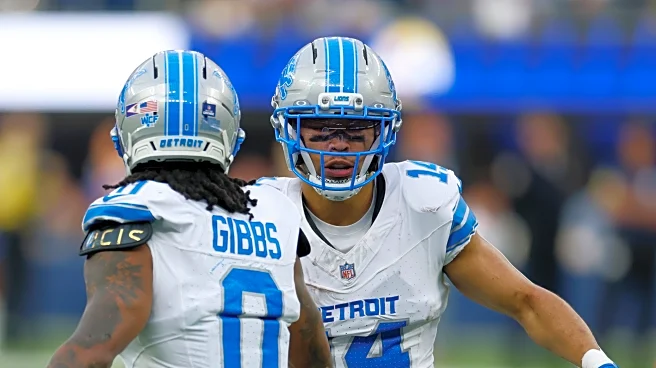
And then there’s Detroit’s run game. Like the receiving room, it’s led by a two-headed monster at running back with Jahmyr Gibbs and David Montgomery, even if Gibbs has stepped even further into the lead back role in 2025. Both are dynamic talents who complement each other in Detroit’s run scheme, which uses both power concepts and outside zone.
Gibbs might be the most electric runner in the NFL, with true take-it-to-the-house speed. He’s already amassed 1,100 rushing yards (and nearly 500 more as a receiver) this season.
Montgomery’s game is also dangerous. He has 635 rushing yards this season, excelling with sharp cuts, fantastic leg drive, and excellent vision.
That being said, the run game hasn’t been perfect this year, with the Los Angeles Rams holding the Lions to just 70 yards in Week 15. Gibbs averaged just 2.9 yards per carry in a 41-34 Rams win.
Part of it is that the Lions’ offensive line underwent a personnel shakeup entering 2025, and has suffered some injuries during the season (center Graham Glasgow was a DNP in Thursday’s practice, which is worth keeping an eye on). It’s clearly a worse group than it was in 2024.
Still, right tackle Penei Sewell is a true star at the position.
LA also had a strong showing defending the run against Detroit last week, using the Lions’ signature condensed formations as an excuse to load the box and bring its edge rushers more inside. The Rams used sim pressures to create chaos at the line of scrimmage, and trusted their second-level defenders (linebackers, defensive backs) to aggressively fill their gaps.
The Detroit passing game still exploded, but the Rams were able to win the shootout thanks to forcing three-straight three-and-outs in the second half. Against an offense this talented, you can certainly win, but it isn’t always pretty.
What to expect from the Lions’ defense

Rushing YPG Allowed: 106.7 (13th)
Passing YPG Allowed: 231.1 YPG (24th)
PPG Allowed: 24.6 (23rd)
RP: While Detroit’s offense remains among the league’s most dangerous, the Lions’ defense has once again been ravaged by injury. Things aren’t quite as drastic as they were in 2024 – for starters, they still have a healthy Aidan Hutchinson in the fold this year – but the secondary has been decimated for the second consecutive year.
The Lions drafted corners Terrion Arnold (No. 24 overall) and Ennis Rakestraw (No. 61) in 2024 with their first two picks, and neither will suit up against Pittsburgh. Rakestraw has played just eight games in two years, and Arnold has been shut down for the season after reaggravating a shoulder injury on Thanksgiving. Out too are star safeties Brian Branch and Kerby Joseph. Joseph last played in Week 6 and has still not returned to practicing after being sidelined with a knee injury. Branch ruptured his Achilles tendon on December 4th during Thursday Night Football. Nickel corner Amik Robertson is also banged up with a hand injury, but is reportedly considering wearing a club on his hand and trending towards playing.
The Lions will also be missing some key depth pieces along their defensive line with both Josh Paschal and Levi Onwuzurike out.
The injuries have started to take a toll, and Detroit’s defense has regressed heavily after a strong start to the season. Presently, the Lions have surrender 27 or more points in four straight games, and 30 or more points in three straight.
However, the return last week of defensive end Marcus Davenport, who also missed a few weeks to injury, means the entirety of the Lions front is healthy again. That’s a big deal for a team like Detroit, which plays the most snaps in base defense in the entire league.
The reason for that is partially because the Lions’ secondary has been a MASH unit. But beyond that, it’s also because the Lions are a team that prides themselves on stopping the run. It’s part of head coach Dan Campbell’s vision, and it’s ingrained in their culture. And while they’ve regressed closer to the middle of the league after finishing fifth-best against the run in 2024, Detroit still possesses a talented front seven.
The star of that group is former number two overall pick Aidan Hutchinson.
Hutchinson has shown no worse for wear after a leg injury ended what was shaping up to be a promising campaign for the young defender in 2024. This year, he leads the team in both sacks (9.5) and pressures (77), while showing he can with both speed and power.
And Hutchinson has a little T.J. Watt in his game, in that he’s looking to impact the play in any way he can. That includes occasionally sniffing out screens and creating turnovers.
Beyond Hutchinson, Al-Quadin Muhammad has emerged as a pass-rushing specialist. Muhammad isn’t often in on early downs, but even in his limited role, he has generated the second-most sacks (9) and pressures (47) for the Lions defense.
In the interior, D.J. Reader and Alim McNeil don’t stuff the box score, but both are big space eaters who allow the linebackers behind them to make plays in the running game, while providing some pass rush ability.
The Lions are actually among the league’s best in generating pressure (5th) and sacks (7th), but that is often lost due to the struggles of Detroit’s injury-riddled secondary. The Lions also create pressure with their linebackers, blitzing at the fourth-highest rate (32.5%) in the NFL.
The Lions’ linebacking corps is made up of the trio of Jack Campbell, Alex Anzalone, and Derrick Barnes.
Campbell is the blue-blood of the group, as a former first-round pick. His 136 tackles are fifth-most in the league, but that doesn’t paint the whole story. Tackle numbers can often be misleading. After all, a tackle on a play that gained 10 yards shows up the same as a tackle on a play that gained only a single yard. What’s more impressive about Campbell is that he leads the league in stops (82), a stat from Next Gen Stats that registers whenever a defender makes a play that causes negative EPA for the opposing offense.
Campbell is stout against the run, and among the best blitzing linebackers in the league. The Steelers will need to protect the football around Campbell.
And I would expect to see Campbell trailing running backs Kenneth Gainwell and Jaylen Warren often in the passing game.
But the best coverage linebacker on the Lions is Alex Anzalone.
Anazalone matches up fairly well with tight ends, and overall, quarterbacks have completed just 25-of-49 (51%) of passes targeting the rangy linebacker. He’s allowed a QB passer rating of just 60.7, and targeting him has generated -25.3 Coverage EPA for opposing offenses.
Barnes is the Lions’ third linebacker, and the one most likely to come off the field if they switch into nickel or dime. He’s third on the team in stops (36) behind only Campbell and Anzalone, while also finishing third on the team in pressures (23), and fourth in sacks (4).
Collectively, the Lions are a group of sound tacklers. That could pose a challenge for the Steelers, a team that creates so much of its offense from yards after the catch.
The Steelers should come prepared this week to face a ton of single-high safety looks. Even with their mounting injuries in the secondary, the Lions prefer to run Cover 1 roughly a third of the time, and Detroit is in Cover 1 or Cover 3 58% of the time.
Fortunately, Detroit’s previous opponents left behind some clues for how the Steelers can take advantage of this defense while still using the heavy, multi-tight-end sets Arthur Smith is so fond of. The Lions generated 12 pressures against the Rams last week. Five of those pressures came against Los Angeles’ 13 personnel, meaning three tight ends were on the field. In those scenarios, Matt Stafford went 5-5 for 61 yards.
Veterans Rock Ya-Sin (87.6 QB rating when targeted) and D.J. Reed (84.9) should be Detroit’s starting corners in this game, and former cornerback Avonte Maddox (97.6) could see reps at safety. The Steelers don’t have the most lethal attack, but if there is a unit to exploit, this is it.
They’ll have to if they want to keep their lead on Baltimore.