




Are you sick of hearing about 13 personnel yet?
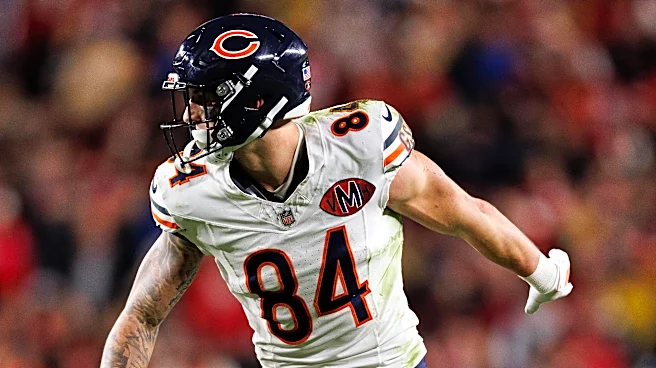
Shortly after the Chicago Bears drafted Sam Roush in the third round (69 overall), analysts started discussing how he’d be deployed with Cole Kmet and Colston Loveland.
Playing three tight ends is a trend that more teams started doing last year, but you really need a unicorn at the position to take advantage of possible mismatches that are created, so not every team is equipped to run 13 effectively.
The Bears are.
Roster Locks
Loveland’s blocking was the most underrated
part of his game coming out of Michigan, but it’s the first thing I noticed in the regular season. In his first four games, he had only 5 receptions for 54 yards, so much of his film was as a blocker, and while his technique had some inconsistent moments, his effort was always there. As he proved he could block in Ben Johnson’s offense, the rock started to come his way more and more.
Running 13 personnel with Loveland will allow the Bears to be right, no matter how the defense counters. As a receiver, the 6’6″, 241-pounder is too big for most defensive backs to match up with, and he’s too good a route runner for most linebackers to cover.
In a recent article by Dwain McFarland of Matthew Berry’s Fantasy Life, Loveland is ranked in their tier 2 of tight ends, only behind Brock Bowers of the Las Vegas Raiders and Trey McBride of the Arizona Cardinals.
“He brings a rare combo of target-earning and vertical usage, the same traits that have driven ceiling seasons from Rob Gronkowski, Jimmy Graham, and Mark Andrews,” McFarland writes about Loveland’s 2026 projection.
To highlight the “vertical usage,” Loveland’s aDOT (average depth of target when targeted) was tied for 4th-best among all tight ends last season at 9.0, but in his two playoff games, it increased to 12.5.
But there’s more to his fantasy projection than aDOT.
McFarland continued, “Ben Johnson leaned into TE-friendly personnel last season, using 12 personnel on 33% of plays (5th) and 13 personnel at 9% (5th)—both strong signals for TE route volume and production. Johnson also creates high-efficiency looks for his pass catchers. Chicago ranked 6th in play action (33%) and 6th in motion at the snap (59%), two areas that consistently boost TE efficiency.”
But staying on the aDOT theme, guess who was just two tight ends away from Loveland in that category?
Yep, Chicago’s other tight end, Cole Kmet. He wasn’t just sneaking out into the flat in 2025, because his aDOT was 8.8. He may never approach the career highs of 73 receptions and 719 yards he had in 2023, but he’s still a top 32 player at the position.
Roush will need to acclimate to the pro game, but Lance Zierlein of NFL.com called him a “plug-and-play” Y (in-line) tight end. He’s going to play more than last year’s TE3, so expect Chicago’s 13 usage to be more than just 9% of the time.
A Good Bet To Make It
The Bears only carried three tight ends last year, but I think UDFA Hayden Large has a good chance to make it. He’s a tenacious blocker, he lined up at fullback for Iowa, and he had plenty of special teams experience with the Hawkeyes as well. If the Bears plan to play more 13, it makes sense to have a fourth on the 53-man roster.
Roster Bubble/Practice Squad
The Bears had three tight ends on their practice squad most of last season, and Nikola Kalinic, Stephen Carlson, and Qadir Ismail all return to try and make it again. Kalanic and Carlson were both elevated for two games each last season, but Ismail ended the year on injured reserve for the Bears. Of the three, Ismail, a former wide receiver, is the only one who has the athleticism to line up as a move tight end.
What are your expectations for Loveland? Do you think the Bears carry a fourth tight end this season? Sound off in the comment section!
Join the conversation!
Sign up for a user account and get:
- Fewer ads
- Create community posts
- Comment on articles, community posts
- Rec comments, community posts
- New, improved notifications system!