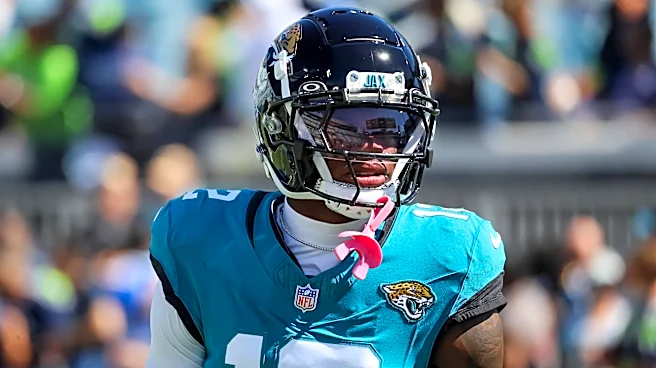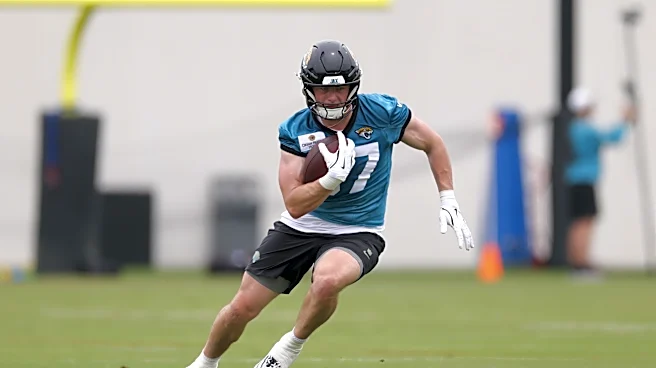






On Saturday, the Jacksonville Jaguars kicked off rookie minicamp with 36 on-field participants at the Miller Electric Center, with an encouraging day one.
Rookie Minicamp Tryout Players: (2)
- QB Derek Robertson (Monmouth, #6)
- P Tyler Perkins (Iowa State, #4)
Non-Rookie Participants: (6)
- RB Ja’Quinden Jackson (#38)
- WR Chandler Brayboy (#15)
- TE Patrick Herbert (#88)
- DT Keivie Rose (#97)
- CB Keni-H Lovely (#31)
- S Trevian Thomas (#34)
Quarterbacks and pass catchers ran a noticeably clean operation in their first look at a new offense led by undrafted free agent QB Joey Aguilar out of Tennessee, wearing number 17. A reasonably clean operation, with minimal alignment issues, or dropped passes for the team’s second practice
feels notable, following the 2025 offseason struggles in both areas early on.
However, despite the efficient passing game, hovering over the pass-happy shorts and helmets rookie showcase remained the murmured, ongoing media cloud surrounding Jacksonville’s second-round selection, tight end Nate Boerkircher. Around the NFL, the tight end’s selection at pick 56 has continued to draw considerable backlash from the consensus board crowd, but Head Coach, Liam Coen addressed the criticism head on when explaining the team’s offseason plan at the position.
“It’s about our consensus and what we believe in this building about each player and how they fit in and character matters, personal and football character matters. The mental, the learning, how much they can take in a short period of time to go be able to get on the grass and go play. I wouldn’t say either of our offensive or defensive systems are quote-unquoteeasy, so we do value players that can do different things and be able to go mentally play the game fast.”
The head coach later reconfirmed that the tight end position was higher on his priority list in this draft class, pointing specifically to how frequently Jacksonville deployed six offensive lineman sets in 2025. His reasoning was simple, replacing one of those linemen with a tight end gives the offense a secondary level of versatility that a traditional sixth offensive lineman simply cannot provide.
“It was up there. It was definitely up there. We kind of went into it looking back at – not necessarily our group as a whole as why we need more – it’s more, I mean, we had two active for three, four games, whatever it was. And that’s just not a world I want to live in and what it limits you. I really appreciate Chuma [OL Chuma Edoga] and Cole [OL Cole Van Lanen] for doing that stuff, but you limit what you can do.”
While the multi-tight end trend has seemingly become something of a league-wide obsession, Coen was careful not to overstate the intention behind Jacksonville’s investment at the position. The primary benefit, as he framed it, wasn’t simply about getting bigger or heavier, it’s about options. A deeper, more versatile tight end group gives a play caller the ability to present multiple looks, stress defenses in different ways, and keep opposing coordinators guessing without tipping the offensive hand before the snap. For Coen, the tight ends aren’t overtaking his base offense. They’re simply a key to unlocking more of it.
“I think the interesting thing about the tight end position or getting bigger is if you can get a bigger grouping on defense, but your tight ends have the ability to spread out and do different things in the pass game, well, you can present 13-personnel pictures or even 12. I like 12 a lot personally, but you can also present 11-personnel pictures, 10-personnel pictures, spread open, empty formations. Now you’re just challenging the defense in base defense to have a lot more calls. You have to have a lot more checks, a lot more adjustments. And look, I believe that there is going to be an uptick probably in the NFL next year in heavier personnel groupings. I’m not sure we’re going to over rotate to a point where we want to get slower or less explosive. We still have some pretty damn good wideouts that I like to use, so I just think it’ll be interesting to see the trends.”
The noise hasn’t gone away, but Saturday gave Boerkircher his first real opportunity to answer it on the field, and he delivered his opening lines well. The Texas A&M product looked more comfortable as a pass catcher than his reputation suggested, moving smoothly in and out of routes without a drop on the day.
It probably shouldn’t require a headline that an NFL tight end caught the football cleanly in a minicamp setting, without an opponent attempting to knock it down. Yet, given the narrative that followed his selection, it does. It’s one practice. But it’s a start, and right now, that’s exactly what Boerkircher and the Jaguars needed. On to the next one.