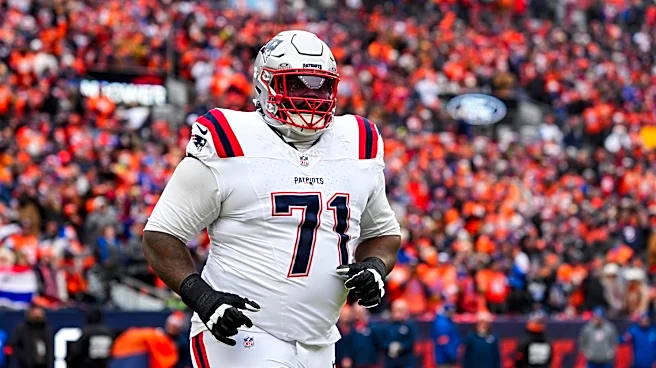





Mike Onwenu has been the New England Patriots’ most reliable offensive lineman the last few seasons, but even a player of his stature and track record is not immune to being asked for a pay cut. This happened earlier this week, with the 28-year-old and the team agreeing to a reworked deal that shaves $7.5 million off his salary and cap hit.
What does all of that mean for the Patriots, though? Let’s take a look at the renegotiated one-year, $10 million deal from a big-picture perspective to find out.
Compensation for security
As we mentioned in our in-depth look at Onwenu’s reworked deal, he effectively decided to give up a significant chunk of his previous salary for a more favorable guarantee structure. While this means that he is set to earn $7.5 million less than he would have under the original contract extension signed in 2024, he also added a combined $8.95 million in new guarantees.
Those guarantees come on top of the preexisting signing bonus proration from the original pact. In total, Onwenu now has $16.45 million contractually guaranteed to him. His cap hit, meanwhile, stands at $17.5 million — down from what was originally a $25 million cap charge.
The Patriots themselves now have $42.5 million in salary cap space to work, according to cap expert Miguel Benzan. That is a significant chunk, meaning that Onwenu’s restructure was not necessary from an operational perspective: New England had plenty of cash to work with already.
First shoe to drop?
The timing of Onwenu’s contract restructure is curious. As mentioned above, the Patriots were not in need of an instant cash infusion; they already ranked top 5 in the NFL in cap space before making the move.
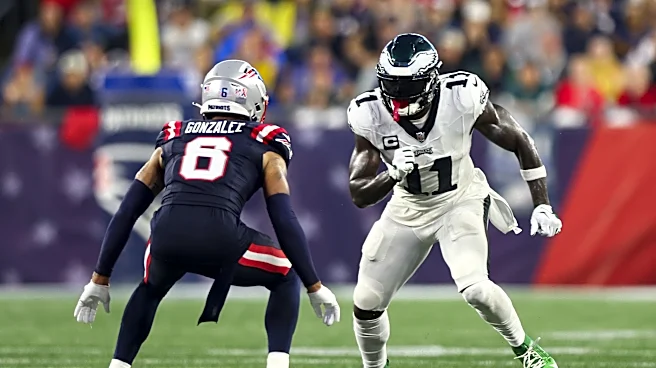
So, could this be a precursor of another move? That certainly seems possible considering that Philadelphia Eagles wide receiver A.J. Brown will soon become available for trade, and has been linked to New England for several months now. While the two sides are reportedly “not particularly close” at the moment as far as compensation is concerned, Brown’s contract will become more easily tradable for the Eagles as soon as the calendar turns from May to June.
Of course, the Patriots wouldn’t need to reduced Onwenu’s cap number to manufacture such a move on their end; Brown would command just $7 million in 2026 cap space if acquired via trade. That doesn’t mean the extra cash would not come in handy, but it is not a necessity for the Brown trade either.
Obviously, though, trading for Brown would not be the only potential big-name transaction for the club in the coming weeks or months. Cornerback Christian Gonzalez, a surprise absentee at the start of organized team activities this week, is also looking for a new deal; he is signed through 2027 after the club picked up the fifth-year option in his rookie deal but is eligible for a new possibly market-resetting contract already.
The same will also be true for quarterback Drake Maye starting next January. So even while the Onwenu restructure might not be a clear-cut sign that the speculated A.J. Brown trade will happen shorty, the money gained will still be put to proper use either in 2026 or 2027.
Increased tradability
Besides saving money, Onwenu’s new contract also has another effect: it makes him more easily tradable.
Under his previous deal, a majority of his $25 million cap number — i.e. up to $17.5 million — would have transferred to his new team. Now, only a fraction of that sum would do so. Depending on the timing, an acquiring team would have to invest no more than $4 million consisting of his $2.95 million salary, $850,000 active roster bonuses and a $200,000 workout bonus.
There are some arguments for trading Onwenu, including the fact that he will enter unrestricted free agency next March and is no lock to be retained at that point. However, he also would leave a sizable hole both literally and figuratively at the right guard spot.
So, while his new pact in theory makes him an asset the Patriots could more likely move on from, that might not be the case in practice unless a new starter-level player emerges. Based on the only open OTA practice so far, we would not bet on that happening anytime soon.
Possible sign of things to come
As noted above, Onwenu is set to enter unrestricted free agency next March. He has been a steady presence along the Patriots offensive line pretty much since joining the team as a sixth-round draft pick in 2020, but a return once he enters the open market is far from a guarantee.
For all his qualities and impressive career, after all, he seemingly does not fit the Patriots’ offensive vision to a T. He is more of a mauler than a pure athlete at the guard position, and therefore provides a different profile than other players brought aboard along the O-line since Mike Vrabel’s arrival as head coach last year: Will Campbell, Jared Wilson, Caleb Lomu and Alijah Vera-Young, for example, are all A-grade athletes.
On the other hand, the possible stop-gaps — Onwenu and Morgan Moses — win not solely because of their athletic profiles but rather due their physicality as well as a rare combination of size, experience, and technique. If the Patriots feel that they want to move on from that, Onwenu might be a goner next offseason.
Giving him an extra $8.95 million in full guarantees might therefore be a sign of good will on the team’s part: Onwenu gets the aforementioned financial security while the Patriots get buy-in and possible trade value in return. A win-win.