


Thanks to the nflFastR project, Pro Football Focus for the timely sources of data.
For those of you new to this, I will publish key QB stats each week judging how well the Colts’ QB performed. Yes, O-Line, receivers, and play-calling impact these numbers but they are primarily QB measures. I will probably modify the charts throughout the season. Commentary will be brief but feel free to let me know in the comments that stats aren’t everything. (click charts for larger view)
Nothing sets the tone for
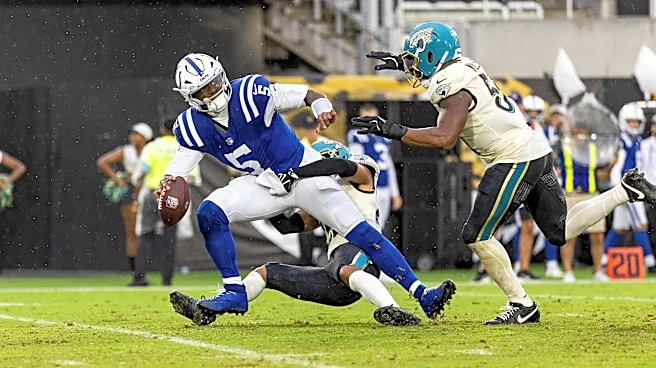
a game quite like punt, punt, punt, fumble, punt, punt, pick-six, kneeldown.

In case you were thinking that a competent passing game might be hidden in there, let me relieve you of that notion. In terms of EPA efficiency, Daniel Jones was NOT the worst QB this week, but he was close. Three other quarterbacks actually managed to do worse, but here’s what it took: You either had to be Baltimore’s third-string QB, Joe Fagnano, who probably expected to spend the afternoon holding a clipboard; throw 4 picks in an ugly, rain-soaked game like Michael Penix Jr.; or play in that same monsoon and fail to complete a single pass like Baker Mayfield. That’s right, those are the only guys Jones outperformed. So… hooray.
HOW WELL?
mouseover definitions: arsr, edp, sg%, oz%, pr%, tip, ttt, adot, ay/c, yac, yacoe, yd/c, ac%, cpoe, aypa, drp, scr%, ta%, sck%, aa%, ny/d, ny/p, 1st%, td%, to%, qbsr, epa/p, adj/p
- The Colts running game struggled somewhat while the offense leaned heavily on early down passing. (22nd ARSR; 7th EDP)
- Daniel Jones again faced heavy pressure, and was forced to get the ball out quickly (8th PR%; 24th TTT)
- Those quick throws translated to short passes, which generated very little production after the catch. This left Jones with one of the lowest yards per completion totals in the league . . . AGAIN. (27th ADOT; 30th AY/C; 20th YAC; 27th YCOE; 31st YD/C)
- Jones accuracy was OK, completing passes at a roughly average rate, even when adjusting for the short depth, but the lack of yardage on those completions left him near the bottom of the league in yards per attempt. (15th AC%; 18th CPOE; 30th AYPA)
- Under pressure, Jones scrambled twice and threw the ball away once, but also took three sacks. Those abandoned passing plays accounted for a relatively large portion of his dropbacks. (15th DRP; 9th SCR%; 17th TA%; 13th SCK%; 12th AA%)
- Between the limited passing production and the abandoned attempts, Jones unsurprisingly finished with poor overall yardage efficiency. (28th NY/D; 28th NY/P)
- He struggled to generate first downs which obviously limits trips to the end zone. (25th 1ST%; 19th TD%, 3rd TO%)
- It was bad enough that Jones struggled to generate successful plays, but the sacks and interceptions — particularly the pick-six — were so damaging that it’s no surprise his overall EPA efficiency was atrocious. (23rd QBSR; 29th EPA/P)

Jones’ efficiency curve was a disaster from the start, with almost no deep passing production and very little yardage on his completions. A decent completion rate provided some relief, but the interceptions erased much of that improvement. The enormous negative impact of the pick-six dragged his final EPA per play down to the seventh-worst single-game performance by any quarterback this season.

Jones produced almost no positive value in the first half, capped off by the disastrous pick-six. Things didn’t get much better in the third quarter, although he eventually put together a productive stretch that included a touchdown pass. Overall, Jones generated positive EPA on just 13 of 34 quarterback plays (38.2%), and his few productive plays were completely overwhelmed by the costly negatives, leaving him with a horrible -0.55 EPA per play.

The long-term trends continue to head in the wrong direction, as Jones makes a serious run at being the least efficient quarterback in the league (look out Justin Herbert).
HOW FAR?

As previously mentioned, Jones’ accuracy wasn’t the problem, as he put together multiple stretches of completed passes. The issue was that many of those completions gained little meaningful yardage, and it wasn’t until late in the third quarter that he managed to string together enough first downs to move the ball downfield. Last week, he didn’t attempt a single pass beyond 20 yards, and this week, his only attempt beyond 20 yards fell incomplete.

(I was so depressed after this game that I redesigned this chart.)
After two weeks of unusually deep targets, Jones has now spent two consecutive weeks throwing some of the shortest passes in the league. This week, his average target depth dropped to just 4.6 yards, while his average completion depth fell even further to 3.1 yards, continuing an overall trend towards shorter passes.

The Colts now throw the fifth-shortest passes in the league this season, without generating enough yards after the catch to make up for it.
TO WHO?

Keenan Allen led the Colts with a whopping 62 receiving yards. Meanwhile, Tyler Warren was targeted nine times but managed only three catches for 15 yards.

Josh Downs and Keenan Allen lead the Colts in season-long receiving production, with Downs holding a slight edge in both total receiving yards and completed air yards.

Passes targeting Tyler Warren were an absolute disaster, generating -19.6 EPA on nine targets (-2.18 per target), largely because both interceptions, including the pick-six, came on throws intended for him. On the positive side, Keenan Allen, Laquon Treadwell and Josh Downs all generated well-above-average value, albeit on relatively short passes for wide receivers.

For the season, most receivers are generating above-average EPA per target, with Pierce and Burks doing so on considerably deeper passes. Despite being one of Jones’ most frequently targeted receivers, Warren is far below average production.
HOW ACCURATE?

Jones bounced back from last week’s poor completion performance, completing 19 of 28 passes and finishing with a 73% adjusted completion rate and +2% CPOE, a significant improvement over last week’s -11% CPOE. However, his season-long completion rates remain below league average at nearly every passing depth, with his biggest struggles coming on throws beyond 20 yards.
HOW FAST?

Jones averaged just 2.44 seconds to throw this week, his quickest since Week 4. I’d like to think that was by design, but given the pressure he’s faced and how short his passes have become, I have my doubts. For the season, his time to throw remains slightly quicker than expected for the depth of his targets, sitting just below the league trend line.
TO WHERE?

Jones threw nearly 61% of his passes to the left, where he averaged a miserable -0.46 EPA per attempt, with the pick-six doing much of the damage. He was even worse over the middle (-0.62), where his other interception occurred. Passes behind the line of scrimmage were also particularly ineffective (-0.60), while his only real bright spots came on isolated intermediate throws to either sideline.

For the season, Jones has struggled across nearly every area of the field. Overall, Jones is generating essentially zero EPA per attempt, well below the league average of +0.20.