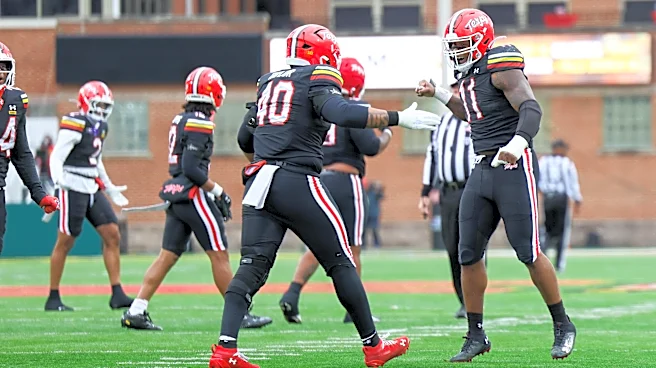



Maryland football brought a two-game winning streak to the West Coast for a matchup with No. 18 USC. Despite that fact, it was a major surprise when the Terps entered halftime up a point on the hosts.
But on a day where several stunning upsets happened across the Big Ten, the Terps couldn’t hang onto any Hollywood magic of their own. The Trojans stormed back and scored 22 unanswered points to open the second half, as Maryland repeatedly neutralized its own hopes at making a comeback.
Here are three
takeaways from the Terps’ road finale.
Defense can’t catch a break
Maryland’s defense had made a habit of bending without breaking under interim head coach Aazaar Abdul-Rahim’s tutelage. The Terps continued to get gashed in man coverage following the leadership change, but twice against Wisconsin and four times against Purdue, Maryland stopped its opponents within the final 25 yards, forcing a field goal.
It initially appeared that trend would continue in California, but as the Terps stayed on the field longer and longer, the defense visibly wore down. By the end of the game, Maryland couldn’t keep up with the West Coast offense.
Out of the first 24 minutes of the game, Maryland possessed the ball for just 6:15. However, that appeared to be more of an issue of the defense being caught asleep early.
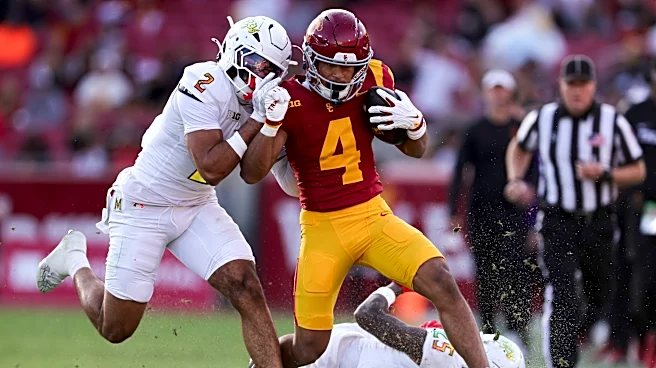
On USC’s first drive, running back King Miller averaged 7.3 yards a carry, while quarterback Jayden Maiava found receivers in space outside the numbers for big gains. Despite that, a false start 11 yards from paydirt forced the hosts into a field goal.
“I didn’t feel like the defense had the same energy that I saw the last two games,” Abdul-Rahim said.
After the break, Maryland’s offense had a chance to extend the lead. But after Sean O’Haire missed a 53-yard field goal, it sputtered.
Maryland’s first second-half drive, which culminated in the miss, lasted 4:40. The Terps’ next three drives lasted a combined 3:07 and went a cumulative 23 yards. After each of those, USC scored.
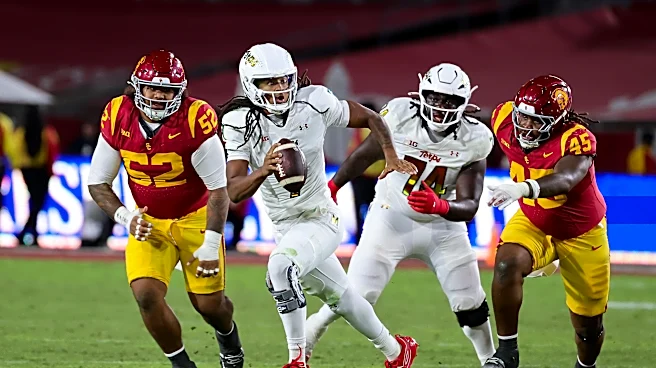
Quarterback Malik Washington’s interceptions to end two of those drives were backbreaking. Maryland gifted its opponents generous field position, but just as critically, it denied its own defense a chance to breathe.
By the end of that stretch, the defense was visibly a half-step slower. The Trojans faced less and less resistance as the points piled up.
“That’s part of the game of football,” safety Lavain Scruggs said. “Physically, yeah, we probably was a little beat down, but at the end of the day, we still have to play defense to stop them from scoring. We didn’t do that.”
Maryland is winning the critical downs
As Maryland has progressed through Big Ten play, the Terps have shown a remarkable improvement in their ability to move the chains on third and fourth downs.
“In situations like that, critical downs, it’s much less about the play and you know how hard you’re willing to execute the play,” Washington said.
In the Terps’ final four games under former head coach Mike Locksley, they went a combined 9-of-55 (16%) on third downs and 5-of-9 (55%) on fourth downs.
In its first three games under Abdul-Rahim, Maryland bumped its third-down conversion rate to 13-of-37 (35%) — and that included a rough 2-of-13 mark against Wisconsin.
Against USC, the Terps had their finest game yet on critical downs. Maryland went 7-of-13 on third downs, its first time clearing 50% in a game since playing Virginia Tech.
And since Abdul-Rahim took over, the Terps haven’t failed a fourth-down conversion. They’re 6-for-6 after making both tries in Los Angeles.
Paradoxically, the head coach said the success on risky downs has come from not treating them as such.
“I think it’s just really mitigating risk with the quarterback, not making it about just him,” Abdul-Rahim said. “We have really good wide receivers, and as you can see, you saw today, guys made some really tough catches […] That’s a lot of it as well, people stepping up and making plays during certain situations.”
It wasn’t enough to give Maryland the win in this game, but it is a critical mark of progress for this Maryland team.
Maryland’s next coach, Abdul-Rahim or otherwise, has work to do
The loss to USC quashed any hopes Maryland had at qualifying for a bowl game as a .500 team — the Terps retain a slim chance of potentially qualifying through their academic progress rate if they can beat Penn State at home, but that is out of their hands.
That wasn’t what mattered to those inside the program in recent weeks, though.
When Abdul-Rahim was introduced as Maryland’s interim head coach with five games remaining in the season, he defined success for the program as being more about a process.
“This is a five-game season for us, and as far as I’m concerned, we’re 0-0 right now, and the kids are excited to show you guys a different, better brand of football,” Abdul-Rahim said.
With four of five games complete, the Terps stand at 2-2 in their new season. Losses to Illinois and USC and wins against Purdue and Wisconsin were results that would have been reasonably expected before the season.
The Terps have shown a brand of football that is different; at their core, though, the same issues persist. Washington’s shortcomings as a quarterback have not improved from year one to year two. Frustrating flags killed momentum, and the Terps lost a lead to drop their 41st consecutive game against a ranked Big Ten opponent.
“Halftime, the focus was not about physical toughness; it was about mental toughness,” Abdul-Rahim said. “We knew that they were going to come out and give us a hell of a second half, and it was not going to be about our physical toughness. We just didn’t come with the right things, man. In the second half, I was extremely disappointed.”
A fresh coat of paint can change instant reactions, but a foundation cannot be rebuilt overnight.
The surface-level results over the previous two weeks were what led to many outside the program supporting Abdul-Rahim being hired as the full-time head coach.
Ultimately, though, Abdul-Rahim’s tenure — and, by extension, his chances at the permanent head coaching job — will be determined by the process part, which is far less visible to those outside the program. Whoever has to establish Maryland’s next foundation will have some deep-seated issues to work through.