




Let’s start by making a few things clear. This is not about wins and losses. This is not even just about the Phoenix Suns. This is about the NBA.
This is about a billion-dollar product that a lot of us pay a lot of money to watch. This is about a league which claims to “encourage[e] communication, dialogue[,] and transparency with NBA fans…” while showing little to no effort to meet such a goal. But it is becoming clear to me that this may not be an issue if Adam Silver actually put competent leadership
in place.
Let’s also be clear that these failures of NBA executives are not a new development. Not at all. The NBA’s leadership void has persisted for years – and evidence suggests the problem is only becoming exacerbated.
Let’s start with Kathy Behrens
Behrens is the Executive Vice President of Social Responsibility and Player Programs for the NBA. According to her bio, she “oversees a group that manages all of the NBA’s programs that coordinate league and player social responsibility efforts, support player growth and development, and enhance the marketing opportunities for current and former players.”
For instance, after Draymond Green punched Jusuf Nurkic on December 13, 2023, the NBA suspended him indefinitely, and Behrens played a role in regular “check-in calls” with Green before he was allowed to return from suspension.
Sounds like Behrens is a real difference-maker in a positive way, right?
That might be the case if you are able to ignore the fact that Kathy Behrens enabled Green’s violent behavior before finally seeing what the rest of the world had seen for years.
Let’s go back to October 5, 2022, when Draymond Green attacked his teammate, Jordan Poole, during a Golden State Warriors team practice. Frankly, my legal background made it an intriguing situation, so I reached out to Behrens via email, asking why the NBA had not issued any discipline to Green. While, for reasons I will not get into here, my email (curiously) never reached Behrens, she eventually provided me with some insight via a Twitter DM.
With respect to Green, Behrens told me that “the [Warriors] disciplined him and [the NBA] determined that was sufficient.”

Public reports regarding the incident, however, suggested that Green faced potential discipline, but that it would be handled internally. So, I asked Behrens if she could clarify the “sufficient” discipline that the Warriors had levied.
In response, Behrens stated, “The warriors suspended him and it was made public…” and that the NBA believes that “was the right outcome.”

The problem with Behrens’ statement, however, is that public reports stated that Green “was fined but not suspended.”
I pointed this out to Behrens, and she changed her response to me: “Draymond was kept out of practice for a number of days and then fined by the team.”

I followed up and asked Behrens how Green’s actions and the NBA’s response fit within the league’s social responsibility principles – what did that result in?

So, let’s recap:
- Draymond Green attacks his teammate in 2022.
- The NBA’s Executive Vice President of Social Responsibility and Player Programs, admittedly, does nothing about it – in fact, does not even know what discipline was levied by the Warriors.
- When I ask whether Green’s conduct falls within the purview of her job, Behrens blocks me.
- One year later, Green attacks Nukic in the middle of a game and THEN the NBA – and Behrens – decide something needs to be done.
What took Behrens so long to take action against Green?
Why did Behrens not even know what discipline – if any – was levied the first time around?
Why would Behrens block someone for asking about the NBA’s role in social responsibility?
All signs point to complete ineptitude in her role. Nothing more, nothing less.
Let’s move on to officiating – and the man responsible for NBA officials – Albert Sanders, Jr.
Sanders is the NBA’s Executive Vice President, Head of Referee Operations. You can learn more about him in this lovely puff piece written by Dan Woike.
According to Woike, Sanders took his job with the NBA “[b]ecause the rules matter.” Which is ironic, considering the fact that Sanders’ officials consistently fail to enforce the rules.
Now, before diving deep into the failures of Sanders and his officials, let’s provide some context for these referees. NBA referees are touted as being the best of the best. That, presumably, is why they are paid between $250,000 and $550,000 per year. They are paid very well to perform in a high-profile job in – as referenced above – a billion-dollar industry.
This, of course, makes their constant failures – and the lack of any discipline or transparency from Sanders – particularly frustrating.
Now, I could post video after video of NBA officials missing calls, but that does not seem productive. Even the most egregious misses, in theory, can be explained by the game speed, angles, etc. So, for purposes of this article, we’ll give officials the benefit of the doubt for on-floor calls.
Let’s focus on more objective standards.
First, the pool reports that are done by NBA officials after certain games and numerous instances where NBA referees have provided explanations/answers to pool questions that are inconsistent with the NBA Rulebook.
Why focus on that? Because these are irrefutable instances where NBA referees demonstrate a complete lack of understanding when it comes to the NBA Rulebook – a circumstance that, for individuals being paid as much as they are and who are as imperative to the game as they are, should be unacceptable to Albert Sanders, Jr.
Exhibit 1
On January 10, 2026, Jason Kidd was ejected from a game between the Chicago Bulls and the Dallas Mavericks, which the Bulls ended up winning, 125-107. After the game, Crew Chief Scott Foster (his existence in the NBA is an entirely different story…quite literally) was asked by a pool reporter the basis for the ejection. Foster’s response: “He used profanity toward an official on two separate occasions and was given a technical foul for each occasion.”
In the NBA Rulebook, can profanity lead to a technical foul? Yes, it can.
But “Cursing at or blaspheming an official shall not be considered the only cause for imposing technical fouls.” (emphasis added.)

So, Foster states that Kidd was ejected for using profanity at an NBA official on two occasions, but the NBA Rulebook provides that such conduct is not even sufficient grounds for one technical foul, let alone an ejection. Objectively, Scott Foster’s response to the pool reporter’s question is inconsistent with the NBA Rulebook.
While Scott Foster may have been besties with Tim Donaghy and, therefore, of questionable ethical makeup in the first place, he has been an NBA referee for more than 30 years, and his inability to grasp the rules is inexcusable.
In any other workplace, such incompetence would not be tolerated. In the NBA, it seems as though it is almost celebrated.
Exhibit 2
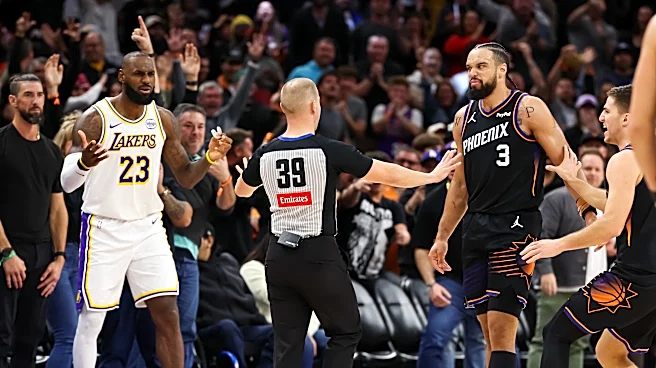
You all may recall this one. On December 14, 2025, LeBron James manhandled a referee in a game against the Phoenix Suns and what came of it? Zero. Nothing. Zilch. Nada.
And why was that, you may ask?
Well, according to Tyler Ford (I know, I know…), “During instant replay review, we have the ability to review all unsportsmanlike acts. There was no unsportsmanlike act observed for making contact with a referee.”
Once again, an NBA official makes a statement that is entirely inconsistent with the NBA Rulebook, which states:

Let’s break this language down, shall we?
According to the dictionary (yes, it needs to be this elementary for NBA officials), “shall” means, “expressing an instruction or command.” In other words, if someone “shall” do something, they are required to do something.
Applying the foregoing to the NBA Rulebook means that an NBA referee must issue a technical foul if a player makes contact with a referee because, by definition, contacting a referee is an “unsportsmanlike act.” The Rulebook does not provide a subjective aspect where the official can decide whether or not an “unsportsmanlike act” exists.
But, apparently, Tyler Ford believes that this subjective element exists. In reality, however, LeBron should have been assessed a technical foul for contacting a game official. Tyler Ford’s explanation indicates that either (1) he expressly ignores the NBA Rulebook and calls games on his own prerogative (which is not entirely out of the question), or (2) he does not know the NBA Rulebook.
Either way, Ford’s nonsensical explanation is another demonstration of Albert Sanders, Jr.’s failures as an NBA executive.
Exhibit 3
OK…this one is not from a pool report, but it is equally objective.
How many times have we seen a referee allow a challenge by an opposing team after a member of the Phoenix Suns has already been given the ball at the free throw line?
Well, guess what? The NBA Rulebook says that cannot happen.
Case in point:
Not to belabor the point – because it is explained in the tweet – but, under the NBA Rulebook, to initiate a Challenge, the team challenging the call “must call a legal timeout immediately after the call….”

Going back to our trusty dictionary, “must” means “to be obliged or bound to by an imperative requirement.” In other words, “must” – much like “shall” – indicates a “requirement.”
Lucky for us, the NBA Rulebook actually defines the term “immediately.”

In the clip referenced above, Ray Acosta passes the ball to Devin Booker, looks to the bench, then blows his whistle and awards the challenge – a decision that Crew Chief, Tyler Ford (yeah, that guy, again), should not have allowed. But, of course, Ford has already demonstrated his inability to grasp the rules.
At the point where Acosta releases the ball to give to Devin Booker, there is no longer the ability to challenge the call. Objectively, that is what the NBA Rulebook says.
So, again, why this error? Incompetence.
And it all starts at the top with Albert Sanders, Jr.
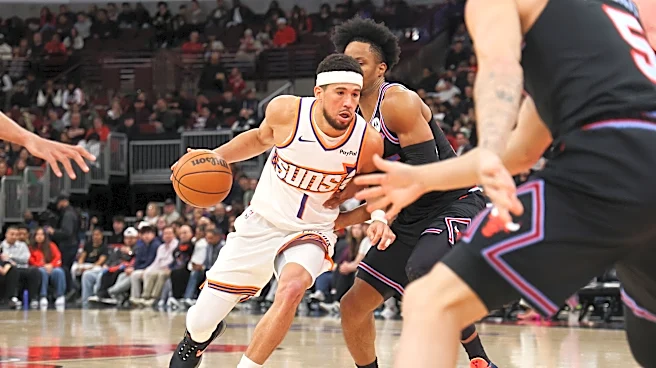
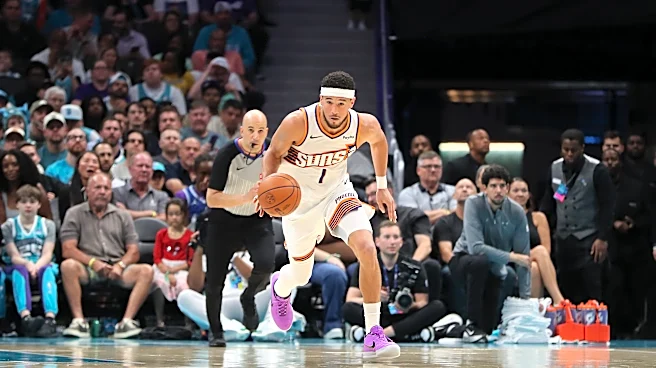
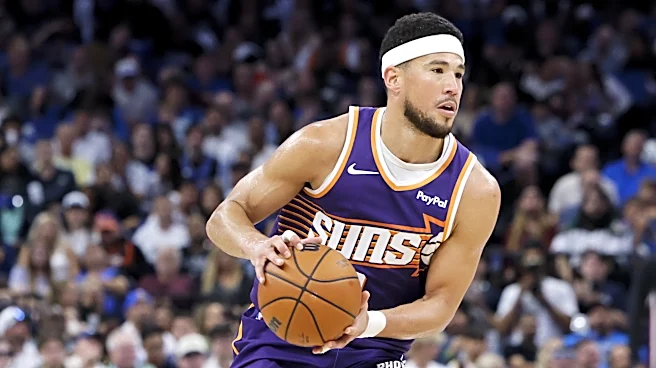
While we are at it, it bears noting that this has happened to the Phoenix Suns at least three times this season – and at least twice to Devin Booker.
So, if the NBA is becoming less watchable for you, these are two individuals who can carry a large load of the blame.
Lastly, I will note that I reached out to Behrens, Sanders, and even Sanders’ boss, Byron Spruell, about these issues. Perhaps not surprisingly, I received no response. Which begs the question: why is the NBA so scared of transparency? Why would Behrens, Sanders, and Spruell not want to demonstrate that the NBA operates with integrity?
Their silence provides all the answers I need.
But, hey…maybe I’m wrong about everything. Maybe every piece of analysis in this article is wrong.
If so, Kathy, Albert, and Byron know how to find me.