


While we’ve only just begun the month of February, Major League Baseball’s 2026 spring training is fast approaching. Teams are gearing up for what is set to be another interesting season with plenty of ups and downs for every player and club.
The New York Yankees are no different. GM Brian Cashman and company feel strongly that their depth through the infield and, of course, the outfield—with MVP Aaron Judge back in right alongside Cody Bellinger and Trent Grisham, who both re-signed—will be strong enough
to keep them in contention with an American League East division that looks poised to be run through north of the American border in Toronto.
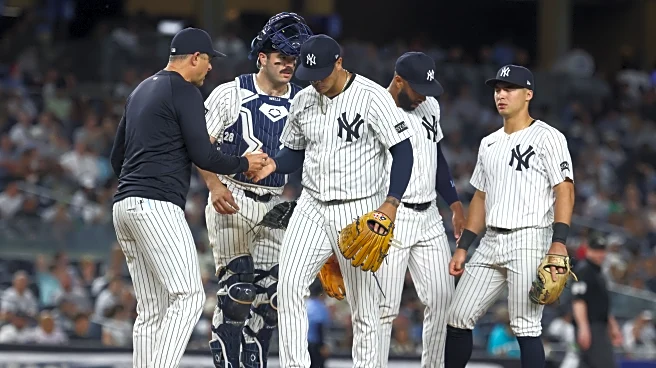
One of the key areas of focus heading into the new season isn’t the bats, though. Instead, it’s the pitching. The Yankees will be down Gerrit Cole and Carlos Rodón until later in the first half, and Clarke Schmidt is also returning from Tommy John surgery that will keep him out for the forseeable future, but the piece of the puzzle that feels hardest to place is the bullpen, which had its fair share of ups and downs through the 2025 regular season and into the playoffs. It lost a few names over the offseason to make things even more interesting. And I’m not so confident things will be as peachy keen as Cashman and manager Aaron Boone believe.
Last season, the Yankees’ relievers finished with an fWAR of 2.8, only good for 21st in MLB, and while some of their numbers like expected Fielding Independent Pitching (xFIP) were strong (third-best in MLB), their ERA was not nearly up to the standard necessary to take them all the way to a championship, finishing 23rd at 4.37. They also had the fourth-worst walk rate of all relief corps, issuing free passes to 9.2 percent of opposing hitters.
The Yankees lost two of their big-name players to the crosstown New York Mets, Devin Williams and Luke Weaver. And while Weaver was far more in favor with Yankees fans than Williams was (although last season was harder for Weaver than his pennant-winning 2024), those are still two arms who pitched plenty of innings for the Yankees that they won’t have access to anymore. Williams, despite his blowups from time to time on the mound, posted the highest fWAR amongst all Yankees relievers (1.4) and the fourth-most among all Yankees pitchers, although Cam Schlittler and Clarke Schmidt were poised to pass him had they played more games. By season’s end, Williams was honestly in a pretty good spot setting up for closer David Bednar.
The Bombers were, of course, right in the middle of Trade Deadline action, acquiring a few names that will still be around in 2026, including Bednar, who was fantastic in high-leverage situations after coming over from the Pittsburgh Pirates. Camilo Doval also came over and had a less-than-ideal 22 games with the Yankees, pitching to the tune of a 4.82 ERA. The former Giants All-Star seemed to flash his old form in late September and early October, but he’s also become known for inconsistency in recent years. Just like the sometimes-dangerous Fernando Cruz, it will always be hard to know which Doval is going to show up on a given night. Then there’s Jake Bird, who garnered the most disappointing reaction of the three and the most disappointing results easily, pitching in three games and in only two innings of work, finished with a 27.00 ERA before being sent down to Triple-A Scranton Wilkes-Barre and struggling in the minors.
Then, of course, there are other names such as Tim Hill, who had his club option picked up, Ryan Yarbrough and Paul Blackburn, both of whom the Yankees re-signed, Cade Winquest, who was selected in the Rule 5 Draft, and Angel Chivilli, who was traded to New York via the Rockies for a prospect.
All of these players will have a serious shot at earning high-leverage innings. However, while these pitchers may have ranging levels of upside, they aren’t names that scream “World Series-caliber bullpen” to me. Instead, it screams: “Matt Blake is going to have his work cut out for him, and if there are any issues whatsoever, the Yankees will be in a world of hurt.”
Having one reclamation project or a pitcher who has intriguing underlying numbers but needs a little bit of guidance in bringing back a pitch to help him reach his full potential is one thing. However, this bullpen feels as if there are about four or five of those for Blake to work with. One could fairly argue that Bednar is the only safe bet in this entire bunch; if you believe in Hill’s moxie (which is also fair), then maybe there are two. And at least a couple of the other arms are going to have to not just be able to fill in during high-leverage situations, but they’re going to need to do that consistently. If they should falter, Yankees fans will be certain to make their voices heard that the offseason decision to not even add one more trustworthy arm was poor.
The Yankees’ pitching coaches have a daunting task ahead of them in 2026 to try to make some sense out of this odd bullpen. While there are still some names who could make a sizeable impact for the team, the majority haven’t gained the trust of the fans—and rightfully so, given previous performances with other teams or in pinstripes. While there could be some room for bullpen optimism heading into 2026, the Yankees’ relief corps has yet to give me any reason for it.