

The goals against numbers are starting to pile up, and there are not many cards left for the Pittsburgh Penguins to play in an effort to fix it.
The trade deadline has come and gone, so there is no move to be made to add outside defensive help.
There is also no immediate help available in Wilkes-Barre/Scranton that can offer much of a fix.
Aside from simply playing better, cutting down on the turnovers, and getting back to controlling games the way they were a couple of weeks ago, there is not much
else the Penguins can do from a personnel standpoint to fix the defense. Switching defensive pairs and defensive partners might just be a case of rearranging deck chairs.
There is, however, one player in Wilkes-Barre/Scranton that could potentially fix some things, and it is prized goalie prospect Sergei Murashov.
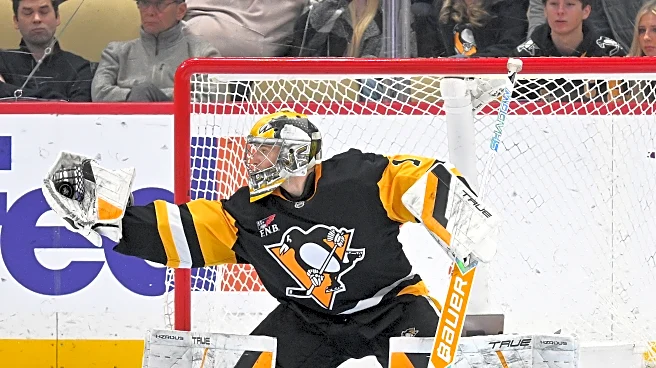
Not only does Murashov have the talent and upside to be a franchise goalie for the next decade, just by the nature of being a goalie he is the one player that could significantly improve things in the short-term. Goalies change everything.
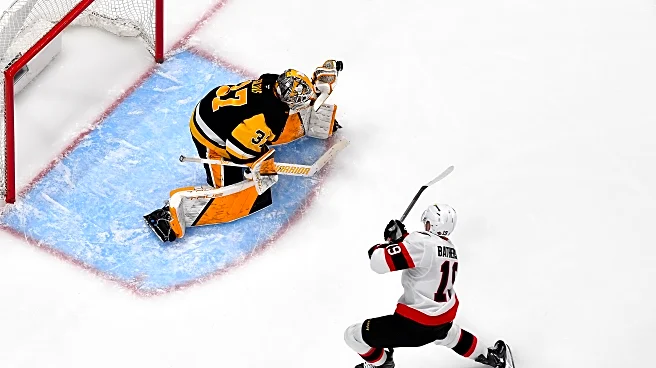
From a big picture standpoint, I am not entirely ready to say Stuart Skinner and Arturs Silovs have been the biggest problem over the past 10-11 games. Going into Tuesday’s game against the Colorado Avalanche, the duo had basically allowed the number of goals that had been expected of them given the chances they were facing and what the Penguins were allowing in front of them.
They were not stealing much, but they were not the biggest cause of the goals against issues.
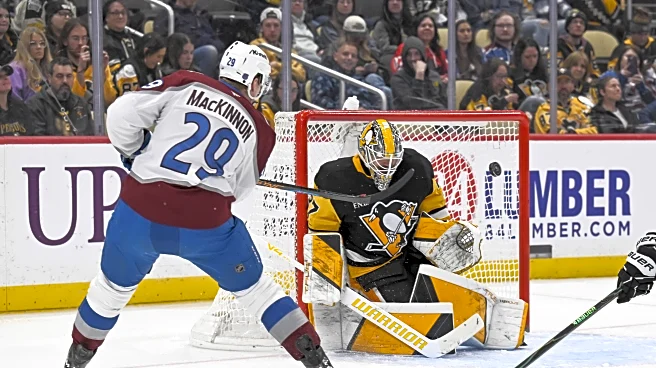
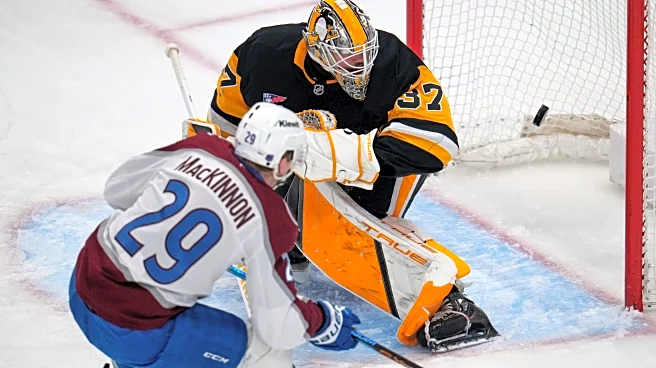
That changed a little bit on Tuesday with Silovs against the Avalanche.
You might disagree, but not only was that game not as lopsided as the 6-2 final score would suggest, I thought the Penguins played better in that game than they did in their win on Saturday against the Winnipeg Jets. I thought it was one of their best recent games in terms of generating chances, they had a pretty significant scoring chance and expected goals advantage, and they really carried play for long stretches of time. It is not always as simple as this, and sometimes we might lean on this a little too much and oversimplify the game, but this was definitely a game where goaltending was the difference.
Scott Wedgewood made every big save the Avalanche needed him to make. And he made a lot of them. Silovs did not make a single one for the Penguins.
It is one thing when your goalies are not stealing games and just doing what is expected. You can still compete with that and win with that if the team around the goalies is playing well enough.
It is something else entirely different when goalies start losing games for you.
You also sometimes need a goalie to steal a game or two for you. That is the thing that is not happening at the moment.
That is also where Murashov could come into play, because with his upside and talent he is the type of goalie that could, in theory, steal a game for you and steal some big saves. He has the upside to potentially do more than just make the saves you are supposed to make.
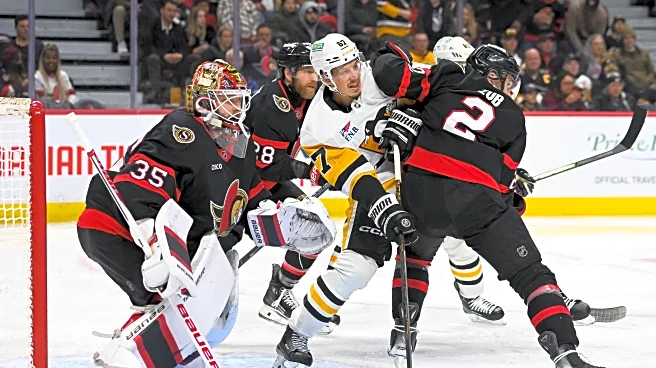
Given the Penguins ongoing goalie rotation, Stuart Skinner is going to start Thursday’s game against the Ottawa Senators. If he plays well in that game, I would give him Saturday’s start against the Dallas Stars. If he plays well in that game, you go from there and maybe start shifting away from the goalie rotation and let somebody try to run with the job.
If he does not play well on Thursday, and the Penguins lose another big game in the standings by allowing four or more goals, I think that is when you start seriously having the Murashov discussion. Because what else can you do at this point other than simply play better in front of the goalies? And while that does need to happen (and while I think it can happen), you still need something more from the goalies.
As we saw on Tuesday, a bad goaltending performance can still swing a better overall performance against you.
The argument against calling up Murashov is that he is only 21 years old, has only a handful of NHL games, and that inserting a young goalie like that into a playoff race could be an extremely risky move. Especially when the team itself is struggling to defend. There is definitely a risk to it. It could go very badly in the short-term.
But there is also an upside to it, and there is SOME precedent for a goalie in this situation getting a chance late in the season for a playoff team.
Not a ton of precedent. But some.
I went back over the past 25 years and searched for goalies that fit the following parameters:
- Age 24 or younger
- Between 5 and 15 games played in the NHL that season and or their career as a whole
- Getting their first real, meaningful playing time late in the season for a playoff team
I only found a handful of players that fit into it. But they are interesting.
- In a small way, this is kind of what is happening in Montreal right now with Jacob Fowler. With the Canadiens clinging to their playoff spot and having major goaltending questions all season, the 21-year-old Fowler has started three of the team’s past seven games. He has not received the bulk of the playing time, but he is still there and might have more upside than Sam Montembeault and Jakub Dobes are currently giving them.
- Late in the 2023-24 season a young Silovs received three starts in April with the Vancouver Canucks due to an injury situation, and then received the bulk of the playing time in the playoffs. He played well enough to get the Canucks into the second round.
- During the 2015-16 season we have Matt Murray with the Penguins. After appearing in just 13 regular season games in his debut season, with the majority of them coming after March, he took advantage of his opportunity at the start of the playoffs and never gave it up in helping lead the Penguins to a Stanley Cup. Just as was the case with Silovs in 2023-24, injuries played a big role in this, but he made the most of his opportunity. The difference here is that 2015-16 Penguins team was an absolute monster that was steamrolling every team it played. That is not to say that Murray did not play well (because he played very well), but there was a very strong supporting cast around him. Then he helped them win another Stanley Cup the next season. This team, while exceeding expectations and perhaps still legitimately very good, is not anywhere close to that level.
- In 2011-12, the Washington Capitals turned to 22-year-old Braden Holtby, with almost no NHL experience, late in the season and let him take the starting job into the playoffs. He posted a .935 save percentage (after posting a .922 mark at the end of the regular season) and had the Capitals in Game 7 of the second round, a 2-1 loss away from reaching the Eastern Conference Finals.
These are the best recent examples I can find that would fit this scenario. The previous ones have mostly worked.
If you are good enough to do it, you will.
If it does not work that well and getting beat in a couple of games ruins the player’s psyche that much that it ruins their long-term development, that is probably a concerning development for a very different reason.
I understand the argument against it.
I am also not going to argue that goaltending has been the only problem.
But it IS the one move that could be made that could make a big impact. There should come a time here very shortly where the Penguins make that call. Or at least give it serious consideration. There are not many other options.