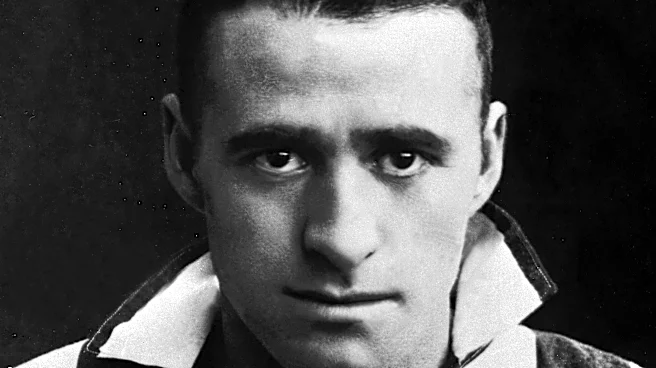








When it was confirmed nearly 100 years ago that Sunderland had decided to sell Dave Halliday to Arsenal, it sent shockwaves through English football. And yet, looking back on it now, there seems to have been some method to the club’s madness.
Had any fan even countenanced the thought of transferring out their star striker just a couple of months earlier, they would have been roundly chastised by their associates, for Halliday was one of Sunderland’s greatest-ever scorers and had been in particularly
good form, even by his own standards. During 1928-29 alone, he had scored 43 goals in just 42 top-flight games, and onlookers naturally assumed that he was the club’s most prized asset. Yet it seems as if there was a sudden shift in opinion amongst the hierarchy in the weeks that followed.
The deal to sell Halliday partway through the following campaign still came as a huge surprise to most, but those closer to proceedings appeared to be comfortable with the development. On the face of it, four goals in his eleven most recent outings would have suggested that the Scottish striker still knew where the net was, but his seven latest appearances had not seen him score. So, on 2 November, the previously unthinkable happened and he was dropped from the starting XI for a home win over Huddersfield Town.
Some other centre-forwards might not even consider that run a drought, and supporters presumed that this was nothing more than a temporary blip. In the days that followed, however, the situation ramped up and, on 5 November, word got out that Sunderland had been in talks for several days and were ready to part ways with a player who, in the previous four seasons, had scored at a rate of almost a goal a game. Breaking the news locally, as was nearly always the case during the era, was Argus, who used his Daily Echo and Shipping Gazette piece to begin preparing the ground for a move that would surely leave the fanbase feeling anxious.

The management of the club may have known what it was doing, yet still recognised that shipping out a terrace favourite was going to raise questions. In feeding the details to a trusted source, they sought to assure readers that this was a development they were keen to facilitate:
“The football world is seething with excitement,” Argus announced. “Sunderland are prepared to sell Dave Halliday”.
“Well, it is no use denying it, but I think the Sunderland club has a right to know from London who ‘let the cat out of the bag.’ These negotiations were supposed to be secret and it is certainly obvious that the Sunderland people would not give it away and cause friction between the club and the player. For that very reason I have written nothing; yet I have known all along what was happening! I have been let down by the story leaking out in London, but at any rate I have kept faith with the club.”
“The whole footballing world now knows about these negotiations, but the public has got a garbled version. If four persons meet in secret conclave at York – at that particular spot to keep it secret – some one of the four must have ‘blown the gaff’.”
Continuing, the article then claimed that a year previously Sunderland could have had ‘what they liked’ for Halliday, but that whilst any fee would now be lower, the club were still expecting a ‘desperate’ Arsenal to pay good money for a man who was attracting interest from other parties too. In the days that followed, press reports claimed that Sunderland secretary Johnny Cochrane had previously turned down a bid of around £12,000 for the forward, whereas the price was now thought to be around £6,000.
It was the section underneath the subheading ‘THE REASON’ that would have caused the most intrigue, though, because this is where fans got to learn why such an unexpected transfer now felt all but done. Stating that there was ‘no apparent explanation’ for the loss of Halliday’s recent goalscoring power or speed, Argus claimed that the player himself had admitted there had been no problems in training. The directors, though, were certain that this was not temporary and so had concluded that now was the time to part company. “Two months,” the article’s closing sentence mused, “is a long time to be out of form when no injuries and no illness stand in the way.”
It was in the early hours of Friday 8 November that things then began to get wrapped up, although many national titles were still expressing disbelief at the situation. Lads fans, however, had by now mulled things over and got used to the idea. They could take some comfort from the knowledge, again brought to them by Argus in later editions of the Echo that evening, that the club had been happy to walk away from the deal late in the afternoon of 7 November had their valuation not been met.
It was seemingly this ultimatum that forced Arsenal’s hand, with manager Herbert Chapman catching a 17:30 train from the capital and being met on the platform in the North East by Cochrane and Halliday. Their discussions then went on beyond midnight, with Chapman and Halliday meeting up again at Roker Park later that morning to go over personal terms. Once verbal agreements had been reached, the paperwork was drawn up and, at around 13:00, everything was signed off.
The Gunners were due to play at Birmingham at the weekend and Halliday set off for the Midlands not long after the formalities had been taken care of, but not before he gave Argus a parting quote:
“I leave Sunderland with the most friendly feelings towards the club and its officials – indeed towards everyone in Sunderland. I have been splendidly treated here, and I wish the boys every success on Saturday and in all their future games.”
The intention for Chapman was to use Halliday as a foil for another Scot, Alex James. Despite the protracted nature of the move, though, the pair didn’t get to play in the same side on many occasions, with injury ruling James out for some of Halliday’s first appearances. Then Chapman started tinkering with his options and settled on Jack Lambert as his preferred centre-forward instead. The decision to start with him in the 1930 FA Cup final effectively ended Halliday’s short spell at Highbury. Arsenal beat Huddersfield at Wembley, and on the cover of the programme was an advert for Charlie Buchan’s column in the Daily News – Buchan having been the person Halliday replaced at Roker when he had moved to The Gunners in 1925.

Buchan and Halliday were both hugely popular at Sunderland, with the latter’s goal output seeming hardly believable. After coming from Dundee, his debut 1925-26 season saw him score 42 goals in 46 league and cup games, followed by 34 in 37 in 1926-27 and 39 in 41 during 1927-28. Not only that, but due to being on Wearside for the requisite time, upon selling him the board applied to the Football League for permission to pay him a benefit of £650 – the funds coming out of the transfer fee they were receiving.
Filling those boots was going to be a hard task, but the player earmarked to do so was already on Sunderland’s books. Silksworth’s Bobby Gurney, who thus far in his career had either been tasked with playing elsewhere in the forward line or acting simply as back-up to Halliday, was the man Cochrane wanted to take over as centre-forward. He would later become the only person to score more goals for The Lads than Buchan and Halliday. Not everybody realised it immediately, but it seems now as if the move to sell Halliday when they did was timed just right after all…